- AEO (Answer Engine Optimization)
- GEO (Generative Engine Optimization)
- LLM visibility
- AI search optimization
- Entity-based SEO
- too generic,
- filled with traditional SEO tools,
- or written by people who haven’t actively tested AI search behavior.
What Makes an AEO Tool Valuable?
 Traditional SEO tools were built for:
- rankings,
- keywords,
- backlinks,
- and SERPs.
- Does AI mention our brand?
- Which competitors dominate AI answers?
- Which sources do LLMs trust?
- What entities are associated with our business?
- Which content structures get cited most often?
- How does AI interpret topical authority?
Quick Classification: Direct AEO Tools vs Supporting SEO Tools
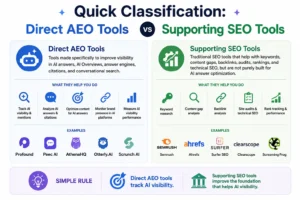 Before looking at the tools individually, it’s important to understand that not every tool in this list is a dedicated AEO platform. Some tools directly track AI visibility, while others support AEO through prompt testing, analytics, SEO authority, trend research, attribution, and content optimization.
 | Tool | Category | Role in AEO/SEO/GEO Strategy |
| ChatGPT | AI Testing Tool | Helps test how AI answers brand, service, and commercial-intent queries |
| Perplexity | AI Search & Citation Tool | Shows citations, source patterns, and AI-native search behavior |
| Claude | AI Content Analysis Tool | Useful for content audits, topical depth, and semantic structure reviews |
| Profound | Direct AEO / AI Visibility Tool | Tracks AI mentions, citations, share of voice, and competitor visibility |
| Google Trends | Supporting Research Tool | Helps identify rising topics, search demand, and future prompt opportunities |
| Google Search Console | Supporting SEO Tool | Tracks indexing, impressions, query growth, and technical visibility |
| GA4 | Supporting Analytics Tool | Measures traffic, engagement, referrals, and conversions from AI-adjacent journeys |
| Ahrefs | Supporting Authority Tool | Helps analyze backlinks, topical authority, competitor gaps, and citation-worthy content |
| Semrush | SEO + AI Visibility Tool | Supports keyword research, competitor analysis, and AI visibility tracking |
| Roadway AI | AI Attribution Tool | Helps connect AI visibility experiments with pipeline, revenue, and growth workflows |
ChatGPT
 ChatGPT is one of the most important AEO research tools available right now.Not because it gives perfect answers —
but because it reveals how mainstream AI systems synthesize information.
ChatGPT is one of the most important AEO research tools available right now.Not because it gives perfect answers —
but because it reveals how mainstream AI systems synthesize information.Why We Use It
We test:- branded prompts,
- commercial-intent queries,
- comparison searches,
- local discovery prompts,
- and informational questions.
- brand visibility,
- answer framing,
- source patterns,
- and topical associations.
Best For
- Prompt testing
- AI answer analysis
- Content gap discovery
- Conversational search research
- Understanding mainstream AI behavior
Biggest Insight
Most brands still optimize for search engines.Very few optimize for AI retrieval systems.That gap creates opportunity.Perplexity
 Perplexity has become one of our favorite tools for AEO research.Why?Because it shows citations directly.Unlike many AI systems, Perplexity exposes:
- source relationships,
- referenced domains,
- supporting articles,
- and retrieval patterns.
Why That Matters
This gives marketers real-world visibility into:- what content gets trusted,
- which sites dominate AI citations,
- and how information ecosystems influence AI answers.
Best For
- Citation analysis
- Competitor monitoring
- AI source discovery
- Research workflows
- Identifying authoritative content
What Makes It Different
Perplexity behaves more like an AI-native search engine than a chatbot.That makes it incredibly useful for GEO and AEO testing.Claude
 Claude is excellent for long-context analysis and structured reasoning.We use it heavily for:
- content audits,
- topical coverage analysis,
- semantic structure reviews,
- and entity relationship evaluation.
Why It’s Valuable
Claude tends to produce:- nuanced responses,
- stronger contextual reasoning,
- and cleaner analytical outputs.
- AI-friendly content structures,
- knowledge depth,
- and topical completeness.
Best For
- Long-form analysis
- Entity mapping
- Structured content reviews
- Knowledge-gap detection
- Advanced content evaluation
Profound
 Profound is one of the first serious platforms built specifically for AI visibility tracking.Instead of asking:
“Where do we rank?”It asks:
“Are we included in AI-generated answers?”That’s a major difference.
Profound is one of the first serious platforms built specifically for AI visibility tracking.Instead of asking:
“Where do we rank?”It asks:
“Are we included in AI-generated answers?”That’s a major difference.What It Tracks
Profound helps monitor:- AI mentions,
- Citation frequency,
- Share of voice,
- Competitor visibility,
- and AI platform coverage.
Why We Like It
Its biggest strength is cross-platform visibility analysis across:- ChatGPT,
- Perplexity,
- Claude,
- and AI Overviews.
Best For
- AI visibility reporting
- Competitive benchmarking
- Executive dashboards
- Citation trend monitoring
- Enterprise AEO analysis
Google Trends
 Google Trends remains one of the most underrated tools in AI search strategy.Because before AI answers questions, people need to ask them.
Why It Matters
Trend acceleration often predicts:- emerging demand,
- future AI prompts,
- and content opportunity gaps.
- rising questions,
- evolving language patterns,
- seasonal behavior,
- and breakout topics.
Best For
- Trend forecasting
- Query evolution analysis
- Emerging topic research
- Content planning
- GEO opportunity discovery
Google Search Console
 Google Search Console remains foundational for AEO.AI systems still rely heavily on:
- indexed content,
- trusted domains,
- structured pages,
- and topical authority.
Why We Still Depend On It
Search Console helps identify:- impression growth,
- query expansion,
- indexing issues,
- CTR shifts,
- and content visibility changes.
Best For
- Technical visibility analysis
- Query monitoring
- Indexation tracking
- AI Overview overlap analysis
- Content performance diagnostics
Google Analytics 4 (GA4)
 Google Analytics 4 helps connect AI visibility to actual business outcomes.Because visibility alone doesn’t matter.Impact does.
Why It Matters
GA4 helps monitor:- engagement quality,
- referral behavior,
- assisted conversions,
- user journeys,
- and AI-adjacent traffic.
Best For
- Attribution analysis
- User behavior tracking
- Conversion monitoring
- Engagement analysis
- AI referral segmentation
Ahrefs
 Ahrefs still plays a major role in AEO strategy.Why?Because AI systems consistently favor authoritative ecosystems.
What Ahrefs Helps Us Understand
We use it for:- backlink authority,
- topical depth,
- entity clusters,
- competitor content gaps,
- and citation-worthy content research.
Why It Matters for AI Search
Strong authority signals often correlate with:- higher citation probability,
- broader entity recognition,
- and stronger retrieval trust.
Best For
- Topical authority mapping
- Backlink intelligence
- Competitor analysis
- Content ecosystem research
- Entity SEO support
Semrush
 Semrush is evolving rapidly toward AI-search intelligence.Its broader ecosystem still makes it extremely valuable for:
- SERP analysis,
- keyword ecosystems,
- competitor visibility,
- and content planning.
Why It Still Belongs Here
AEO doesn’t replace SEO.It expands it.Traditional search demand still shapes:- AI training data,
- content ecosystems,
- and retrieval relevance.
Best For
- Search demand analysis
- Competitive SEO intelligence
- Keyword clustering
- Topic research
- Multi-channel visibility tracking
Roadway AI
 Roadway AI is an emerging platform focused on AI-native growth workflows and attribution.The category is still early —
but promising.
Roadway AI is an emerging platform focused on AI-native growth workflows and attribution.The category is still early —
but promising.Why We’re Watching It
One of the hardest challenges in AEO is proving impact.Brands want to know:- Which prompts influence conversions?
- Does AI visibility drive the pipeline?
- Which AI touchpoints affect revenue?
Best For
- AI attribution experiments
- Growth automation
- Workflow orchestration
- AI-native analytics
- Early-stage AEO operations
The Reality of AEO Tools And GEO Tools Right Now
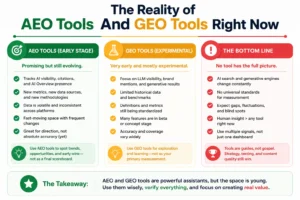 Here’s the truth:No AEO tools and GEO tools are perfect yet.The industry is moving too fast.
- AI systems change constantly.
- Retrieval behavior evolves weekly.
- Citation patterns shift unpredictably.
- Human analysis,
- Structured experimentation,
- Entity optimization,
- Authority building,
- and continuous testing.
- Trust,
- Entities,
- Information retrieval,
- And user intent.
Final Thoughts
The future of search belongs to brands that optimize for:- Humans,
- Search engines,
- And AI systems together.
- Topical authority,
- Structured clarity,
- Semantic relevance,
- Trusted entities,
- And genuinely useful content.
FAQs on AEO Tools
Is AEO Different From SEO?
Yes. SEO focuses on ranking in search engines, while AEO focuses on getting your brand included, cited, or recommended in AI-generated answers.
Which Tool Is Best For AI Visibility Tracking?
Profound is one of the stronger tools for AI visibility tracking, while Perplexity is useful for citation analysis and understanding AI search source patterns.
Do Traditional SEO Tools Still Matter For AEO?
Yes. Tools like Ahrefs, Semrush, Google Search Console, and GA4 still help improve authority, content visibility, topical depth, and performance signals.
How Can Brands Improve AI Search Visibility?
Brands can improve AI search visibility by building topical authority, publishing structured content, strengthening entity signals, and getting mentioned on trusted sources.
Why Do Businesses Need AEO Services?
Businesses need AEO services because customers are now discovering brands through ChatGPT, Perplexity, Google AI Overviews, and other AI search platforms. AEO helps brands improve visibility, trust, and chances of being mentioned in AI-generated answers.
Can BrainADZ Help With AI Search Visibility?
Yes. BrainADZ Marketing helps brands audit their AEO, GEO, and LLM visibility, identify content gaps, improve entity signals, and build a smarter AI search optimization strategy for future-ready digital growth.
Is AEO Useful For Lead Generation?
Yes. AEO can support lead generation by helping your brand appear in AI-generated recommendations when users search for solutions, tools, agencies, or services related to your business.
How Does GEO Help In Digital Marketing?
GEO helps brands optimize content for generative AI platforms so their business can be discovered, cited, or recommended in AI answers, not just traditional Google search results.
Who Should Invest In AI Search Optimization?
Startups, service businesses, agencies, SaaS brands, local businesses, and enterprises should invest in AI search optimization if they want better visibility across ChatGPT, Perplexity, Claude, Google AI Overviews, and future AI search platforms.