AI SEO
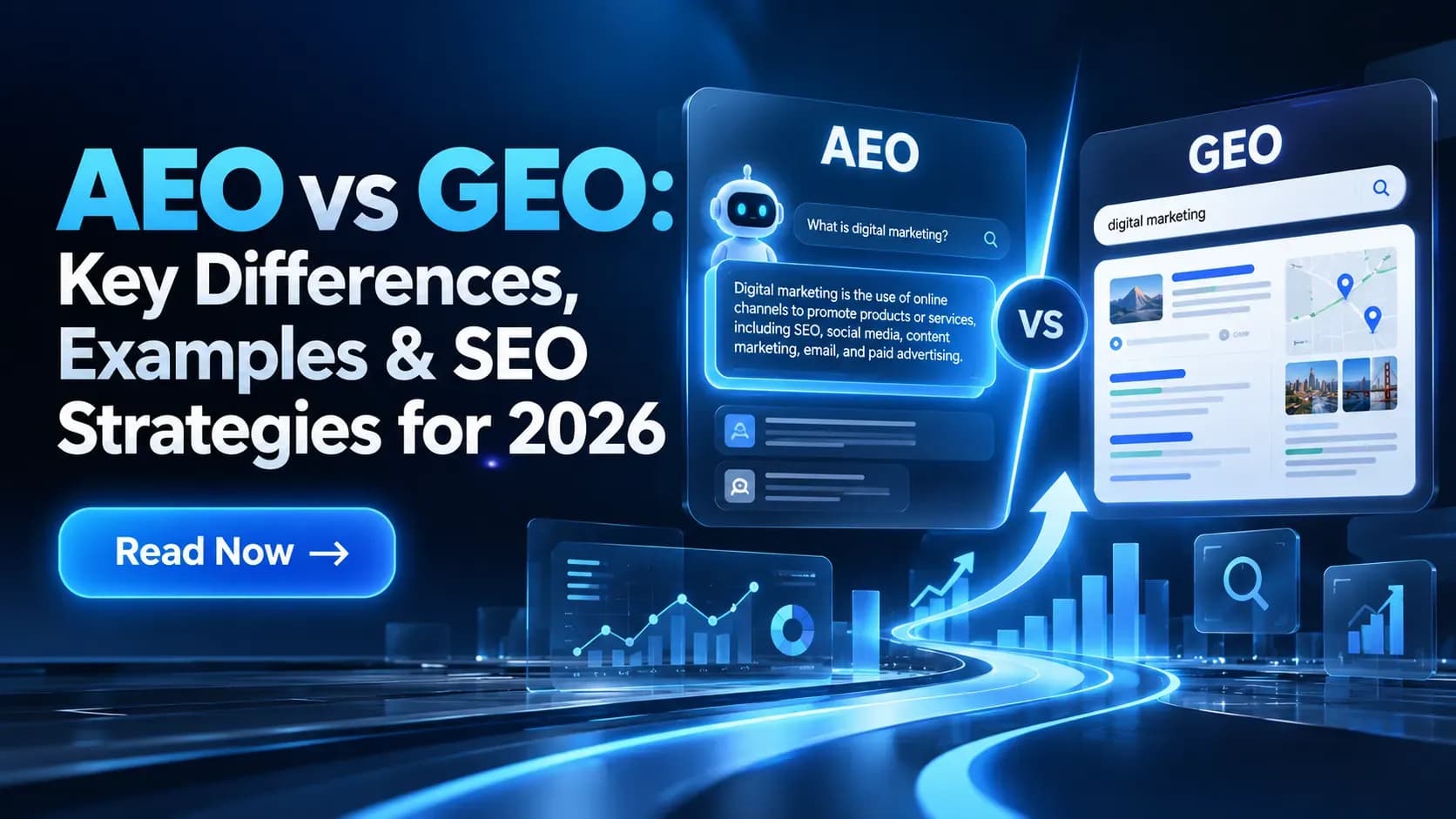
AEO vs GEO: Key Differences, Examples & SEO Strategies for 2026
Search is changing. People no longer depend only on traditional Google search results to find information.
Today, users also ask questions through ChatGPT, Google AI Overviews, Perplexity, and other AI-powered platforms.
Instead of browsing several websites, they often receive direct answers or AI-generated summaries.
This shift has introduced two important digital marketing concepts: Answer Engine Optimization (AEO) and Generative Engine Optimization (GEO).
Both aim to improve content visibility in answer-driven search experiences. However, they differ in emphasis, optimization techniques, and how success is measured.
In this guide, we explain AEO vs GEO, their differences, real-world examples, and how businesses can use both alongside traditional SEO.
What Is AEO (Answer Engine Optimization)?
.webp&w=3840&q=75)
Answer Engine Optimization (AEO) is the process of optimizing website content so search engines and answer platforms can easily identify and present relevant answers to user questions.
The main goal of AEO is simple: make your content easy to understand, relevant, and useful when someone asks a specific question.
For example, someone searching for "What is digital marketing?" may see a short explanation directly in Google's search results.
If your website provides a clear and helpful explanation, its content may be considered for an answer-focused search feature.
How Does AEO Work?
AEO focuses on understanding what users want to know and providing clear responses.
It encourages website owners to organize information in a way that is easy for both readers and search systems to understand.
Common AEO practices include:
- Answering questions directly.
- Using descriptive headings.
- Including relevant frequently asked questions.
- Creating well-structured, informative content.
- Using appropriate structured data where supported.
- Improving website accessibility and technical SEO.
These practices can help search systems interpret your content. However, they do not guarantee featured snippets or answer placements.
Example of AEO
Imagine someone searches:
"What is the difference between SEO and PPC?"
A website with a short, accurate comparison may be useful for Google's featured snippets or other answer-based experiences.
The key is to answer the question immediately and then provide supporting details.
What Is GEO (Generative Engine Optimization)?
_.webp&w=3840&q=75)
Generative Engine Optimization (GEO) is the practice of improving content and brand visibility within AI-generated responses.
Unlike traditional search results, generative AI platforms can combine information from several sources to produce a single response.
GEO focuses on making your website's information useful, credible, and relevant enough to be discovered, referenced, or cited in those responses.
For example, someone might ask ChatGPT or Perplexity:
"What are the best digital marketing strategies for small businesses in India?"
An AI-powered platform may generate an answer covering SEO, content marketing, paid advertising, and social media.
Relevant, trustworthy resources can help inform such responses, depending on the platform and how it retrieves information.
How Does GEO Work?
GEO emphasizes content quality, credibility, context, and topical relevance.
Generative AI systems may retrieve information from external sources, summarize it, and include links or citations where supported.
Useful GEO practices include:
- Publishing original and well-researched content.
- Demonstrating expertise and subject knowledge.
- Adding real examples and supporting evidence.
- Keeping information accurate and updated.
- Building consistent brand information online.
- Creating comprehensive content around relevant topics.
- Maintaining a technically accessible website.
GEO is not about adding keywords repeatedly or writing only for AI bots.
It is about creating reliable information that serves real users and can be understood by different search systems.
Example of GEO
Consider a user asking:
"How can a Delhi-based business improve its online visibility?"
An AI platform may suggest local SEO, Google Business Profile optimization, website improvements, and useful content creation.
If a digital marketing agency publishes detailed, trustworthy information on these topics, its content could become a relevant resource for AI-assisted research.
However, inclusion or citation depends on the platform and cannot be guaranteed.
AEO vs GEO: What Is the Main Difference?
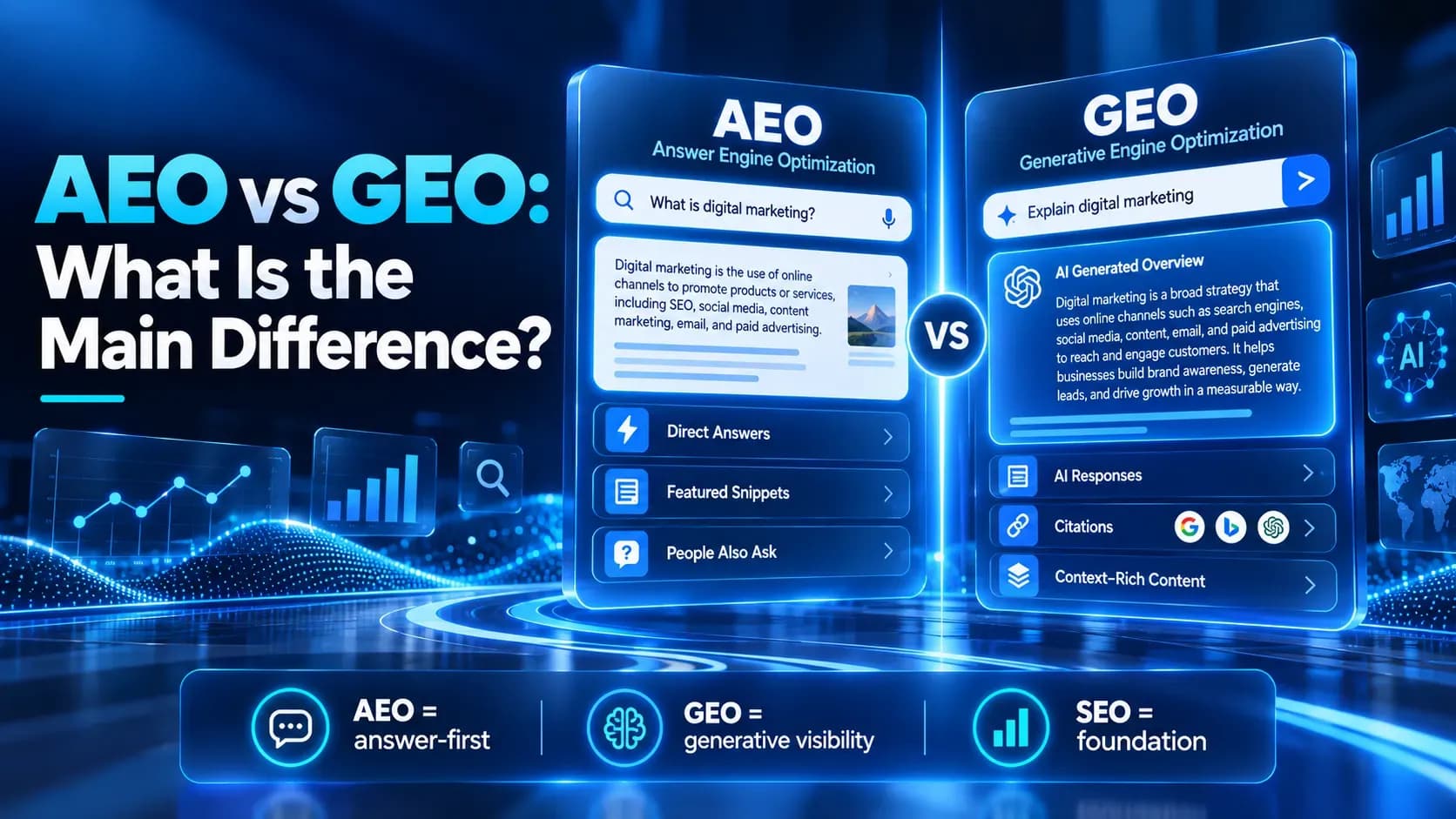
The main difference between AEO and GEO is their primary emphasis.
AEO focuses on making content suitable for direct answers, while GEO emphasizes visibility and credibility within AI-generated responses.
Both approaches overlap significantly. In fact, some digital marketing professionals use these terms interchangeably.
The comparison below explains a commonly used distinction.
Feature | AEO | GEO |
Full form | Answer Engine Optimization | Generative Engine Optimization |
Main focus | Direct answers | AI-generated responses |
Primary goal | Make answers easy to extract and present | Improve visibility and source relevance |
Typical platforms | Featured snippets, People Also Ask, voice search | ChatGPT Search, Perplexity, Google AI Overviews |
Content approach | Concise, clearly structured answers | Detailed, credible, context-rich information |
Optimization | Questions, definitions, headings, clarity | Original insights, evidence, authority, context |
Measurement | Answer visibility, snippet appearances | AI mentions, citations, referral traffic |
These are differences in emphasis, not strict boundaries.
Modern AI search systems can use both concise answers and detailed supporting content.
AEO vs GEO vs SEO: How Are They Different?
To understand AEO and GEO, it is important to understand their relationship with Search Engine Optimization (SEO).
SEO (Search Engine Optimization) helps websites become more discoverable through traditional organic search results.
AEO (Answer Engine Optimization) emphasizes delivering information in a format suitable for direct answers.
GEO (Generative Engine Optimization) emphasizes improving visibility in AI-generated responses and citations.
For example, imagine a business publishes an article titled "How to Improve Website Traffic."
With SEO, the goal may be to rank the article for relevant Google searches.
With AEO, the goal may be to provide a direct answer when someone asks how to increase website traffic.
With GEO, the goal may be for the article's valuable information to become a useful source in an AI-generated explanation.
Does AEO or GEO Replace Traditional SEO?
No. AEO and GEO do not replace traditional SEO.
Technical optimization, useful content, crawlability, internal linking, and website quality remain important.
Google's official guidance confirms that foundational SEO best practices continue to apply to AI Overviews and AI Mode.
Therefore, businesses should consider SEO, AEO, and GEO as complementary approaches rather than competing strategies.
Why Are AEO and GEO Important in 2026?
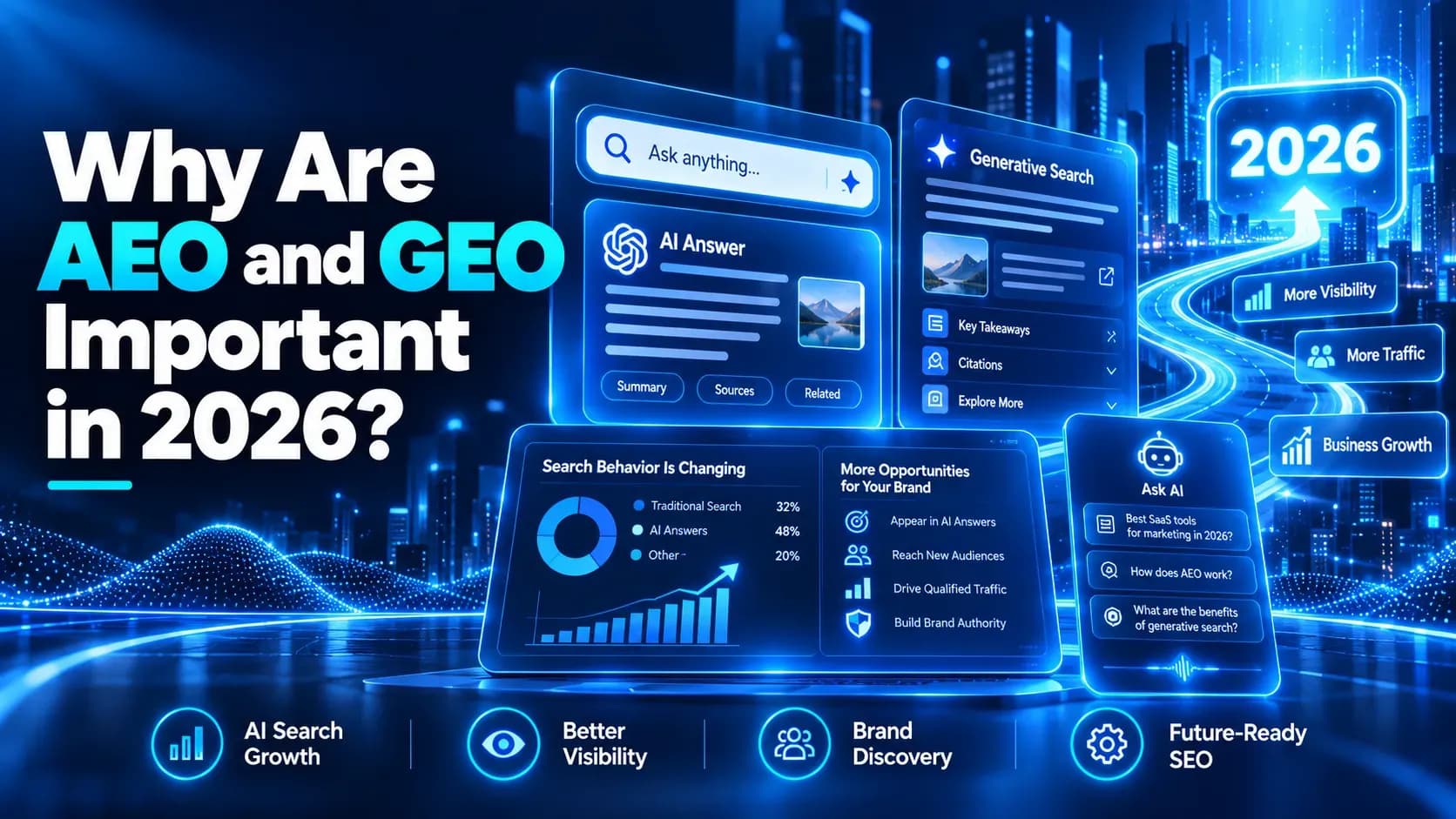
Search behavior is becoming more conversational.
Instead of entering short keywords, users can ask complete questions, request comparisons, and explore topics through follow-up conversations.
For businesses, this creates new opportunities to reach potential customers during the research and decision-making process.
1. Changing Search Behavior
Users increasingly interact with AI-powered search features to understand products, services, and complex topics.
Content that clearly addresses user questions can remain useful across multiple search experiences.
2. Greater Focus on Helpful Content
Both answer engines and generative systems benefit from accurate and relevant information.
Businesses that publish original guides, explanations, case studies, and practical examples can provide stronger resources for users.
3. Opportunities for Brand Discovery
AI-assisted search can introduce users to brands and websites they may not have discovered through traditional browsing.
Being mentioned or cited in a relevant answer may create additional opportunities for brand awareness.
4. Support for Customer Decision-Making
People frequently search for comparisons before purchasing a product or hiring a service provider.
Content that explains benefits, limitations, pricing considerations, and practical use cases can help users make informed decisions.
How to Optimize Your Website for AEO and GEO
Businesses do not need completely separate content strategies for AEO and GEO.
Many useful optimization practices support both approaches.
Here are seven practical steps.
1. Understand User Search Intent
Start by identifying what your audience wants to know.
Some users want definitions, while others want comparisons, solutions, or buying advice.
For example, a digital marketing company might target questions such as:
- What is AEO in digital marketing?
- How does GEO work?
- Is GEO better than SEO?
- How can small businesses improve AI search visibility?
Create content that directly matches these questions and their underlying search intent.
2. Write Clear and Direct Answers
Avoid lengthy introductions before answering the main question.
Start important sections with a simple explanation.
For example:
"GEO is the practice of improving content visibility within AI-generated search responses."
After the definition, explain how it works, why it matters, and when businesses should use it.
This makes the content more useful for readers and easier for search systems to interpret.
3. Use Proper Heading Structure
Organize your articles using descriptive H1, H2, and H3 headings.
Each heading should introduce a clear topic or question.
Use short paragraphs, bullet points, and tables whenever they improve understanding.
Avoid forcing keywords into every heading.
Readable content should always remain the priority.
4. Publish Original and Trustworthy Information
Generic content often repeats information already available across the internet.
Instead, include unique observations, practical examples, case studies, and reliable references.
For instance, a marketing agency could explain how it improved a client's organic visibility through better site architecture or content optimization.
Real experience makes content more useful and helps establish credibility.
5. Build Topical Authority
Create related articles that explore a subject from different perspectives.
For example, a website covering AI SEO could publish:
- What Is Answer Engine Optimization?
- What Is Generative Engine Optimization?
- AEO vs GEO vs SEO
- How to Optimize Content for AI Search
- Common AI SEO Mistakes to Avoid
Connect these articles using relevant internal links.
This helps users discover related information and supports a clearer website structure.
6. Improve Technical SEO
Even high-quality content can struggle if search engines cannot access it properly.
Pay attention to:
- Crawlability and indexability.
- Mobile-friendly design.
- Website speed and usability.
- Logical internal linking.
- Canonical URLs.
- Relevant structured data.
- Accessible text-based content.
For Google's AI search features, there is no requirement to add special AI-specific schema markup or files.
7. Measure Search and AI Visibility
Track performance to understand which improvements are working.
Traditional SEO metrics include organic clicks, impressions, keyword rankings, and conversions.
For AEO, businesses can also review featured snippet appearances and answer-oriented search visibility.
For GEO, useful indicators may include AI citations, relevant brand mentions, AI referral traffic, and conversions from those visits.
AI visibility tracking is still developing, so results should be interpreted carefully.
AEO vs GEO: Which Is Better for Your Business?
There is no universal winner between AEO and GEO.
The right approach depends on your audience, business goals, and the questions people ask before making a decision.
For Small Businesses
Start with strong local SEO and useful website content.
Answer common customer questions about services, locations, pricing, and business processes.
Then expand into detailed guides that support AI-assisted discovery.
For E-Commerce Websites
Product descriptions, FAQs, buying guides, and comparison articles can support answer-focused searches.
Original product information, detailed specifications, and helpful comparisons can also support broader AI search visibility.
For B2B Companies
B2B customers often conduct detailed research before contacting a service provider.
Industry guides, case studies, technical explanations, and service comparisons can support both AEO and GEO.
For Digital Marketing Agencies
Agencies should combine traditional SEO with clear educational content and credible examples.
This can help attract users searching for SEO services while also addressing emerging questions about AI-powered search.
The best approach is to combine SEO, AEO, and GEO into one practical content strategy.
Common AEO and GEO Mistakes to Avoid
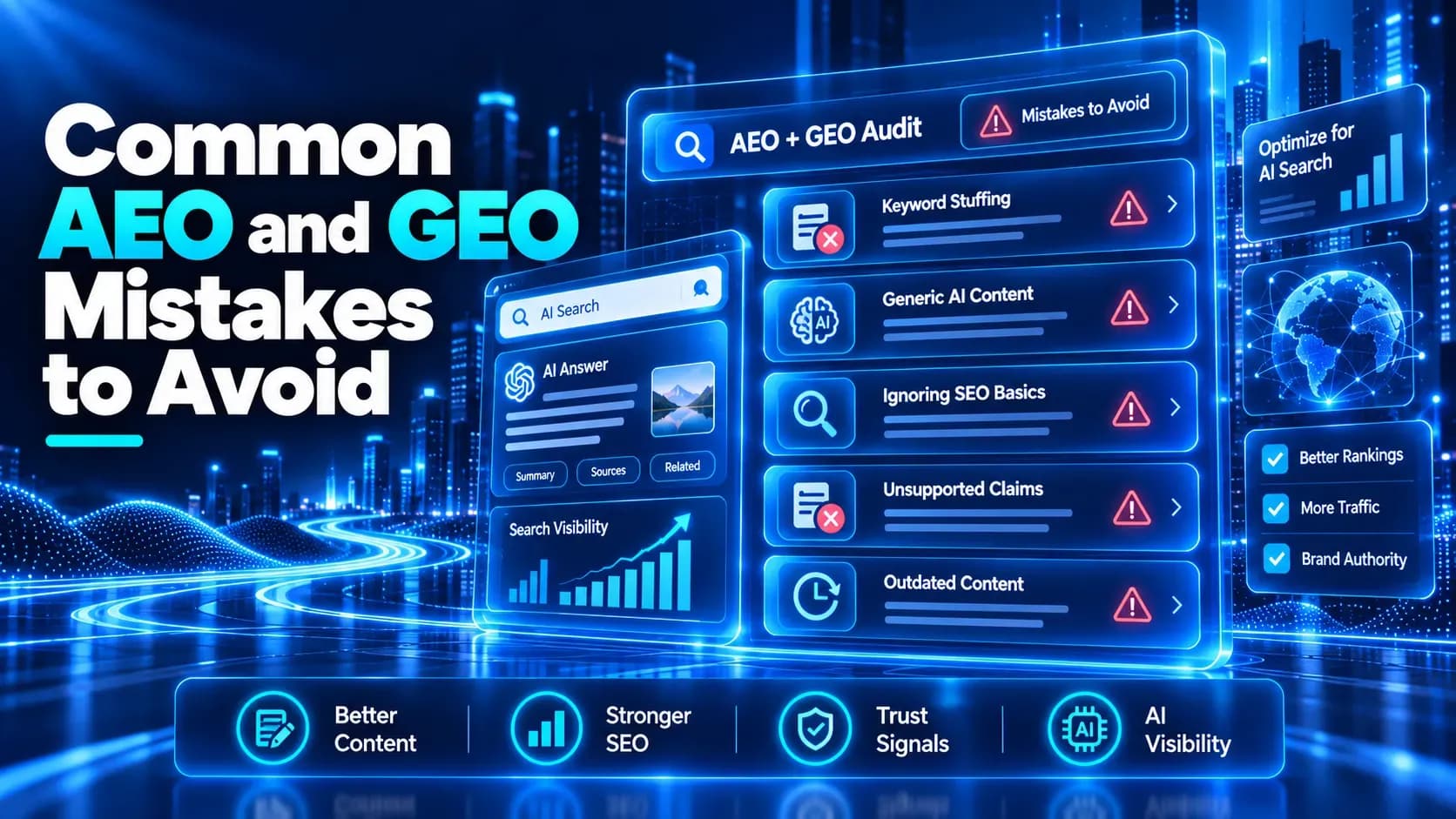
Businesses sometimes treat AI search optimization as a shortcut to immediate visibility.
However, several common mistakes can reduce content quality.
Keyword Stuffing
Repeating "AEO vs GEO" excessively does not make an article more valuable.
Use important terms naturally and prioritize clarity.
Publishing Generic AI Content
Content that only repeats existing information provides limited value.
Add meaningful examples, accurate facts, and original insights.
Ignoring Traditional SEO
AI visibility should not come at the expense of technical SEO.
A technically inaccessible or poorly organized website can create problems for both users and search systems.
Using Unsupported Claims
Avoid claims such as guaranteed AI citations or guaranteed first-page rankings.
Search results and AI-generated responses depend on many factors outside a website owner's control.
Ignoring Content Updates
Search technology, platform capabilities, and user behavior continue to evolve.
Review important articles periodically to keep facts, examples, and recommendations current.
The Future of AEO and GEO
The future of digital search is likely to include a combination of traditional search results, direct answers, and conversational AI experiences.
Users may discover businesses through a search listing, an AI-generated comparison, or a cited resource within a detailed response.
This means brands should focus on being useful wherever potential customers research information.
Strong technical SEO, original content, credible information, and a consistent online presence will continue to matter.
Rather than chasing every new optimization term, businesses should build a sustainable strategy focused on user needs.
Conclusion
The debate around AEO vs GEO is not about choosing one strategy and ignoring the other.
AEO helps businesses create content suited to direct answers, while GEO emphasizes visibility and credibility within AI-generated responses.
Traditional SEO provides the foundation that supports both.
As search continues to evolve, businesses that prioritize helpful, accurate, and well-organized information will be better prepared to reach customers across different search experiences.
Build a Smarter SEO and AI Search Strategy with BrainADZ Marketing
Want to improve your website's organic visibility and prepare your content for AI-powered search?
BrainADZ Marketing helps businesses develop digital marketing strategies focused on SEO, content optimization, and sustainable online growth.
Whether your business operates in Delhi, across India, or serves an international audience, a well-planned search strategy can help you connect with relevant customers.
Explore our digital marketing services and connect with BrainADZ Marketing to discuss your growth goals.
Frequently Asked Questions About AEO vs GEO
What is the main difference between AEO and GEO?+
AEO focuses on optimizing content for direct answers, while GEO emphasizes improving visibility in AI-generated responses. Both approaches overlap and rely on useful, well-structured information.
Is GEO better than SEO?+
No. GEO is not necessarily better than SEO. Traditional SEO supports website discoverability, while GEO focuses on visibility in generative AI experiences. Businesses can benefit from using both.
Is AEO part of SEO?+
AEO is commonly considered an extension of SEO. It applies many traditional SEO principles while emphasizing clear answers and question-based search experiences.
Can AEO and GEO improve website traffic?+
They may create additional discovery and referral opportunities. However, answer visibility does not always lead to clicks, and neither approach guarantees increased traffic.
How can I optimize my website for ChatGPT and Google AI Overviews?+
Publish helpful, original content, maintain a technically accessible website, use clear headings, and support claims with reliable information. Different AI platforms use different systems, so citations and visibility are not guaranteed.
Do I need special schema markup for GEO?+
No special GEO schema markup is required for Google's AI Overviews or AI Mode. Use supported structured data when it accurately represents visible page content.
Which businesses should focus on AEO and GEO?+
E-commerce companies, local businesses, B2B organizations, SaaS brands, and service providers can all benefit from creating helpful content for answer-driven and AI-assisted search experiences.
What is the best AEO and GEO strategy for 2026?+
Build on strong SEO fundamentals. Understand user questions, create original content, provide direct answers, improve technical accessibility, and measure relevant search and AI visibility outcomes.