Clear issue visibility
See which technical, content and authority problems are actually affecting important pages and search performance.

Find the technical, content, authority and measurement issues holding back organic growth—with evidence, priorities and an implementation-ready roadmap.
Enquire NowSEO audit overview
An SEO audit should explain more than what a crawler reports. BrainADZ combines technical evidence, search data, content analysis, authority review and conversion context to identify the issues that matter to real pages and business outcomes.
Every finding is validated, connected to an affected scope and prioritised by impact, scale, risk and effort. The result is a roadmap your SEO, content and development teams can actually use.
Enquire Now
See which technical, content and authority problems are actually affecting important pages and search performance.
Separate critical blockers from low-impact warnings using business value, affected scale, risk and implementation effort.
Turn audit findings into practical tickets, owners, acceptance criteria and a realistic release sequence.
Validate assumptions before redesigns, migrations, content expansion or large technical changes create additional risk.
Complete audit scope
The audit scope is adapted to the website. A service site, ecommerce store, publisher and JavaScript platform should not receive the same generic checklist.
Technical SEO audit
We examine the systems that determine whether search engines can discover, process and index the right version of your pages.
Site architecture audit
The website structure is evaluated for crawl depth, page hierarchy, taxonomy, internal links and the clarity of topic relationships.
On-page and content audit
We compare keyword ownership, search intent, headings, metadata, content depth and page usefulness across priority landing pages.
Authority and backlink audit
We review referring domains, anchors, lost links, suspicious patterns and competitor authority gaps without relying on one third-party metric.
Analytics and tracking audit
Search Console, analytics and conversion tracking are checked for gaps that could distort traffic, lead or revenue reporting.
UX and conversion audit
We review mobile usability, content hierarchy, trust signals, forms and calls to action on pages expected to generate enquiries or sales.
Audit evidence
A crawler warning, a ranking change or one tool score is not enough. Findings are stronger when separate evidence sources support the same conclusion.
A controlled crawl reveals status codes, canonicals, directives, links, depth, duplicate patterns and template-level issues.
Index coverage, search queries, page performance and inspection data show how Google currently processes the site.
Traffic, landing-page behaviour and conversion events help connect SEO issues with actual business outcomes.
Field and laboratory metrics identify loading, responsiveness and layout stability problems by template and device.
Source HTML, rendered HTML and user-visible content are compared to validate JavaScript and indexing assumptions.
Search results, content coverage, architecture and authority profiles reveal realistic gaps and opportunities.
Impact-based prioritisation
Audit tools can produce hundreds of findings. The priority framework prevents low-value cleanup from delaying changes that affect important pages and templates.
How strongly does the issue affect high-value services, categories, locations, leads, transactions or revenue?
Commercial importance
Does the issue block crawling, indexing, relevance, authority, user experience or measurable search visibility?
Search-performance effect
Is the problem limited to one page, repeated across a template or present across a major section of the website?
Number of affected URLs
What development, content, platform, stakeholder or release dependencies are required to resolve the issue safely?
Implementation reality
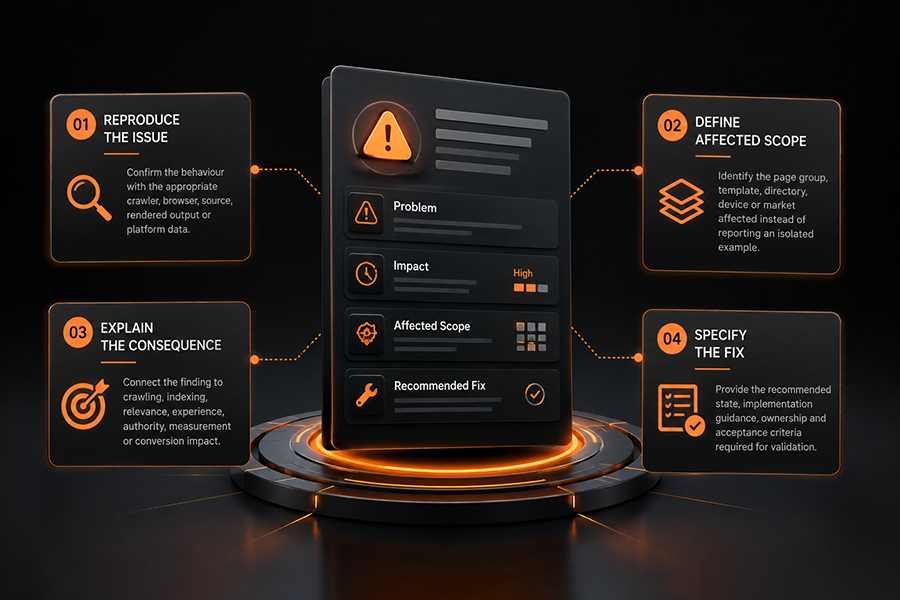
Finding validation
A screenshot and a tool label are not an implementation brief. We document the behaviour, affected scope, consequence and required state so teams can resolve and verify the issue.
Confirm the behaviour with the appropriate crawler, browser, source, rendered output or platform data.
Identify the page group, template, directory, device or market affected instead of reporting an isolated example.
Connect the finding to crawling, indexing, relevance, experience, authority, measurement or conversion impact.
Provide the recommended state, implementation guidance, ownership and acceptance criteria required for validation.
SEO audit deliverables
Business stakeholders need priorities. SEO teams need context. Developers and content teams need precise implementation requirements.
A concise view of the most important findings, business risks, growth constraints and recommended sequence of action.
A transparent issue list with evidence, examples, affected scope, impact, priority, owner and recommended resolution.
A phased backlog separating urgent blockers, high-value improvements, supporting work and lower-priority maintenance.
Technical findings can be translated into clear requirements, examples, acceptance criteria and QA steps.
Priority pages, cannibalisation, consolidation, refresh and new-content opportunities are organised around search intent.
The findings are explained to SEO, content, development and business stakeholders so ownership and next actions are clear.
SEO audit process
The process keeps the audit connected to business priorities, implementation ownership and post-release validation.
Enquire NowWe define priority services, products, locations, competitors, platform constraints and the data sources available for the audit.
The website is crawled and reviewed using Search Console, analytics, rendered-page checks, performance data and platform information.
Priority page groups are assessed for intent, overlap, content quality, internal linking, hierarchy and external authority.
Each issue is confirmed, assigned an affected scope and scored by business impact, SEO impact, scale, risk and effort.
Findings are organised into implementation phases and explained to the teams responsible for development, content and measurement.
Where included, we review proposed fixes, staging changes and released updates to confirm that the intended SEO state has been achieved.
SEO audit FAQs
Understand scope, deliverables, implementation, timing, ecommerce and JavaScript auditing before the project begins.
Enquire NowAn SEO audit can include technical crawling and indexation, site architecture, JavaScript rendering, Core Web Vitals, on-page targeting, content quality, internal linking, backlinks, analytics, conversion tracking and organic landing-page UX. The final scope depends on the website type, scale, platform and business priorities.
No. A complete SEO audit should consider technical access, page relevance, content quality, architecture, internal links, external authority, measurement and conversion pathways. A technical-only review can miss major content or commercial problems.
You receive an executive summary, detailed findings with evidence, priority scoring, affected URLs or templates, recommended fixes and an implementation roadmap. Depending on scope, the audit can also include developer tickets, content briefs and a stakeholder handover session.
Timing depends on website size, technical complexity, data access and the depth of analysis required. A focused audit for a smaller website may be completed faster than a large ecommerce, marketplace, publisher or JavaScript platform with many templates and URL states.
The audit identifies, validates and prioritises issues. Implementation can be handled by your development and content teams, or BrainADZ can support selected fixes, ticket creation, staging review and post-release validation under a separate implementation scope.
Yes. We can review server-rendered, statically generated and client-rendered websites, including Next.js. Checks can cover source and rendered HTML, routing, metadata, internal links, canonicals, structured data, hydration, lazy loading and indexability.
Yes. Ecommerce audits can include category and product architecture, faceted navigation, parameters, variants, pagination, product states, structured data, crawl efficiency, internal linking, index quality and organic revenue tracking.
A full audit is useful before major SEO investment, redesigns, migrations, platform changes or recovery work. Ongoing websites also benefit from periodic focused audits when performance changes, templates are updated or new sections are launched.
Findings are prioritised using business importance, SEO impact, affected scale, implementation effort, dependencies and risk. This prevents minor warnings from receiving the same attention as issues blocking valuable pages or entire templates.
No audit can guarantee rankings. An audit reduces uncertainty by identifying technical, content and authority constraints, but results depend on implementation quality, competition, content value, authority, search demand and ongoing optimisation.

Get a clear roadmap for campaigns, creative, website, SEO, and performance before you scale your next project.