Scalable SEO control
Manage crawling, indexing, templates and internal links across large page inventories without relying on page-by-page fixes.

Build scalable organic growth across large websites, complex platforms, multiple teams and high-value page portfolios.
Enquire NowEnterprise SEO overview
Enterprise SEO manages organic performance across large inventories, shared templates, complex platforms and multiple decision-making teams. BrainADZ connects technical strategy, content operations, platform requirements and measurement into one scalable programme.
The goal is not to produce a larger list of recommendations. It is to create standards, workflows and priorities that make high-impact SEO changes easier to approve, implement, validate and repeat.
Enquire Now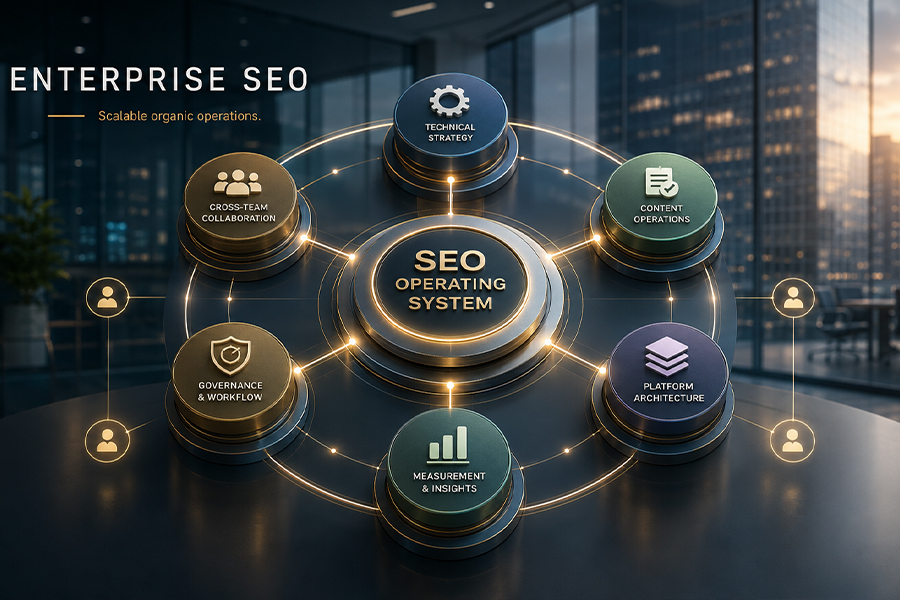
Manage crawling, indexing, templates and internal links across large page inventories without relying on page-by-page fixes.
Define ownership, standards, approvals and QA across SEO, content, product, engineering and regional teams.
Prioritise changes by affected scale, business value, search opportunity, risk and implementation dependency.
Connect portfolio-level organic performance with revenue, leads, product adoption and strategic business priorities.
Enterprise complexity
Large websites are not simply small websites with more pages. Shared systems, multiple teams and portfolio-wide risks require a different operating model.
Thousands or millions of product, category, article, location, profile or parameter URLs require clear index-quality rules.
Crawl and index scale
One template decision can improve or damage entire page groups, making technical and content QA critical before release.
Template-level impact
SEO changes depend on product, engineering, design, content, legal, analytics, brand and regional teams with different priorities.
Cross-functional ownership
Migrations, redesigns, platform releases, acquisitions and international expansion can alter visibility across large portfolios.
Change and release risk
Enterprise SEO capabilities
Each capability is designed for repeatability. The strongest enterprise improvements change templates, systems and workflows rather than isolated URLs.
Technical SEO at scale
We create scalable technical rules and monitoring systems for large inventories, dynamic URLs, JavaScript applications and shared templates.
Information architecture
Taxonomy, navigation, hierarchy and internal links are aligned with customer journeys, search demand and commercial page ownership.
Template optimisation
Metadata, headings, content modules, schema, links and conversion elements are optimised at the template level where scale makes manual editing impractical.
Content governance
We establish planning, creation, review, refresh and consolidation standards that keep large content inventories useful and differentiated.
Platform changes and migrations
SEO requirements are integrated into redesigns, replatforming, domain changes, acquisitions and major routing or architecture updates.
SEO automation and monitoring
Repeatable checks, alerts and dashboards help teams identify technical, template and content changes across large page sets.
Enterprise operating models
Different enterprise models require different governance, page rules, ownership structures and definitions of success.
Create shared SEO standards while preserving distinct product, audience and brand strategies across multiple websites or business units.
Manage category, listing, profile, product, filter and parameter pages with scalable index and template controls.
Coordinate high publishing velocity, archives, topic hubs, evergreen updates and content lifecycle decisions.
Align central strategy with regional markets, language variants and local teams without creating uncontrolled duplication.
SEO governance
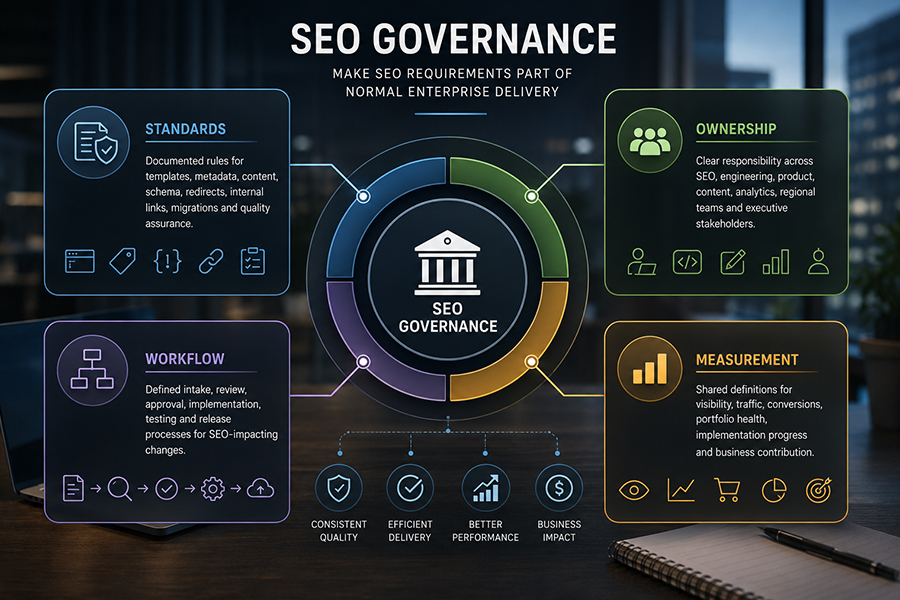
Enterprise SEO becomes sustainable when teams know the standards, ownership, workflow and measurement expectations before changes reach production.
Documented rules for templates, metadata, content, schema, redirects, internal links, migrations and quality assurance.
Clear responsibility across SEO, engineering, product, content, analytics, regional teams and executive stakeholders.
Defined intake, review, approval, implementation, testing and release processes for SEO-impacting changes.
Shared definitions for visibility, traffic, conversions, portfolio health, implementation progress and business contribution.
Enterprise prioritisation
The roadmap balances commercial importance, portfolio scale, organic opportunity and the realities of enterprise implementation.
Prioritise the products, services, markets and page groups most closely connected to revenue, leads or strategic growth.
Business importance
A template issue affecting hundreds of thousands of URLs may deserve attention before a severe issue on one low-value page.
Portfolio reach
Estimate the visibility, demand and competitive upside available when the issue or opportunity is addressed.
Organic potential
Account for engineering capacity, platform constraints, stakeholder approvals, release schedules and operational risk.
Execution reality
Enterprise SEO process
Strategy, standards, implementation and reporting remain connected through one shared operating roadmap.
Enquire NowWe define business priorities, target markets, portfolio structure, decision-makers, implementation teams and current operating constraints.
Large page groups, templates, indexation patterns, traffic segments, conversion paths and competitors are analysed to establish the baseline.
Opportunities are organised into technical, content, architecture, platform and governance workstreams with impact and dependency scoring.
Recommendations are translated into template requirements, content standards, technical tickets, workflow changes and QA criteria.
We work with teams through development, content production, staging, launch and validation for high-impact initiatives.
Portfolio health, implementation progress and business outcomes are reviewed so the next roadmap cycle reflects current evidence.
Enterprise SEO reporting
Executive reporting explains business contribution and strategic progress, while operating reports show portfolio health, issues and implementation status.
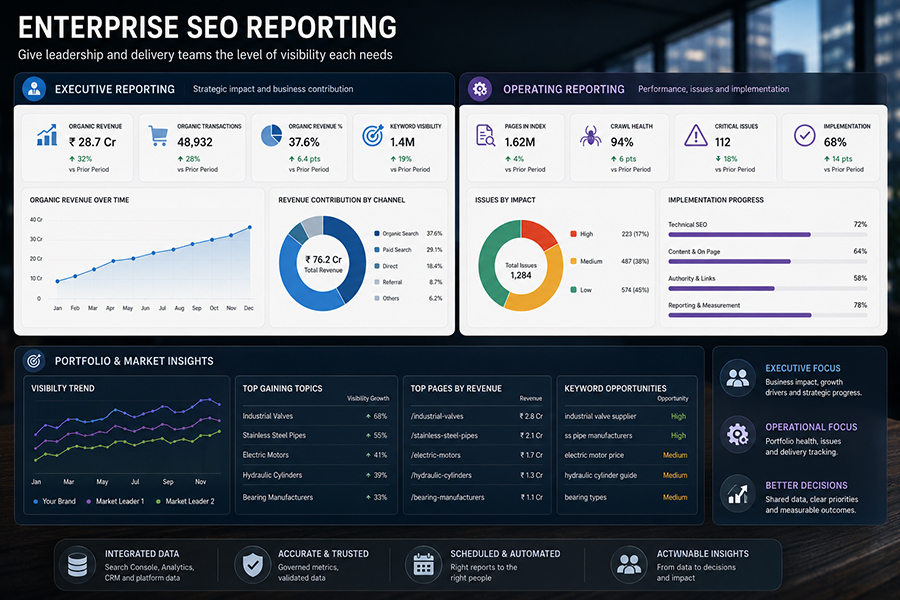
Track performance across business units, brands, markets, page types and strategic search themes.
Monitor large-scale conditions that affect discoverability, rendering, index quality and template performance.
Show which recommendations are planned, approved, in development, released, validated or blocked.
Connect organic portfolio performance with enterprise goals using the most reliable available conversion and revenue data.
Enterprise SEO FAQs
Understand scale, governance, development requirements, migrations, prioritisation and performance measurement before starting.
Enquire NowEnterprise SEO can include large-scale technical audits, crawl and index management, template optimisation, information architecture, content governance, internal linking, migrations, automation, cross-functional workflows and executive reporting. The final scope depends on the organisation, platform, page inventory and business priorities.
Enterprise SEO manages greater scale, complexity and organisational dependency. Changes often affect large page groups and require coordination across engineering, product, content, analytics, legal, regional and executive teams. Governance and implementation systems are therefore as important as recommendations.
Yes. BrainADZ can support an existing in-house team with strategy, specialist audits, roadmap prioritisation, technical requirements, content governance, migrations, executive reporting or implementation validation.
Yes, provided the scope and data access are appropriate. Large websites require page-group analysis, sampling, templates, log or crawl data, Search Console segmentation and scalable monitoring rather than manual review of every URL.
Yes. Technical recommendations can be translated into implementation requirements, examples, affected templates, acceptance criteria, QA steps and release validation guidance.
Yes. We can support domain changes, replatforming, redesigns, acquisitions, URL restructures and major routing changes through inventory creation, benchmarks, redirect mapping, staging review, launch monitoring and post-release validation.
Work is prioritised using commercial importance, affected scale, search opportunity, technical risk, effort, dependencies and implementation readiness. This helps teams focus on changes with the strongest realistic enterprise impact.
Measurement can include portfolio visibility, crawl and index health, page-group traffic, conversions, revenue, implementation progress and competitive movement. Reporting is segmented by the organisation's actual brands, markets, products and strategic initiatives.
Some technical or template fixes can create early movement after implementation, while large content, architecture and authority initiatives require sustained work. Enterprise timelines are strongly influenced by release cycles, dependencies, platform constraints and organisational decision speed.

Get a clear roadmap for campaigns, creative, website, SEO, and performance before you scale your next project.