Reach relevant prospects
Use search, social, video and professional-network channels according to where the target audience discovers and evaluates solutions.

Generate, qualify and route business enquiries through paid campaigns, conversion-focused journeys and sales feedback built around real pipeline value.
Enquire NowLead generation overview
Lead generation connects advertising, conversion experience and sales operations. BrainADZ aligns channels, audiences, offers, forms, calls, CRM routing and qualification so campaigns are judged by useful business enquiries rather than raw submission volume.
The feedback loop continues after the form. Validity, fit, response time, sales acceptance, opportunities and revenue are used wherever possible to guide the next media and conversion decision.
Enquire Now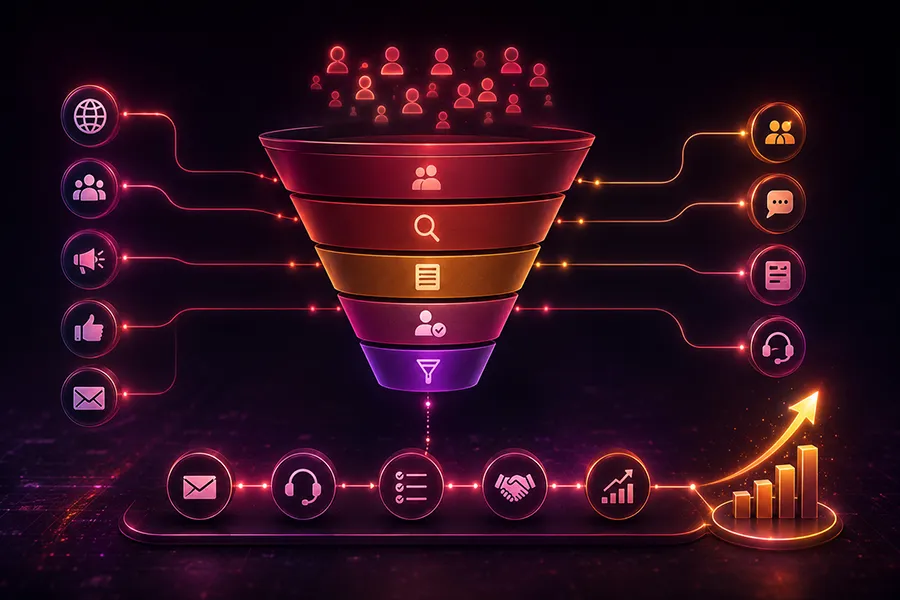
Use search, social, video and professional-network channels according to where the target audience discovers and evaluates solutions.
Match the offer, message, form, call or landing-page experience with the user’s intent and level of readiness.
Separate valid, suitable and sales-ready enquiries from spam, duplicates and poor-fit submissions.
Use CRM stages and downstream outcomes to guide channel, audience, keyword, creative and budget decisions.
Lead funnel
A lead is not the final result. Qualification, contact, sales acceptance and pipeline progression reveal whether acquisition is commercially useful.
Reach people actively searching for a solution or create interest among audiences likely to need the offer.
Relevant traffic and attention
Present a clear reason to enquire through the most appropriate page, form, message, booking or call journey.
Completed enquiries
Evaluate fit using form data, validation rules, CRM information, sales feedback and agreed lead criteria.
Valid and qualified leads
Track appointments, opportunities, proposals, customers and revenue where the sales process provides reliable feedback.
Business contribution
Lead generation capabilities
Lead volume becomes useful only when offer, conversion, qualification and sales feedback operate as one system.
Audience and demand strategy
We map high-intent search demand, social discovery, professional targeting, video consideration and remarketing around the customer journey.
Offer and message design
The offer, proof, risk reduction and call to action are aligned with the prospect’s problem, stage and expected sales journey.
Campaign architecture
Campaigns are structured around channel, audience, service, geography, offer and conversion path so performance can be diagnosed accurately.
Lead capture systems
Website forms, native lead forms, phone calls, messages and booking journeys are designed around intent, friction and the information required for qualification.
Lead qualification
We create shared criteria for valid, marketing-qualified, sales-qualified and disqualified leads so campaigns are not judged by raw form totals.
CRM and offline feedback
Lead sources, campaign parameters, CRM stages and offline conversion feedback are connected where technically possible.
Lead generation channels
Paid search captures active need, social creates demand, professional networks support B2B targeting and video develops consideration.
Capture active demand from prospects searching for specific services, products, locations or business solutions.
Create or capture demand through Facebook and Instagram using website forms, instant forms, messages and calls.
Reach professional audiences using role, company and business attributes where B2B economics justify the higher media cost.
Build consideration through video, then re-engage viewers and visitors with proof, qualification and conversion-focused messages.
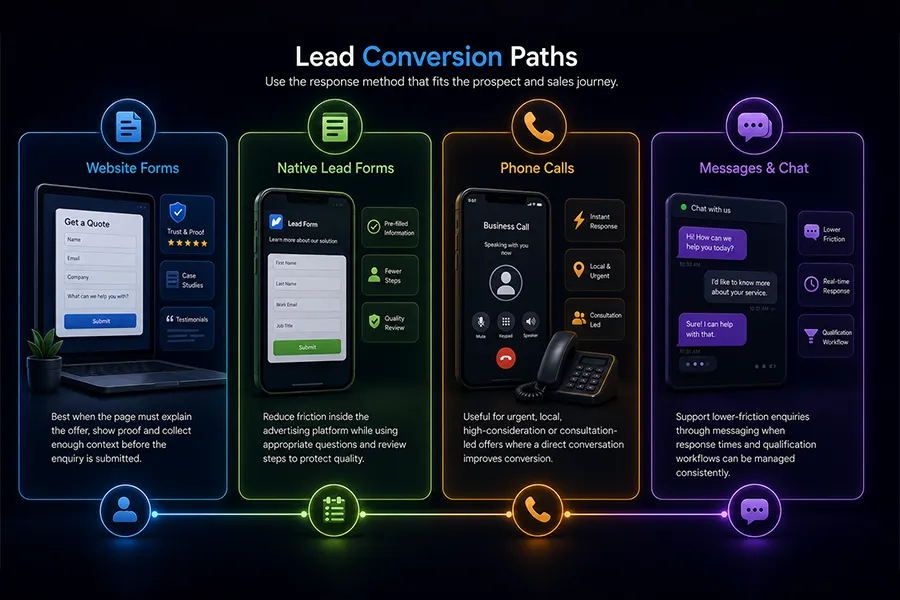
Lead conversion paths
A complex B2B enquiry, urgent local service and simple callback request require different levels of explanation, friction and qualification.
Best when the page must explain the offer, show proof and collect enough context before the enquiry is submitted.
Reduce friction inside the advertising platform while using appropriate questions and review steps to protect quality.
Useful for urgent, local, high-consideration or consultation-led offers where a direct conversation improves conversion.
Support lower-friction enquiries through messaging when response times and qualification workflows can be managed consistently.
Lead qualification
Marketing, sales and reporting become more useful when stages and rejection reasons are defined before campaigns scale.
The submission is genuine, reachable and not a duplicate, test, employee, vendor or obvious spam enquiry.
The prospect matches agreed geography, service, company, requirement or audience criteria and deserves follow-up.
Sales confirms a real requirement, appropriate timing, decision process or commercial fit according to the agreed model.
The lead progresses into a meeting, proposal, opportunity, sale or revenue event that can be connected back to acquisition.
Sales handoff
Slow routing, missing context and inconsistent disposition can make strong acquisition appear weak—or hide poor-quality campaigns.
Enquire NowAssign enquiries by service, location, territory, language, product or sales ownership so the correct team receives them.
Set clear response targets, alerts and fallback ownership because delayed contact can reduce conversion quality.
Pass source, campaign, form answers, page, keyword and other useful context into the CRM or lead-notification workflow.
Require sales teams to mark valid, qualified, disqualified, unreachable, won and lost outcomes using consistent reasons.
Primary campaign conversions are limited to meaningful lead actions instead of treating every button click or page view as equal.
Fields, validation, consent, confirmation and qualification questions are balanced against completion friction.
Lead volume is not scaled when routing, response time and follow-up capacity cannot support additional enquiries.
Campaign optimisation uses enough CRM and sales disposition data to distinguish cheap leads from useful pipeline.
Lead generation process
Channel, offer, conversion, CRM and sales decisions remain connected through one lead generation roadmap.
Enquire NowWe agree valid, qualified and sales-qualified lead definitions, priority services, geography, customer value and the actions campaigns should generate.
Search intent, audience characteristics, buying stages, channel roles, offers and proof requirements are researched.
Landing pages, native forms, calls, messages, form fields, validation and qualification questions are planned.
Campaigns, ads, audiences, conversion events, source parameters, notifications and CRM handoff requirements are configured.
Early delivery, form behaviour, call quality, spam, duplicate rate, response time and sales feedback are monitored.
Keywords, audiences, offers, creative, forms, budgets and channels are refined using qualified-lead and opportunity evidence.
Lead generation reporting
Reporting separates submission volume from useful sales outcomes and explains where the next acquisition budget should move.
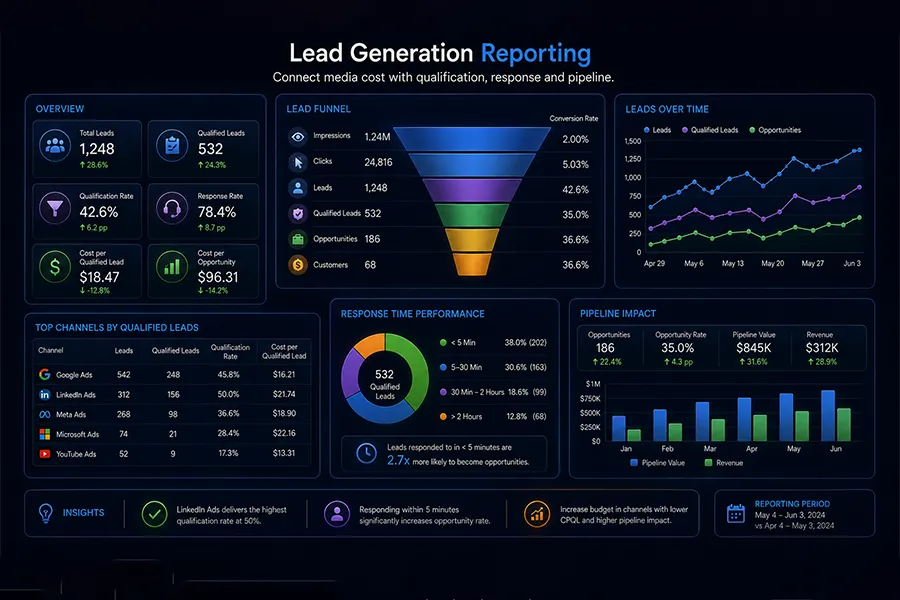
Understand where enquiries originate and how volume changes across channels, campaigns, services and locations.
Separate genuine and suitable prospects from duplicates, spam, invalid enquiries and poor-fit submissions.
Review whether leads are routed and contacted quickly enough to preserve the value generated by paid media.
Connect qualified acquisition with opportunities, proposals, customers and revenue where sales data allows.
Lead generation FAQs
Understand channels, qualification, forms, calls, CRM connections, sales response and reporting before starting.
Enquire NowThe service can include channel strategy, audience and keyword research, offer planning, paid campaign setup, landing pages or native forms, call and message tracking, CRM routing, lead qualification, sales feedback, optimisation and reporting.
Depending on the business, lead generation can use Google Ads, Meta Ads, LinkedIn Ads, YouTube, remarketing and other relevant paid channels. Channel selection is based on demand, audience, sales value, budget and conversion journey.
A qualified lead is a genuine prospect that matches agreed business criteria such as service requirement, geography, company type, budget, timing or decision role. The definition is agreed with the sales team before campaigns are evaluated.
Both can be used. Website forms are useful when the page needs to explain the offer and build trust, while native platform forms can reduce friction. The choice depends on intent, required qualification information and lead-quality performance.
Yes. Call clicks, call extensions, tracked phone numbers or call-platform integrations can be used depending on the website, platform and technical setup. Call quality still requires business or CRM feedback.
Yes, where the CRM and technical access support it. We can plan lead-source fields, UTM parameters, routing, notifications, status definitions and offline conversion feedback so campaign decisions use downstream outcomes.
Faster response is generally preferable, but the correct service-level target depends on the industry, operating hours, urgency and lead source. We define a practical response workflow and monitor whether it is followed.
We use targeting, negative keywords, exclusions, form validation, qualification questions, confirmation steps, CRM feedback and sales rejection reasons. No system removes every low-quality submission, but the feedback loop helps reduce them.
Reporting can include total leads, valid leads, qualified leads, cost per lead, cost per qualified lead, response time, appointment rate, opportunities, pipeline and customers depending on available CRM and sales data.
No responsible lead generation service can guarantee a fixed number and quality of leads because results depend on market demand, budget, competition, offer, conversion experience, tracking and sales follow-up. We provide transparent optimisation around agreed quality and commercial goals.
Get a clear roadmap for campaigns, creative, website, SEO, and performance before you scale your next project.