Build visual awareness
Use sight, sound, motion and product demonstration to make the brand easier to recognise and remember.

Use video to build awareness, deepen consideration and generate measurable action across in-stream, in-feed, bumper and Shorts formats.
Enquire NowYouTube Ads overview
YouTube Ads combine reach, storytelling and measurable response across multiple video formats. BrainADZ connects the campaign objective, audience, creative, format, bidding and destination so the video has a clear role in the customer journey.
Performance is reviewed beyond impression and view totals. We examine watch behaviour, creative response, website actions and downstream business outcomes to guide the next campaign decision.
Enquire Now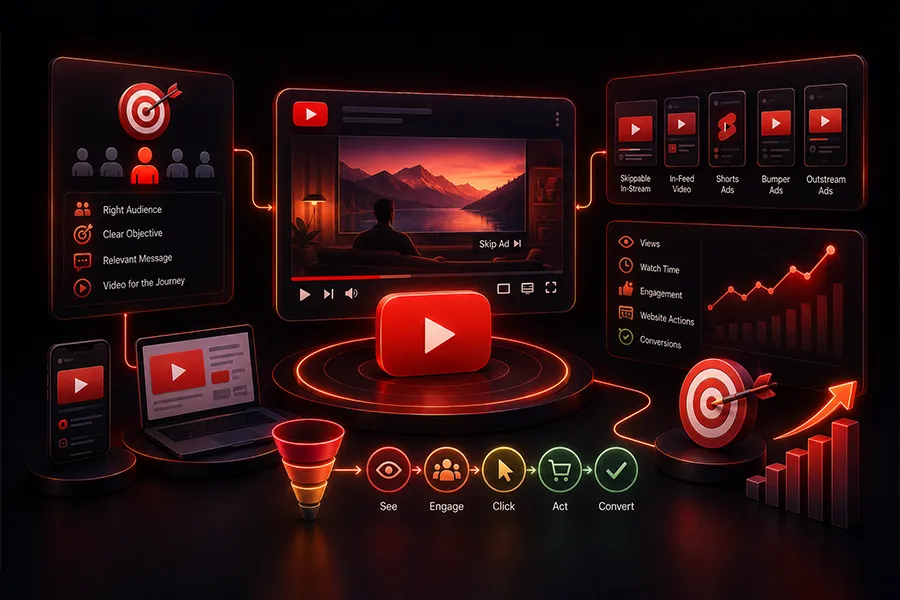
Use sight, sound, motion and product demonstration to make the brand easier to recognise and remember.
Combine audience, content, demographic and first-party signals with objective-led video campaign delivery.
Use long-form, in-feed and sequenced video messages to explain products, services and buying reasons more clearly.
Connect YouTube activity with website conversions, leads, purchases and downstream business outcomes.
Video campaign objectives
The objective influences campaign subtype, bidding, available formats, delivery and the metrics that should define success.
Maximise relevant exposure using formats and bidding designed to reach more unique viewers within the available budget.
Awareness at scale
Increase meaningful video consumption and interaction among people likely to consider the brand or offer.
Attention and consideration
Use video campaigns and eligible Google campaign types to encourage visits, enquiries, sign-ups or other website actions.
Traffic and conversion
Optimise toward purchases, valuable conversion events or revenue signals when measurement quality and conversion volume are sufficient.
Commercial outcomes
YouTube ad formats
Different formats change how viewers encounter the message, whether they can skip and how much creative context is available.
Skippable in-stream ads
Skippable in-stream ads appear around video content and allow the viewer to skip after the opening seconds, making the hook and early value proposition critical.
Non-skippable in-stream ads
Non-skippable formats are suited to controlled reach and complete-message delivery when the concept can communicate value within a short duration.
In-feed video ads
In-feed ads use a thumbnail and headline to attract people browsing YouTube Search, Home or related discovery surfaces.
Bumper ads
Bumper ads are short, non-skippable messages that support broad awareness, recall and reinforcement within larger video plans.
YouTube Shorts ads
Shorts ads appear between organic short-form videos and require fast, native-feeling creative that can communicate before the user swipes.
Multi-format video campaigns
A complete video campaign can combine in-stream, in-feed and Shorts inventory where the campaign type and assets support that mix.

Video creative strategy
YouTube creative must work in the first seconds, remain understandable with different viewing behaviours and adapt to horizontal and vertical environments without losing the central message.
The first seconds communicate the problem, desire, visual surprise or result clearly enough to prevent immediate loss of attention.
The brand appears naturally and early enough to remain memorable even when the viewer skips or watches briefly.
Demonstration, examples, social proof, results or process visibility explain why the offer deserves consideration.
The video, CTA and destination make the next step clear and consistent with the campaign objective.
Creative campaign models
Strong testing compares different communication ideas, not only minor edits to the same script or design.
Show how the product works, what changes after use and which details distinguish it from alternatives.
Make the audience recognise the problem quickly, then position the offer as a practical next step.
Use testimonials, case evidence, outcomes or real-use context to reduce uncertainty and strengthen trust.
Use credible people, expertise and direct explanation to make complex offers easier to understand.
Build vertical, fast-paced creative that feels appropriate inside Shorts while remaining clear and branded.
Use in-feed promotion to bring interested viewers toward deeper demonstrations, explainers, webinars or channel content.
Audience and targeting
Audience strategy changes by objective. Awareness and consideration can use broader context, while conversion-led campaigns depend more heavily on reliable optimisation signals.
Use demographics, interests, life events, custom segments, customer data and remarketing where they support the campaign goal.
Topics, keywords, placements and channel context can support reach or consideration campaigns where content targeting is appropriate.
Website visitors, customer lists, channel engagement and existing converters can support exclusions, remarketing and audience insight.
Campaign delivery is controlled around the markets, languages and service areas the business can genuinely support.
Measurement and conversion tracking
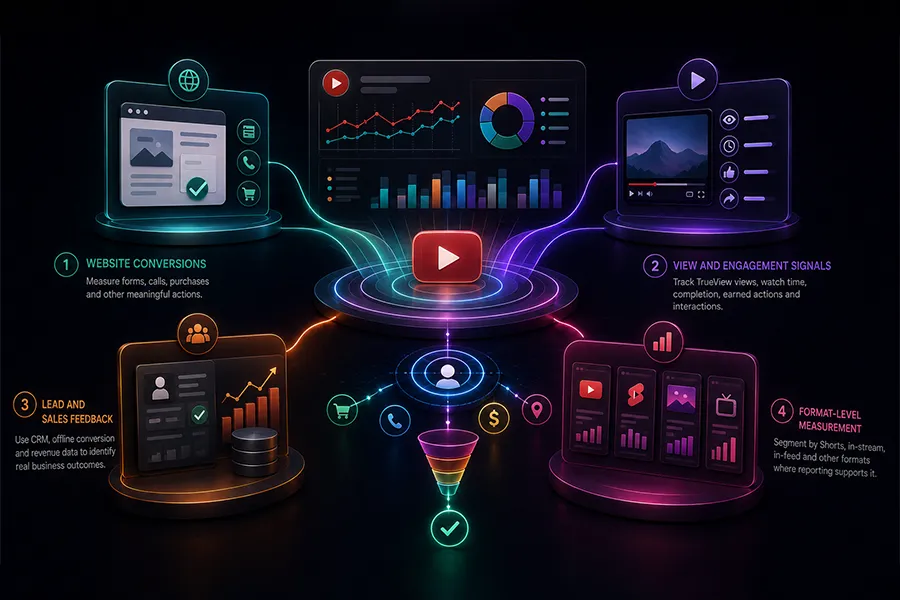
Views and watch behaviour explain attention. Conversion and business data explain whether that attention contributed to a valuable outcome.
Google Ads tags and conversion actions measure forms, calls, purchases and other meaningful website outcomes.
TrueView views, watch time, completion, earned actions and interactions help explain how audiences respond to the video.
CRM, offline conversion and revenue information can distinguish real business outcomes from surface-level website actions.
Campaign and ad-format segmentation helps separate Shorts, in-stream, in-feed and other delivery patterns where reporting supports it.
Campaign quality controls
Video automation performs best when the campaign goal, assets, audience signals and conversion definitions are clear.
Enquire NowThe campaign objective determines which formats, networks, bidding strategies and optimisation signals are appropriate.
Horizontal, vertical and short-duration assets are planned intentionally instead of relying on one video to perform everywhere.
Conversion tags, primary actions and downstream business feedback are validated before conversion-led scaling.
Reach, repetition and creative fatigue are reviewed so awareness does not become wasteful overexposure.
YouTube Ads process
Audience, creative, format, measurement and budget decisions remain connected through one campaign roadmap.
Enquire NowWe confirm the campaign goal, audience, offer, expected action, budget, creative resources and the role video should play in the wider funnel.
Audience signals, market demand, competitor activity, channel context and first-party data are reviewed to shape campaign targeting.
Hooks, scripts, durations, aspect ratios, thumbnails, calls to action and format-specific asset requirements are organised.
Objectives, campaign subtypes, formats, bidding, budgets, audiences, conversion actions and destinations are configured and checked.
Early reach, views, watch behaviour, placements, conversion signals, budget pacing and creative response are monitored.
Formats, videos, audiences, bids, budgets, frequency and destinations are refined using attention and business-outcome evidence.
YouTube Ads reporting
Reporting explains how campaigns delivered, how viewers responded and which creative, formats and audiences deserve the next investment.
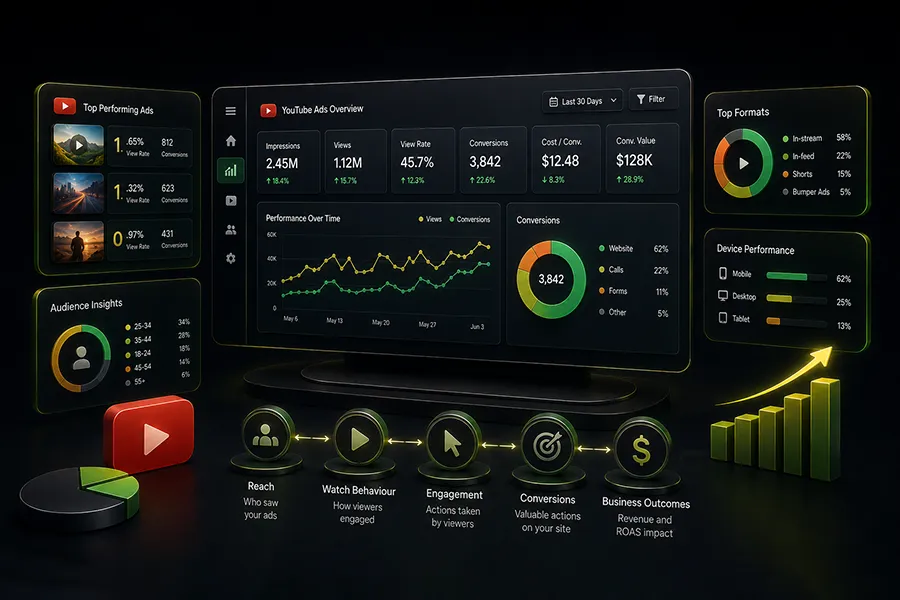
Understand how broadly campaigns deliver and whether frequency remains appropriate for the objective and audience.
Review how viewers respond after the impression instead of relying on reach alone.
Connect YouTube activity with website actions and reliable downstream business outcomes.
Identify which hooks, videos, formats and audience combinations should be refreshed, reduced or expanded.
YouTube Ads FAQs
Understand ad formats, Shorts, creative production, targeting, conversion tracking and campaign measurement before starting.
Enquire NowThe service can include campaign strategy, audience research, ad-format planning, creative briefs, video ad setup, bidding, conversion tracking, optimisation and reporting. The exact scope depends on whether the goal is awareness, views, engagement, website action, leads or sales.
We can manage skippable in-stream, non-skippable in-stream, in-feed video, bumper and YouTube Shorts ads, subject to campaign type, objective, account eligibility and available creative assets.
In-stream ads play around video content, while in-feed ads appear in YouTube discovery environments such as Search, Home and related browsing surfaces. In-feed ads rely strongly on the thumbnail and headline because the viewer chooses to open the video.
Vertical 9:16 video is strongly recommended for Shorts because it matches the mobile-first full-screen experience. Horizontal and square assets may be supported in some campaign setups, but vertical creative is generally better suited to the format.
The service can include creative strategy, scripts, storyboards, production briefs, editing and format adaptations. The production scope depends on the number of concepts, shoot requirements, animation and monthly testing needs.
Yes. YouTube campaigns and eligible Google campaign types can optimise toward website conversions when conversion tracking is configured correctly. Performance depends on the offer, audience, creative, landing page, budget and quality of the conversion signal.
The right duration depends on format and objective. Bumper ads are six seconds, Shorts creative is usually brief and vertical, while skippable in-stream and in-feed videos can support longer explanations. The message should earn attention quickly regardless of total length.
Measurement can include reach, frequency, TrueView views, view rate, watch time, completion, clicks, website conversions, qualified leads, purchases, conversion value and format-level performance.
Some reach and consideration campaign types can use content signals such as topics, keywords or placements. Availability and suitability depend on the campaign objective and subtype, and conversion-focused campaign setups may rely more heavily on audience and automated delivery.
No responsible video advertising service can guarantee fixed business results. Performance depends on the objective, audience, creative, budget, competition, measurement, website experience and sales process. We provide transparent planning, optimisation and reporting.
Get a clear roadmap for campaigns, creative, website, SEO, and performance before you scale your next project.