More product discovery
Help shoppers find relevant categories, products and buying guides across commercial and transactional searches.

Improve category visibility, product discovery and organic revenue with an ecommerce SEO strategy built for catalogue scale, customer intent and technical control.
Enquire NowEcommerce SEO overview
Ecommerce SEO connects search demand with the structure of your store. BrainADZ aligns category pages, product pages, filters, internal links, product data and technical rules so shoppers can discover the right catalogue pages through organic search.
The goal is not simply to increase indexed URLs. It is to improve the quality of the index, strengthen commercially important pages and connect search performance with product engagement, transactions and revenue.
Enquire Now
Help shoppers find relevant categories, products and buying guides across commercial and transactional searches.
Build high-value collection pages that rank for broader demand and guide users toward the right products.
Control filters, parameters, duplicates and product states so search engines spend time on pages that matter.
Connect search visibility with product views, add-to-cart activity, transactions and revenue contribution.
Ecommerce site architecture
Search engines and shoppers need a logical path from broad category demand to specific products. We connect taxonomy, internal links, variants and conversion journeys into one clear architecture.
Organise category, subcategory, product, brand and informational demand around the way customers research and buy.
Keyword-to-page ownership
Create a clear taxonomy that supports crawl depth, merchandising, internal linking and scalable content expansion.
Navigation and page hierarchy
Connect variants, related products, brands, collections and alternatives without creating avoidable duplication.
Product and variant logic
Align search landing pages with filters, proof, product discovery and calls to action that help shoppers continue confidently.
Organic landing experience
Ecommerce SEO optimisation
Each optimisation area has a different role. Category pages capture broader demand, product pages convert specific demand and technical controls protect the quality of the catalogue index.
Category-page SEO
We optimise category and subcategory pages around commercial intent, product selection and internal discovery instead of adding generic text that shoppers ignore.
Product-page SEO
Product pages are strengthened with unique decision-making information, complete attributes, structured data and contextual links that support both rankings and conversion.
Faceted navigation
We decide which filtered combinations deserve indexable landing pages and which parameters should remain available to users without entering the search index.
Structured data
We review structured data against visible page content, product states and template logic so markup remains valid and commercially meaningful at scale.
Crawl and index management
Large stores generate many URLs through filters, sorting, search, pagination, tracking parameters and product states. We create rules that protect crawl efficiency and index quality.
Content and internal links
Buying guides, comparisons, brand pages and supporting content are connected to relevant commercial pages so authority and users move naturally through the store.

Category-to-product alignment
Category pages should help shoppers compare a range, while product pages should answer the questions required to choose a specific item. We prevent overlap by defining page ownership, content depth and internal-link relationships across the catalogue.
One clear landing page for each valuable commercial search theme.
Useful specifications, benefits, compatibility and purchase information.
Links that connect guides, brands, categories, products and alternatives.
Availability, delivery, proof and calls to action aligned with search intent.
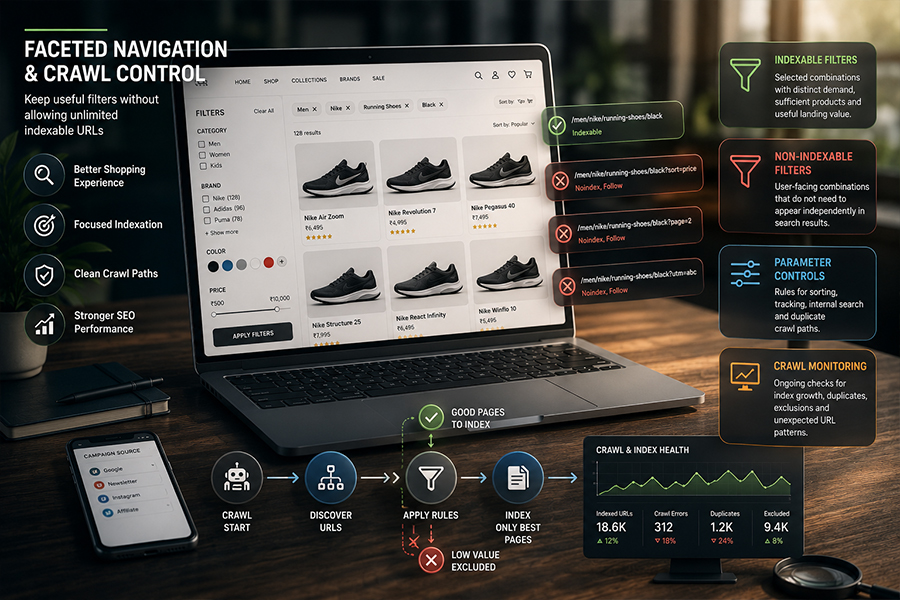
Faceted navigation and crawl control
Filters improve shopping, but every combination can generate another URL. We identify valuable filtered demand, protect approved landing pages and control low-value combinations through platform-appropriate technical and linking rules.
Product lifecycle SEO
Active, unavailable, discontinued and variant products should not all receive the same treatment. Clear rules preserve valuable visibility while reducing dead ends and catalogue duplication.
Keep indexable products complete, internally linked, included in relevant sitemaps and aligned with live price and availability data.
Preserve useful URLs when products are expected to return, while clearly communicating stock status and offering relevant alternatives.
Choose between retaining, redirecting or retiring URLs based on backlinks, demand, replacements and the value of historical search visibility.
Define canonical and indexation rules for colour, size, pack and model variants according to unique demand and page value.
Store-specific strategy
A focused D2C brand, a large multi-category store and a technical B2B catalogue need different page strategies, operational controls and definitions of conversion success.
Build demand beyond branded searches by connecting product benefits, category intent, educational content and conversion-focused product experiences.
Manage scale across thousands of SKUs, filters and product states with template controls, crawl rules and prioritised catalogue optimisation.
Support technical product discovery, specification-led searches and longer buying journeys where enquiries, quote requests and assisted sales matter.
Ecommerce SEO process
Ecommerce SEO works best when technical fixes, catalogue priorities, merchandising and measurement follow one implementation roadmap with clear ownership.
Enquire NowWe review architecture, templates, indexation, crawl paths, category and product pages, structured data, analytics and organic revenue performance.
We connect priority searches with categories, subcategories, products, brands and content while identifying gaps, overlap and cannibalisation.
We resolve critical crawl, canonical, parameter, sitemap, schema, rendering and template issues that affect the store at scale.
Priority category and product pages receive stronger targeting, content, internal links, structured data and merchandising support.
We review visibility, landing-page engagement, transactions and revenue to refine priorities and scale the page groups producing commercial value.
Ecommerce SEO reporting
Commercial reporting should show which page groups attract qualified shoppers, where technical issues limit discovery and how organic search contributes to transactions.
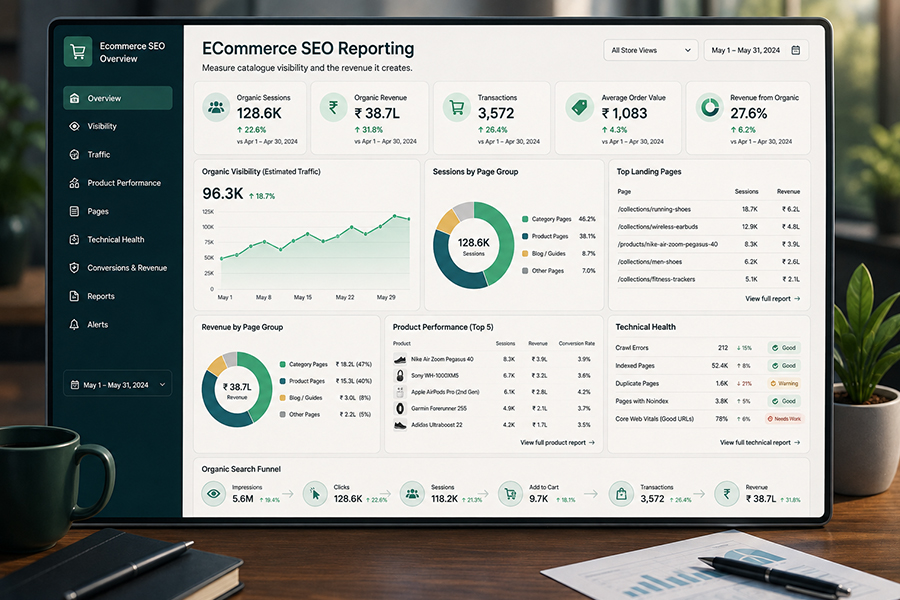
Measure whether SEO visibility contributes to ecommerce outcomes instead of reporting rankings and traffic in isolation.
Track how commercial page groups perform across high-value search themes, brands, categories and product demand.
Monitor the technical conditions that affect catalogue discoverability and rich-result eligibility at template scale.
Evaluate whether category and product pages attract qualified users and help them continue through the shopping journey.
Ecommerce SEO readiness checklist
Ecommerce SEO depends on accurate catalogue data, editable templates, reliable tracking and a development workflow capable of implementing changes safely at scale.
Enquire NowFoundation review
Access to the ecommerce platform, analytics, Search Console and product data sources
A clear category hierarchy that reflects real products and customer buying behaviour
Stable product URLs and documented rules for variants, stock states and discontinued items
Crawlable category and product pages with important content available in rendered HTML
Consistent product names, prices, currencies, availability and identifiers across templates
Control over faceted-navigation URLs, sorting parameters and internal search pages
Editable titles, headings, descriptions, canonicals and structured-data templates
Reliable ecommerce event tracking for product views, carts, checkouts and purchases
A development workflow for testing and releasing technical SEO changes safely
Merchandising and content teams available to support priority category and product improvements
Ecommerce SEO FAQs
These answers cover the questions ecommerce teams usually ask about categories, products, filters, stock states, platforms and revenue measurement.
Enquire NowAn Ecommerce SEO engagement can include technical and catalogue audits, category-page optimisation, product-page optimisation, faceted-navigation controls, product schema, internal linking, content planning, crawl and index management, product lifecycle rules and organic revenue reporting. The final scope depends on your platform, catalogue size, implementation access and commercial priorities.
FAQ item 1Ecommerce SEO must manage large numbers of category, product, variant, filter and parameter URLs while connecting visibility directly to transactions and revenue. It also requires closer coordination with merchandising, inventory, product data, structured data and platform templates than a typical content-led website.
FAQ item 2No. Most filter combinations should remain available for users without becoming indexable search landing pages. We evaluate demand, uniqueness, inventory depth and business value to decide which filtered pages deserve dedicated URLs and which should be controlled through canonicals, noindex rules, robots directives or internal-link restrictions.
FAQ item 3We align each category with a distinct commercial search theme, improve titles and headings, add useful supporting copy, strengthen internal links, review pagination and canonicals, improve product discovery and ensure the page offers enough inventory and decision-making value to satisfy the search intent.
FAQ item 4Unique product content is valuable when it adds information shoppers need, such as benefits, specifications, compatibility, sizing, use cases, comparisons, delivery details or FAQs. Rewriting manufacturer text without adding useful value is less important than improving the completeness and usefulness of the page.
FAQ item 5The correct treatment depends on whether the product will return, whether the URL has search demand or backlinks and whether a relevant replacement exists. Temporarily unavailable products can often remain live, while discontinued products may be retained, redirected or removed according to their continuing value.
FAQ item 6Yes. The strategy is platform-independent, but implementation methods vary. We adapt recommendations to the platform's routing, template, app, plugin, structured-data, rendering and deployment constraints, and we identify where developer support is required.
FAQ item 7Critical crawl, indexation and template fixes may create early improvements, while category growth, product discovery and revenue gains usually require sustained implementation. Timing depends on catalogue size, competition, platform limitations, development speed, content quality and the site's existing authority.
FAQ item 8We combine category and product visibility with organic clicks, product views, add-to-cart activity, transactions, conversion rate and revenue. Reporting also monitors index coverage, crawl quality, structured-data health and the landing-page groups creating or losing commercial value.
FAQ item 9
Get a clear roadmap for campaigns, creative, website, SEO, and performance before you scale your next project.