Improve message continuity
Carry the same intent, offer and promise from the ad or keyword into the landing-page experience.

Improve paid campaign conversion through stronger message match, mobile-first UX, clearer forms, trusted proof and structured experimentation.
Enquire NowLanding-page overview
Landing Page Optimization connects campaign intent with the page users see after the click. BrainADZ improves message continuity, hierarchy, trust, mobile usability, forms and measurement so the page supports the outcome the campaign is paying to generate.
Success is evaluated beyond conversion rate. We review whether the additional leads, bookings or purchases remain valid, qualified and commercially useful before treating a change as an improvement.
Enquire Now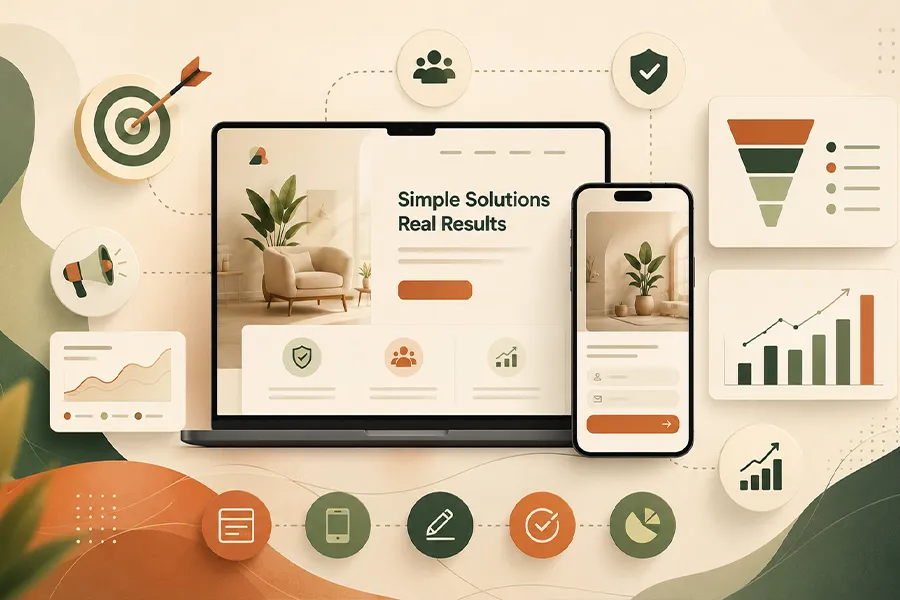
Carry the same intent, offer and promise from the ad or keyword into the landing-page experience.
Remove avoidable confusion, unnecessary fields, weak hierarchy and poor mobile interactions from the user journey.
Improve the rate of useful enquiries, bookings, purchases or sign-ups rather than chasing low-quality form volume.
Use analytics, hypotheses and controlled experiments to improve decisions over time instead of relying on opinion.
Conversion framework
Every high-performing landing page answers four questions quickly: Am I in the right place? Why does this matter? Why should I trust it? What do I do next?
The page immediately confirms that the visitor has reached the right offer, product, service or solution.
Ad-to-page continuity
The primary benefit, audience, differentiation and expected outcome are easy to understand without excessive effort.
Why the offer matters
Relevant evidence, credentials, product details, testimonials and process visibility reduce uncertainty.
Why the visitor should believe
The page provides a clear, appropriate next action with the right amount of information and friction.
How the visitor responds
Optimization capabilities
Copy, UX, forms, trust, speed and analytics must work together. A stronger headline cannot repair a broken form or weak campaign-page match.
Landing-page audit
We review message match, structure, content, UX, forms, trust, speed, mobile behaviour, tracking and downstream lead quality.
Offer and messaging
Headlines, supporting copy, benefits, proof, objections and calls to action are organised around the visitor’s intent and stage.
Page structure and hierarchy
Sections are prioritised so users can understand the offer, evaluate proof and act without navigating a cluttered or repetitive page.
Form and interaction optimisation
Forms, calls, chat, booking and purchase actions are designed around the minimum information needed for the intended outcome.
Trust and conversion proof
Testimonials, reviews, case examples, credentials, guarantees, process details and product proof are selected according to the visitor’s concerns.
Analytics and experimentation
Tracking, event definitions, funnels, qualitative evidence and experiments are used to test specific conversion hypotheses.
Landing-page models
Lead forms, ecommerce products, campaign microsites and B2B decisions require different information depth and conversion controls.
Convert paid search and social traffic into calls, forms, messages, bookings and qualified sales enquiries.
Improve product understanding, trust, variant selection, cart action and purchase confidence for paid traffic.
Create focused experiences for launches, events, offers, reports, webinars or limited campaign objectives.
Support longer evaluation journeys using technical detail, credibility, use cases and high-value conversion paths.
UX and mobile optimisation
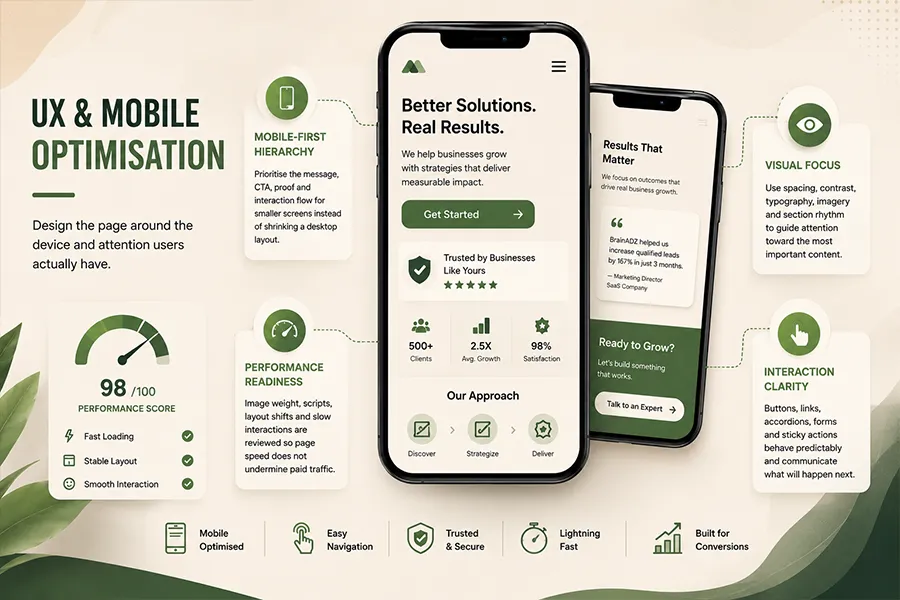
Mobile landing pages need stronger prioritisation, simpler interactions and faster access to the primary action. Desktop layouts should not be compressed without reconsidering the complete experience.
Prioritise the message, CTA, proof and interaction flow for smaller screens instead of shrinking a desktop layout.
Use spacing, contrast, typography, imagery and section rhythm to guide attention toward the most important content.
Buttons, links, accordions, forms and sticky actions behave predictably and communicate what will happen next.
Image weight, scripts, layout shifts and slow interactions are reviewed so page speed does not undermine paid traffic.
Form optimisation
A shorter form is not automatically better. Field requirements should reflect the value of the offer, qualification need and user expectation.
Collect only the details required to route, qualify or complete the intended transaction at that stage.
Labels, input types, validation, autofill and mobile keyboards should make completion clear and efficient.
Explain what happens after submission, how soon the user will hear back and what information they should prepare.
Consent language, privacy links and data-use explanations should be appropriate to the form and business requirements.
Experimentation system
A/B testing is useful only when tracking, traffic, hypotheses and business-quality checks are strong enough to support a decision.
Enquire NowUse analytics, campaign data, sales feedback, user behaviour and page review to identify the most important friction.
Define the specific page change, expected behaviour and business reason before creating a test.
Run controlled A/B or sequential tests where traffic, tooling and risk make experimentation reliable.
Review lead quality, revenue, form validity and downstream outcomes so a higher conversion rate does not create weaker results.
Adopt, reject or revise the variation using statistical and commercial evidence rather than preference.
Document results and convert each test into the next prioritised hypothesis instead of restarting from zero.
Every landing page has one clearly prioritised conversion goal, with secondary actions used only when they support the journey.
The page is evaluated by campaign, keyword, audience, device and intent so mixed traffic does not hide experience problems.
Form volume, sales quality, order value and downstream outcomes are checked before declaring a page improvement successful.
Forms, events, redirects, confirmation states and mobile interactions are tested before paid traffic is increased.
Optimization process
Campaign context, UX, implementation, tracking and experiment learning remain connected through one conversion roadmap.
Enquire NowWe confirm the campaign source, audience, offer, primary action, qualification requirements and downstream business outcome.
Message match, content, hierarchy, mobile UX, forms, speed, analytics, funnel drop-off and lead or sales feedback are reviewed.
Opportunities are scored by expected impact, evidence strength, implementation effort, traffic and business risk.
Page hierarchy, messaging, proof, forms, mobile behaviour and conversion actions are translated into implementation-ready requirements.
Changes are built, responsive states are checked and conversion events, forms and confirmation journeys are validated.
Page performance and qualified outcomes are monitored, tests are evaluated and the next hypothesis backlog is updated.
Landing-page reporting
Reporting explains which visitors convert, where friction remains and whether additional conversions maintain the required commercial quality.
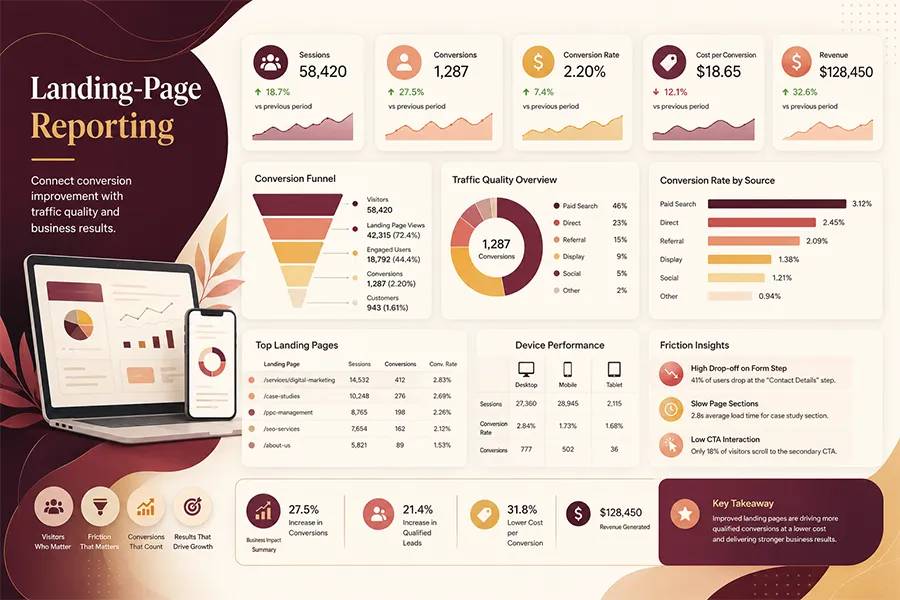
Understand which campaigns, audiences, keywords and devices bring users to the page and how their behaviour differs.
Measure the page’s ability to generate the primary action and identify where users leave the journey.
Review whether improved page performance produces useful leads, purchases and revenue—not only more actions.
Document hypotheses, test results, confidence, business impact and the next recommended page improvement.
Landing Page Optimization FAQs
Understand page scope, forms, mobile UX, testing, speed, conversion quality and measurement before starting.
Enquire NowThe service can include message-match review, copy and hierarchy improvements, UX and mobile analysis, form optimisation, trust and proof, page-speed recommendations, conversion tracking, testing strategy and qualified-conversion reporting.
No. Landing Page Optimization focuses on improving a specific campaign or conversion experience. It may involve significant changes, but the work is driven by conversion evidence and user intent rather than a complete visual redesign of the website.
Yes. We can optimise an existing page or create a new campaign-specific landing page when the current website cannot provide sufficient message match, focus, tracking or conversion control.
The exact content depends on the offer, but most effective pages need a clear headline, value proposition, relevant proof, useful details, objection handling, a strong primary action and a mobile-friendly conversion path.
There is no universal number. The form should collect the minimum information required to complete, route or qualify the enquiry. Removing fields can improve completion, but it can also reduce lead quality if important qualification information is lost.
Yes, when the page has enough traffic, conversions, stable tracking and an appropriate testing tool. Where volume is limited, we use evidence-led sequential improvements and monitor results carefully instead of claiming statistical certainty.
Measurement can include conversion rate, form completion, calls, bookings, purchases, qualified leads, revenue, cost per qualified conversion and experiment results. The primary metric is agreed according to the campaign goal.
Speed can reduce abandonment and improve user experience, especially on mobile. Its business impact depends on the current performance problem, page complexity, connection quality and the rest of the conversion experience.
Changes can affect behaviour as soon as they are released, but reliable conclusions require enough traffic and conversions. Timing depends on campaign volume, conversion rate, test design, implementation quality and downstream lead or sales feedback.
No responsible optimisation service can guarantee a fixed uplift because results depend on traffic quality, offer, pricing, brand trust, page experience, tracking and market conditions. We use evidence, testing and transparent reporting to improve the probability of better outcomes.
Get a clear roadmap for campaigns, creative, website, SEO, and performance before you scale your next project.