Acquire profitable customers
Build campaigns around contribution, repeat purchase potential and customer value instead of revenue volume alone.

Grow ecommerce revenue through product-level paid acquisition, accurate measurement and optimisation guided by profitability and customer quality.
Enquire NowEcommerce PPC overview
Ecommerce PPC coordinates search, shopping, social, video and remarketing around product demand and commercial outcomes. BrainADZ connects catalogue strategy, creative, campaign structure, bidding, website experience and revenue measurement into one paid growth system.
Performance is evaluated beyond total sales. We review which products sell, which customers are acquired, how basket value changes and whether the resulting revenue can support further investment.
Enquire Now
Build campaigns around contribution, repeat purchase potential and customer value instead of revenue volume alone.
Allocate spend toward products, categories and offers with stronger demand, margin, stock and conversion potential.
Connect clicks with orders, revenue, basket value, new customers, refunds and profitability signals.
Expand budgets only when tracking, product economics, stock, creative and conversion performance remain stable.
Ecommerce growth model
Sustainable ecommerce growth needs more than one channel or one order. Paid media should create demand, capture intent, recover interest and improve customer value over time.
Reach people actively searching for products, categories and solutions through high-intent paid search and shopping environments.
Existing purchase intent
Use social and video advertising to introduce products, demonstrate value and build consideration before the customer searches.
New product discovery
Bring back product viewers, cart users and recent visitors with relevant messages, exclusions and controlled frequency.
Remarketing and recovery
Use repeat purchase, average order value and customer-quality signals to move beyond one-order campaign evaluation.
Longer-term profitability
Ecommerce PPC capabilities
Product economics, catalogue quality, campaign structure and conversion data must work together before spend can scale responsibly.
Commercial and catalogue strategy
We review product demand, margin, stock, pricing, seasonality, repeat purchase and conversion potential before assigning campaign priority.
Channel and campaign architecture
Search, shopping, social, video and remarketing campaigns are structured around acquisition, consideration, recovery and customer value.
Product data and feed readiness
Titles, descriptions, categories, identifiers, pricing, availability and image quality are reviewed so platforms can understand and match products accurately.
Creative and offer testing
Product demonstrations, benefits, bundles, proof, pricing, urgency and promotional messages are tested across suitable paid formats.
Bidding and budget management
Campaign budgets and bidding are managed around conversion volume, value, margin, inventory, promotional periods and account maturity.
Conversion and customer measurement
Tracking is reviewed across purchase events, order value, new customers, repeat purchases, refunds and other available ecommerce outcomes.
Ecommerce business models
A single-product brand, large catalogue, seasonal store and repeat-purchase business should not use the same campaign model.
Concentrate spend around one core offer while testing bundles, creative angles, audiences and conversion paths.
Segment campaigns by category economics, demand and inventory instead of treating the complete catalogue equally.
Plan demand, stock, offers, creative and budget around predictable sales periods without sacrificing post-event profitability.
Measure acquisition quality using reorder behaviour, customer value and retention rather than only first-order ROAS.

Product and merchandising readiness
The product, catalogue and website experience must support the promise the campaign makes. Merchandising readiness is reviewed before additional budget is used to amplify avoidable problems.
The product, price and offer should satisfy a clear demand or create a convincing reason for discovery-led purchase.
Titles, variants, images, attributes and category structure should help platforms and customers understand the product.
The ad promise, product detail, pricing, delivery, proof and checkout path should remain consistent after the click.
Stock, fulfilment, returns, support and promotional terms must support the demand campaigns generate.
Ecommerce measurement
Orders and revenue matter, but basket value, customer type, discounts, refunds and contribution determine whether paid growth is sustainable.
Track completed purchase value and order volume while validating the accuracy of the ecommerce event implementation.
Review cost per order, ROAS and contribution-aware targets rather than relying on revenue without spend context.
Monitor average order value, item count, bundles and product mix to understand the value of acquired transactions.
Where data allows, separate new and returning customers and evaluate repeat purchase or customer value.
Profitability controls
Ecommerce campaigns should account for product economics, stock, customer type and transaction quality before budgets are scaled.
Enquire NowRevenue and ROAS are reviewed with product margin, discounting, shipping and other available contribution factors.
Budgets are reduced, redirected or paused when inventory and availability cannot support additional demand.
Performance is analysed by product, category, brand, offer and channel instead of only at total account level.
Campaigns are reviewed for acquisition quality so returning-customer revenue does not hide weak prospecting performance.
Ecommerce PPC process
Catalogue, channel, creative, conversion and profitability decisions remain connected through one ecommerce campaign roadmap.
Enquire NowWe confirm products, margins, average order value, stock, fulfilment, conversion tracking, customer data and commercial priorities.
Demand, competition, stock, margin, conversion potential and creative readiness are used to define the initial campaign portfolio.
Product data, image assets, promotional messages, landing pages and checkout journeys are reviewed before campaign build.
Campaigns, product groups, audiences, bids, budgets, exclusions and ecommerce conversion events are configured and checked.
Early delivery, product demand, conversion value, stock, creative response and category economics are monitored.
Budgets, product groups, bids, creative, offers and remarketing are refined using revenue, contribution and customer-quality evidence.
Ecommerce PPC reporting
Reporting explains which products sell, which campaigns acquire useful customers and where additional budget can create sustainable growth.
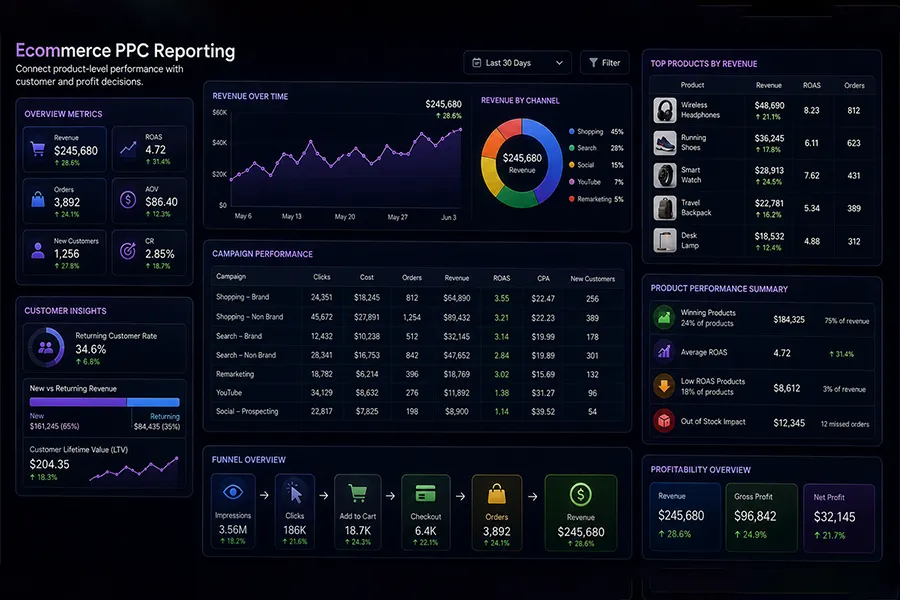
Identify which products and categories attract demand, convert efficiently and deserve additional budget.
Review how efficiently campaigns acquire transactions and customers across channels, audiences and offers.
Understand whether campaign growth improves the value and quality of transactions rather than only order volume.
Show where spend should be expanded, protected, reduced or redirected based on product economics and demand.
Ecommerce PPC FAQs
Understand channels, feeds, ROAS, new customers, remarketing, creative, timelines and profitability before starting.
Enquire NowThe service can include paid acquisition strategy, product and category prioritisation, campaign structure, feed readiness, creative testing, bidding, budgets, remarketing, purchase tracking, revenue analysis and ongoing optimisation. The exact channel mix depends on your store, products and goals.
Ecommerce PPC can include Google Search, Google Shopping, eligible automated Google campaign types, Meta Ads, YouTube and remarketing. Channel selection depends on product demand, visual appeal, search behaviour, margins, budget and tracking readiness.
Google Shopping Ads are one specific product-ad channel. Ecommerce PPC is broader and coordinates search, shopping, social, video, remarketing, product economics, creative, measurement and customer acquisition across the complete paid ecommerce programme.
Yes. Feed work can include titles, descriptions, categories, product types, identifiers, pricing, availability and image quality, along with issue and disapproval monitoring. The depth of feed management depends on the platform and catalogue setup.
The correct ROAS depends on gross margin, discounts, shipping, payment costs, returns, repeat purchase and operating goals. A high revenue-based ROAS can still be unprofitable, so targets should reflect actual business economics.
Yes. Prospecting campaigns can be separated from remarketing and returning-customer activity. Where platform and ecommerce data allow, new-customer performance can be reviewed separately so acquisition quality is clearer.
Yes. Remarketing can include product viewers, category visitors, cart users, checkout users and past customers, with exclusions and frequency controls based on the buying cycle and product type.
Campaigns can generate traffic and orders after launch, but reliable profitability patterns require enough product-level demand and conversion data. Results depend on price, product-market fit, competition, creative, website experience, stock and tracking quality.
The service can include creative strategy, product images, static ads, video briefs, UGC concepts and placement adaptations. Production scope is agreed according to channel mix, catalogue size and testing requirements.
No responsible PPC provider can guarantee a fixed ROAS or revenue because performance depends on demand, competition, pricing, margin, stock, website conversion, creative, budget and measurement. We provide transparent management and optimisation around agreed commercial goals.

Get a clear roadmap for campaigns, creative, website, SEO, and performance before you scale your next project.