Clearer keyword relevance
Align each page with one defined search purpose so rankings are not weakened by overlap or mixed intent.

Improve page relevance, content quality and organic conversions with search-intent mapping, structured optimisation and clearer user journeys.
Enquire NowOn Page SEO overview
On Page SEO connects search demand with page purpose. BrainADZ aligns keywords, headings, content, metadata, internal links, structured data and calls to action so each page communicates one clear answer to users and search engines.
The work goes beyond inserting keywords. Strong optimisation improves information quality, removes overlap, strengthens topical relevance and helps visitors continue toward the most useful next step.
Enquire Now
Align each page with one defined search purpose so rankings are not weakened by overlap or mixed intent.
Improve titles, headings, content depth and supporting signals that help search engines understand page value.
Guide visitors from the search result to the right information, proof and next action without unnecessary friction.
Connect page-level visibility and engagement with enquiries, assisted conversions and commercial performance.
Search-intent strategy
Strong On Page SEO starts before rewriting. We first decide what the searcher needs, which page should satisfy it and what action makes sense after the answer.
Understand whether the searcher wants information, comparison, a solution, a product, a service or an immediate action.
Why the search happens
Assign each valuable search theme to one primary page so multiple URLs do not compete for the same intent.
Which page should rank
Choose the right page type, depth, headings, media and proof based on the format already satisfying the search result.
How the answer should appear
Match the call to action with the visitor’s stage instead of forcing the same commercial action on every search.
What the user should do next
On Page SEO optimisation
Each element has a specific role. Metadata earns attention, headings organise understanding, content satisfies intent and calls to action move the user forward.
Titles and metadata
We refine titles and meta descriptions around page intent, differentiation and click value while keeping claims accurate and natural.
Headings and page structure
Heading hierarchy is organised around the real questions, comparisons and decision points users need instead of keyword repetition.
Content optimisation
We improve existing content by filling meaningful gaps, removing repetition and adding the evidence required to satisfy the target search.
Image and media SEO
Images, diagrams and videos are reviewed for relevance, naming, alternative text, loading behaviour and their role in the page journey.
Structured data
We review eligible markup for services, articles, products, FAQs, breadcrumbs and organisations without adding unsupported claims.
Conversion elements
Calls to action, proof, forms, contact details and next-step links are aligned with the page objective and visitor readiness.

Content quality
Search visibility is difficult to sustain when a page is generic, repetitive or unsupported. We improve the substance of the page, not only the placement of target phrases.
The page adds useful explanation, experience, evidence or perspective instead of restating what already exists elsewhere.
Important questions, subtopics, entities and decision factors are covered to the depth appropriate for the intent.
Claims are supported with examples, credentials, sources, case evidence, product details or transparent business information.
Time-sensitive information, statistics, screenshots, offers and operational details are reviewed and updated when necessary.
Internal linking
Internal links help search engines discover relationships and help users move from broad information to the most relevant service, product or next action.
Direct internal authority toward high-priority pages through contextual, relevant and crawlable links.
Connect services, categories, guides, case studies and FAQs so users and search engines can understand subject relationships.
Use descriptive anchor text that explains the destination without relying on repetitive exact-match wording.
Identify valuable pages with weak or missing internal links and integrate them into the appropriate site journeys.
On Page SEO process
Every recommendation is tied to a page, intent, priority and expected outcome so implementation stays focused and reviewable.
Enquire NowWe review rankings, search queries, competing URLs, content quality, metadata, headings, internal links, schema and conversion behaviour.
We map primary and supporting search themes to the right pages, resolving cannibalisation and identifying missing landing pages.
Each priority page receives recommendations for metadata, headings, content sections, proof, internal links, schema and calls to action.
Approved changes are published and reviewed for accuracy, formatting, internal links, mobile usability, schema and indexability.
We monitor query coverage, clicks, engagement and conversion signals, then improve pages that are gaining visibility or losing relevance.
On Page SEO reporting
Reporting focuses on the pages and search themes that were actually optimised so progress can be connected to specific changes.
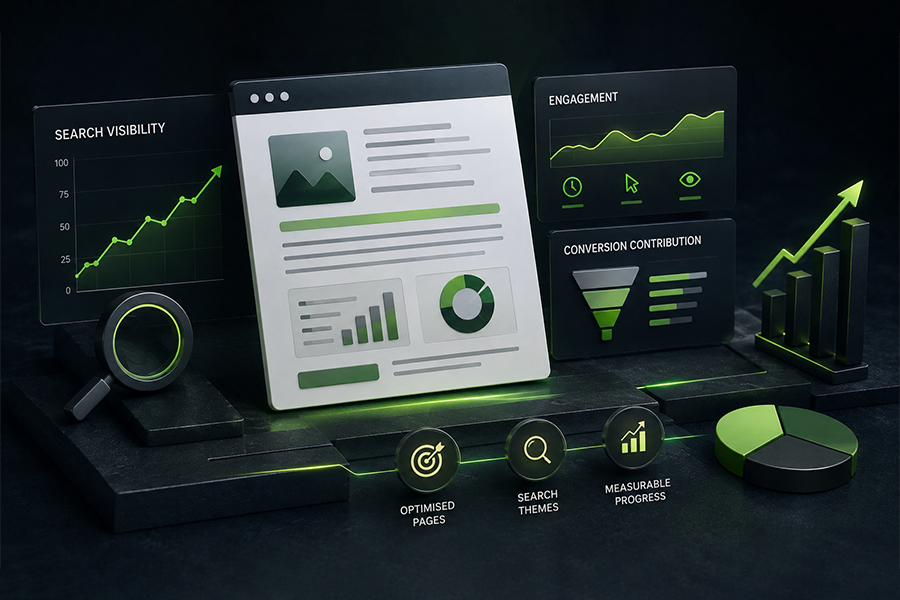
Measure how priority pages appear across target topics, supporting questions and search-intent variations.
Evaluate the visibility and engagement of individual pages rather than relying only on total website traffic.
Review whether titles, descriptions and eligible enhancements are improving click-through performance.
Connect optimised pages with enquiries, assisted actions and commercial outcomes where tracking is available.
On Page SEO FAQs
Understand page targeting, content updates, metadata, schema, timelines and measurement before starting.
Enquire NowAn On Page SEO engagement can include keyword-to-page mapping, search-intent analysis, title and meta-description optimisation, heading structure, content improvement, internal linking, image optimisation, structured data, conversion alignment and page-level reporting. The exact scope depends on your website, content quality and commercial priorities.
On Page SEO focuses on the relevance, usefulness, structure and conversion quality of individual pages. Technical SEO focuses more on crawling, rendering, indexing, performance, canonicals, structured-data infrastructure and site-wide technical controls. Both areas often need to work together.
We can provide detailed optimisation briefs, edit existing content or create complete page copy depending on the agreed scope. In many cases, the best result comes from improving strong existing information rather than replacing the entire page.
A page should primarily serve one clear search intent, but that intent can include several closely related keywords, questions and variations. We avoid forcing unrelated topics onto one URL or creating separate pages for every minor keyword variation.
Yes. We identify pages competing for the same search intent and recommend consolidation, retargeting, internal-link changes, canonical adjustments or content differentiation depending on the cause and value of each URL.
Meta descriptions are not generally treated as a direct ranking factor, but they can influence how users understand and click a search result. We optimise them for relevance, differentiation and realistic click value.
Where relevant, yes. We review schema types such as Service, Article, Product, FAQ, Breadcrumb and Organisation. Markup must reflect visible page content and follow current eligibility requirements.
Some pages can improve after they are recrawled and re-evaluated, while competitive topics usually require more time. Results depend on current rankings, content quality, technical condition, authority, competition and how quickly recommendations are implemented.
We measure rankings, query coverage, impressions, clicks, click-through rate, landing-page engagement, schema visibility and conversion activity. Reporting focuses on the performance of the specific pages and search themes that were optimised.
Get a clear roadmap for campaigns, creative, website, SEO, and performance before you scale your next project.