Reach professional decision-makers
Use role, seniority, company and industry context to reach business audiences aligned with the offer.

Reach relevant professional audiences, generate qualified B2B demand and connect LinkedIn campaigns with sales acceptance, pipeline and revenue.
Enquire NowLinkedIn Ads overview
LinkedIn Ads help businesses reach professional audiences using role, company and industry context. BrainADZ connects audience strategy, business-relevant creative, native forms, website conversions and CRM outcomes into one B2B acquisition programme.
Campaigns are evaluated beyond platform lead totals. Validity, sales acceptance, opportunity progression, pipeline value and revenue are used wherever possible to guide future spend.
Enquire Now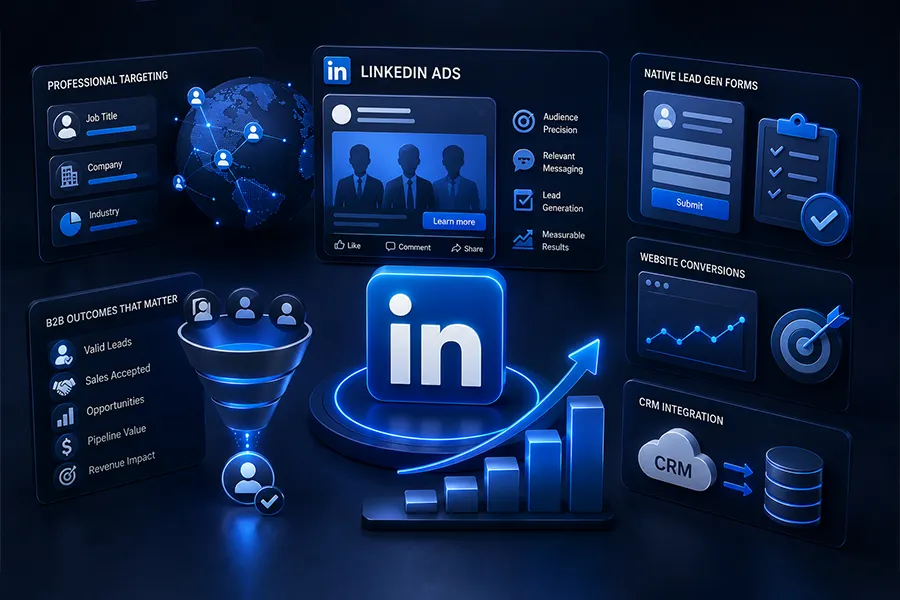
Use role, seniority, company and industry context to reach business audiences aligned with the offer.
Use thought leadership, proof, content offers and demonstrations to support longer decision journeys.
Use native Lead Gen Forms or website journeys with appropriate fields, routing and CRM context.
Connect campaigns with qualified leads, opportunities and sales outcomes instead of judging raw form volume alone.
B2B campaign funnel
B2B audiences often need education, internal alignment and proof before they are ready for a sales conversation.
Introduce the business problem, category or point of view to relevant professional audiences before active vendor evaluation.
Reach and professional relevance
Use expert content, documents, video, proof and educational offers to build credibility and buying interest.
Engagement and intent signals
Convert interest through native forms, demos, consultations, webinars, reports, website forms or other relevant actions.
Valid and qualified enquiries
Use sales acceptance, opportunity stage, deal value and customer outcomes to evaluate acquisition quality.
Commercial contribution
LinkedIn Ads capabilities
Audience precision alone is not enough. Creative, conversion paths and downstream sales feedback determine whether targeting creates useful demand.
Professional audience strategy
We map job function, seniority, role, skills, company attributes, industry and geography to the buying committee and campaign objective.
Campaign and funnel architecture
Campaigns are organised by audience, offer, funnel stage, geography and conversion path so performance remains diagnosable.
Creative and content strategy
Creative concepts are developed around professional challenges, evidence, expertise, customer outcomes and buying-stage questions.
Lead Gen Forms
Native forms are designed around the minimum profile and custom information needed to route, qualify and follow up effectively.
Website conversion campaigns
Website journeys are aligned with the ad promise, audience, proof requirements, form experience and conversion measurement.
CRM and pipeline optimisation
Lead source, campaign context, sales qualification, opportunities and customers are connected where the CRM and technical setup allow.
B2B campaign models
Content offers, demos, account-based programmes and events need different audience, creative and qualification systems.
Build credibility and audience engagement through reports, documents, webinars, videos and expert viewpoints.
Reach relevant professional audiences with high-value offers tied to a clear sales qualification journey.
Use company lists, decision-maker audiences and stage-specific content to support named-account acquisition.
Promote business events, webinars, reports and sessions with relevant audience filters and post-registration nurture.
Audience strategy
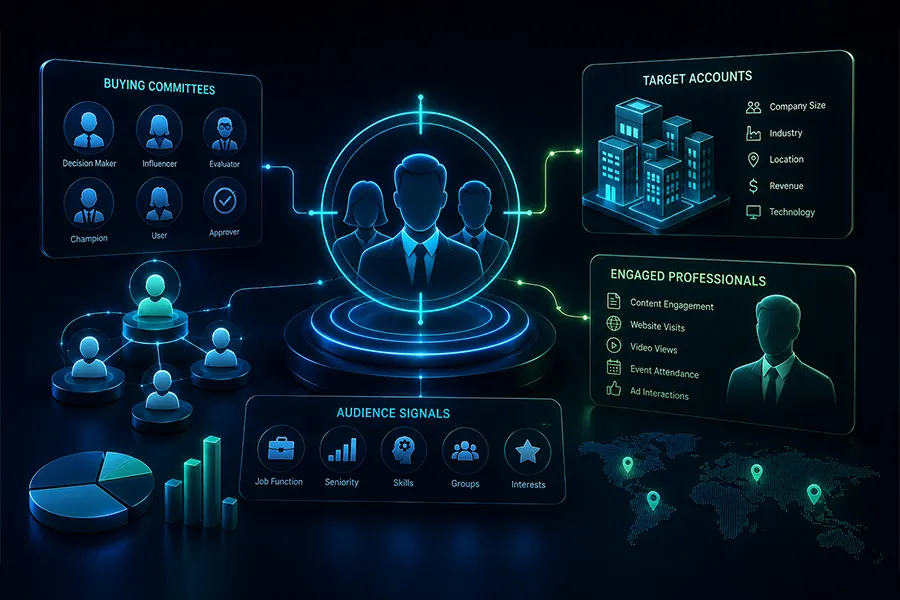
Professional targeting is organised around the people involved in the decision, the companies they work for and the signals they have already created.
Build reusable audiences using LinkedIn member attributes aligned with the role, company and market.
Use eligible company lists to reach named organisations and analyse matched versus unmatched account coverage.
Use eligible first-party contact data for customer, prospect, exclusion and nurture audiences subject to rights and consent.
Create retargeting groups from eligible website, video, form, event and content interactions.
Audiences include the roles that influence, evaluate and approve the purchase rather than one job title alone.
Targeting precision is balanced with sufficient audience size, delivery opportunity and campaign budget.
Employees, existing customers, converted leads and unsuitable companies are excluded where they should not receive acquisition spend.
Company and contact lists use clear ownership, refresh schedules, lawful data use and consistent naming.
Lead Gen Forms
Native forms can improve completion, but fields, consent, hidden metadata, lead delivery and sales response determine the commercial quality.
Use relevant prefilled professional and contact information that helps sales understand the prospect.
Ask only the custom questions needed to evaluate requirement, timing, company fit or routing.
Pass campaign, source, offer or operational metadata into lead reports and connected systems.
Deliver leads quickly with the form answers, campaign context and follow-up expectations the sales team needs.
Measurement and CRM feedback
Insight Tag, server or partner data and CRM outcomes can strengthen measurement when implementation, consent and data quality are reliable.
Insight Tag
The LinkedIn Insight Tag supports website conversion tracking, campaign reporting, retargeting and aggregate audience insights where policy and privacy requirements allow.
Conversions API
Conversions API can support broader funnel measurement and reduce reliance on browser-only signals when implementation and data governance are appropriate.
CRM conversion feedback
Connected CRM outcomes can help distinguish submitted leads from qualified leads, contacts, opportunities and customers.
Attribution and conversion windows
Conversion windows and attribution reports are reviewed alongside analytics and CRM data so platform credit is not treated as the only source of truth.
B2B acquisition controls
LinkedIn’s professional context can justify higher media costs only when audience fit, deal value and sales outcomes support the investment.
Enquire NowCampaign decisions move toward qualified leads, opportunities and customers when enough reliable CRM feedback is available.
LinkedIn media costs are evaluated against expected contract value, gross margin, close rate and sales-cycle length.
Ads speak to the professional role, company context and business problem instead of using one generic message for all audiences.
Lead volume is not scaled when routing, response time, qualification and CRM disposition cannot support additional demand.
LinkedIn Ads process
Audience, content, forms, website actions, CRM feedback and budget decisions remain connected through one B2B growth roadmap.
We confirm target organisations, roles, seniority, markets, deal value, sales cycle, qualification criteria and the desired conversion.
Professional attributes, Matched Audiences, content themes, offers, funnel stages and exclusions are organised.
Ads, documents, video, Lead Gen Forms, landing pages, qualification questions and thank-you journeys are prepared.
Campaign Manager structure, audiences, bids, budgets, forms, Insight Tag, conversions and CRM delivery requirements are configured.
Audience delivery, cost, engagement, form completion, website conversions, lead validity and sales response are monitored.
Audiences, creative, offers, forms, bids and budgets are refined using qualified-lead, opportunity and revenue evidence.
LinkedIn Ads reporting
Reporting explains which audiences and offers create qualified demand and where the next B2B media budget should move.
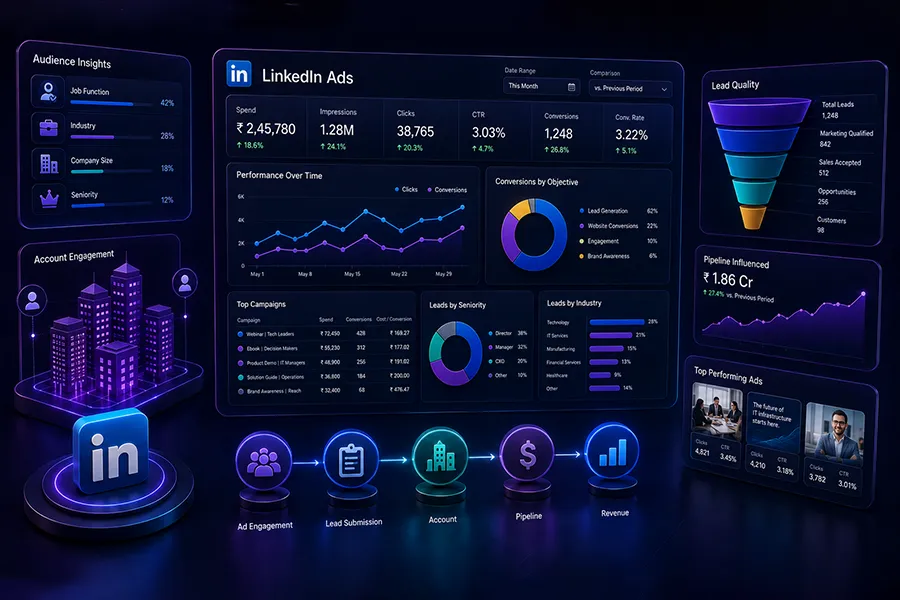
Understand which professional and company segments received spend and engaged with the campaign.
Compare messages, formats and offers to identify which business themes create useful engagement.
Separate form submissions from genuine, suitable and sales-accepted opportunities.
Connect campaign activity with target-account engagement, opportunities, pipeline value and revenue where data allows.
LinkedIn Ads FAQs
Understand targeting, Matched Audiences, forms, Insight Tag, CRM data, measurement and lead quality before starting.
Enquire NowThe service can include B2B strategy, professional audience research, Matched Audiences, campaign setup, creative planning, Lead Gen Forms, website conversions, Insight Tag, Conversions API planning, CRM feedback, optimisation and reporting.
LinkedIn Ads are often suitable for B2B products and services with identifiable professional audiences and enough lead or contract value to support the platform’s media costs. Suitability depends on audience size, offer, sales cycle and conversion economics.
Campaigns can use professional and company attributes such as role, function, seniority, skills, industry, company size and geography, along with eligible saved and Matched Audiences.
Matched Audiences are custom audience segments built from eligible sources such as company lists, contact lists, website retargeting, engagement data, third-party integrations or predictive audiences, subject to current account and regional availability.
Lead Gen Forms are native forms attached to eligible LinkedIn ads. They can prefill professional and contact information from a member’s LinkedIn profile and can include custom and hidden fields for qualification and routing.
Lead Gen Forms can reduce friction, while landing pages allow deeper explanation, proof and website-based conversion experiences. We test or select the route according to offer complexity, qualification needs and downstream lead quality.
The Insight Tag is website code used for campaign reporting, website conversions, retargeting audiences and aggregate audience insights. It must be implemented according to LinkedIn policy, privacy and consent requirements.
Yes, depending on the CRM, integration method and account setup. Leads, qualified leads, contacts, opportunities and other eligible outcomes can provide stronger downstream campaign feedback.
Measurement can include reach, engagement, Lead Gen Form completion, website conversions, valid leads, qualified leads, sales acceptance, meetings, opportunities, pipeline value and customers.
No responsible provider can guarantee fixed lead or pipeline outcomes because performance depends on audience size, competition, budget, offer, creative, conversion experience, sales response and data quality. We provide transparent optimisation around agreed commercial goals.
Get a clear roadmap for campaigns, creative, website, SEO, and performance before you scale your next project.