Find wasted spend
Identify irrelevant traffic, weak audience controls, inefficient budgets and campaign overlap that reduce paid media efficiency.

Identify tracking gaps, wasted spend and growth constraints through a structured paid media audit with a prioritised implementation roadmap.
Enquire NowPPC audit overview
A PPC audit examines how campaigns are structured, measured and optimised. BrainADZ reviews the complete paid media system—from traffic quality and bidding to landing pages, lead quality and revenue feedback.
Findings are prioritised by urgency, expected impact and implementation effort so teams know which problems require immediate correction and which opportunities belong in a longer growth roadmap.
Enquire Now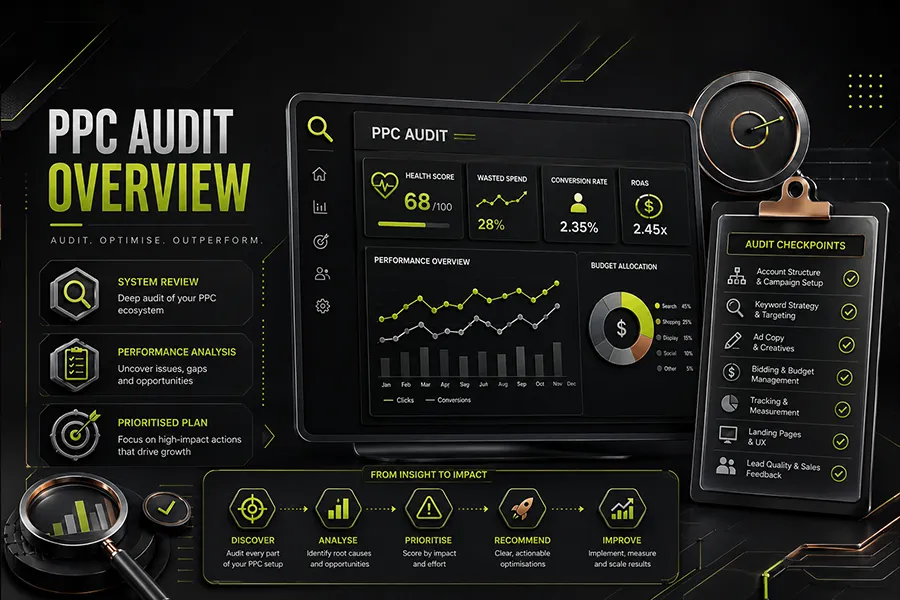
Identify irrelevant traffic, weak audience controls, inefficient budgets and campaign overlap that reduce paid media efficiency.
Check whether conversion events, revenue, lead quality and attribution inputs are reliable enough for optimisation.
Separate critical account risks from medium-term improvements and lower-impact housekeeping.
Translate findings into a practical action plan covering immediate fixes, rebuilds, tests and scaling opportunities.
Audit scope
Strong audits do not isolate platform settings from traffic quality, conversion accuracy and business value.
Review campaigns, ad groups, ad sets, naming, segmentation, channel roles and account organisation.
Control and clarity
Assess keywords, search terms, audiences, locations, placements, devices, schedules and exclusions.
Who and what receives spend
Validate primary and secondary actions, tags, values, lead quality and downstream sales feedback.
What success means
Review bids, budgets, CPA, ROAS, revenue quality, lead value and campaign contribution.
Where money creates value
PPC audit capabilities
Campaign settings, creative, landing pages and business feedback are analysed together so recommendations remain practical.
Account and campaign structure
We review campaign segmentation, naming, objectives, ad groups, ad sets, product groups, audience separation and budget ownership.
Keywords, queries and audiences
Search terms, match types, negative keywords, audience definitions, exclusions, placements and geography are reviewed for relevance.
Ads and creative
We assess whether ads match intent, communicate differentiation, use suitable formats and provide enough variation for testing.
Bidding and budgets
Bidding strategies, budget allocation, target settings, learning periods and campaign constraints are checked against conversion quality.
Landing pages and conversion paths
Landing pages, forms, calls, booking journeys, mobile UX and ad-to-page continuity are reviewed alongside campaign performance.
Lead and revenue quality
Where data is available, we compare reported conversions with valid leads, opportunities, customers, revenue, refunds and sales feedback.
Platform coverage
Cross-channel accounts need consistent conversion definitions, budget roles and audience controls.
Search, Shopping, Display, YouTube, remarketing, bidding, conversion actions and campaign structure.
Objectives, campaign structure, audiences, creative, placements, Pixel, Conversions API and lead quality.
Professional targeting, campaign objectives, Lead Gen Forms, creative, bidding and pipeline quality.
Budget allocation, duplication, remarketing overlap, attribution, naming and total business contribution.

Measurement audit
Incorrect events, duplicated conversions and weak lead definitions can make inefficient campaigns appear successful.
Confirm which actions are primary, which are diagnostic and which should not guide bidding.
Check whether forms, calls, purchases, values and key website events fire accurately and consistently.
Review CRM, sales and ecommerce data that can distinguish useful outcomes from weak platform conversions.
Compare platform reporting, analytics and downstream systems without assuming one source is complete business truth.
Audit priorities
A useful audit tells teams what to fix first, what to test next and what can wait.
Issues that invalidate reporting, waste substantial spend or expose the account to immediate performance risk.
Changes likely to improve efficiency, lead quality or revenue performance after critical risks are corrected.
Structured experiments that can improve growth once the account and measurement system are stable.
Lower-impact hygiene and governance tasks that protect long-term account quality.
Audit deliverables
The audit is designed to support implementation, not simply document problems.
Enquire NowA concise explanation of current account health, major risks, growth constraints and the highest-value actions.
Evidence-backed observations covering campaigns, traffic, conversions, creative, budgets, landing pages and lead quality.
Actions organised by urgency, expected impact, implementation effort, ownership and dependency.
Recommended conversion definitions, tag corrections, CRM feedback and reporting improvements.
Every major recommendation is tied to account data, configuration, tracking evidence or a clearly stated hypothesis.
Findings are interpreted using margins, lead value, sales process, geography, stock and operational constraints.
Recommendations identify whether media, analytics, development, creative, CRM or sales teams need to act.
We do not recommend rebuilding an account unless the expected benefit clearly outweighs disruption and lost learning.
PPC audit process
Measurement, campaign analysis, experience review and prioritisation remain connected through one audit method.
We define the audit scope, platforms, commercial targets, lead or revenue model, reporting period and required account access.
Primary actions, tags, values, attribution settings, CRM feedback and data consistency are reviewed before performance conclusions.
Structure, queries, audiences, placements, ads, bidding, budgets, locations, devices and schedules are analysed.
Ads, assets, message match, page UX, forms and conversion journeys are checked for relevance and friction.
Findings are ranked by urgency, evidence, expected impact, implementation effort and dependency.
We explain the evidence, recommended order of work, ownership and the measurements needed to confirm improvement.
PPC Audit FAQs
Understand scope, platforms, tracking, history, deliverables and implementation before starting.
Enquire NowA PPC audit can include account structure, keywords, search terms, audiences, locations, placements, ads, creative, bidding, budgets, conversion tracking, landing pages, lead quality, revenue quality and reporting. The exact scope depends on the platforms and business model.
We can audit Google Ads, Meta Ads, LinkedIn Ads and cross-channel paid media programmes. Platform coverage is confirmed before the audit begins.
The standard audit focuses on analysis and recommendations. Critical changes can be implemented separately when requested and when account access, ownership and risk are clear.
The useful period depends on spend, conversion volume, seasonality and recent account changes. We generally review enough history to identify stable patterns while separating unusual promotional or migration periods.
Yes. Conversion definitions, tags, values, duplicate events, primary and secondary actions, CRM feedback and reporting consistency are central parts of the audit.
Yes, when lead or CRM data is available. We can compare platform conversions with valid, qualified, disqualified, opportunity and customer outcomes.
Yes. Findings are prioritised by urgency, expected impact, implementation effort and ownership so the business can act in a practical sequence.
No. Many accounts can improve through targeted corrections. A rebuild is recommended only when the existing structure prevents control, measurement or responsible optimisation.
Yes. We can review message match, mobile UX, forms, trust, conversion friction and tracking on the pages used by paid campaigns.
No audit can guarantee a fixed result. It identifies evidence-based risks and opportunities. Improvement still depends on implementation quality, market conditions, budget, offer, creative, tracking and sales or ecommerce operations.

Get a clear roadmap for campaigns, creative, website, SEO, and performance before you scale your next project.