Cleaner search access
Make important pages easier for search engines to discover, crawl, render and understand.

Improve how search engines crawl, render, index and evaluate your website with a technical roadmap built for performance, scale and reliable implementation.
Enquire NowTechnical SEO overview
Technical SEO ensures that search engines can discover, render, understand and index the right version of your pages. BrainADZ combines crawl data, index coverage, performance diagnostics, template analysis and implementation support into one practical technical roadmap.
The objective is not to generate a long list of warnings. It is to identify which technical conditions affect valuable page groups, prioritise fixes by impact and verify that released changes produce the intended search-engine signals.
Enquire Now
Make important pages easier for search engines to discover, crawl, render and understand.
Reduce duplicate, low-value and conflicting URLs so the index reflects the pages that matter.
Improve Core Web Vitals, mobile usability and technical performance across critical templates.
Turn complex findings into prioritised tickets, validation steps and release-ready recommendations.
Core technical SEO areas
Each technical area affects a different stage of search processing. We connect them so crawling, rendering, canonicalisation, speed and structured data reinforce the same preferred pages.
Crawling and discovery
We identify blocked resources, inefficient crawl paths, orphan pages, redirect chains and architecture issues that prevent important content from being discovered consistently.
Indexing and canonicalisation
We align canonical tags, status codes, redirects, pagination and index directives so search engines receive consistent signals about which URLs should appear in search.
JavaScript SEO
For JavaScript-heavy websites, we compare source HTML, rendered HTML and user-visible content to find missing links, delayed content and rendering dependencies.
Core Web Vitals
We analyse real-user and laboratory data to prioritise improvements for loading, responsiveness and visual stability across high-value page templates.
Structured data
We review structured data at template level, correct validation issues and ensure markup reflects the actual page rather than creating unsupported rich-result claims.
Log-file analysis
Server logs reveal which URLs bots request, how often they crawl, where crawl budget is wasted and whether important sections receive enough attention.
Search access framework
Technical SEO is a sequence. A failure at an early stage can prevent content, authority and on-page optimisation from reaching their full value.
Important URLs need crawlable links, clean navigation and accurate sitemap support before any other signal can work.
Architecture and URL discovery
Search engines must receive the same essential content, links and metadata that users receive after the page loads.
HTML and JavaScript rendering
Canonical, status, robots and duplication signals should identify one useful version of each search landing page.
Index eligibility and consolidation
Fast, stable and mobile-friendly templates support users while reducing technical friction across organic landing pages.
Performance and usability

Crawl and index control
Conflicting canonicals, redirects, links, sitemap entries and robots directives create uncertainty. We compare these signals at URL and template level so important pages remain eligible and duplicate paths are consolidated correctly.
Confirm that priority URLs return the right status, are not blocked and contain indexable content.
Align canonicals, redirects, internal links, sitemaps and robots directives around the same preferred URL.
Identify parameters, alternate routes and near-duplicate templates that divide crawling and indexing signals.
Compare known, submitted, crawled and indexed URLs to find exclusions, gaps and unexpected index growth.
Performance and JavaScript SEO
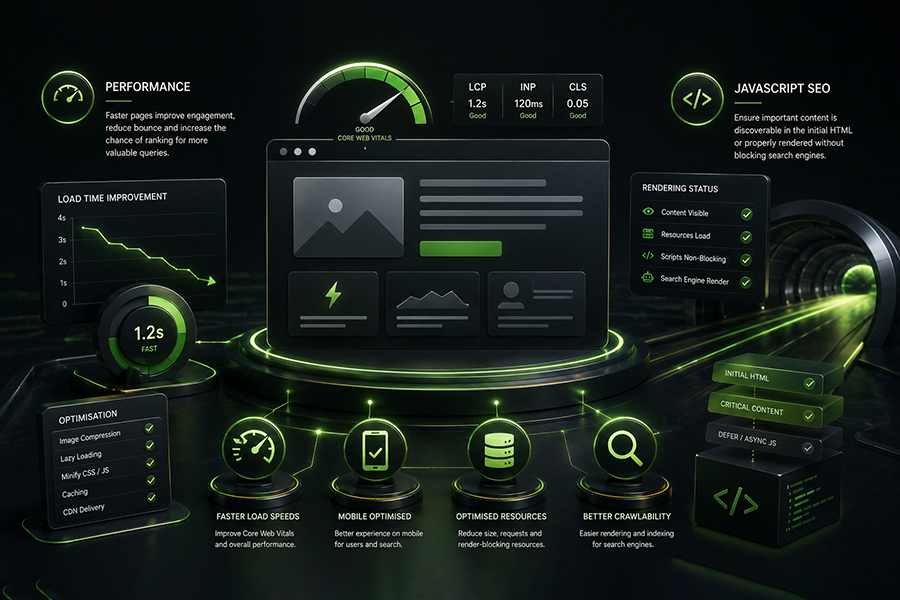
Performance and rendering are template problems before they are page problems. We identify shared causes so one implementation can improve many organic landing pages at once.
Improve how quickly the primary content element becomes visible through image, server and critical-resource optimisation.
Reduce long tasks, excessive JavaScript and third-party overhead that delay visible responses to user interactions.
Reserve stable space for images, fonts, embeds and dynamic elements so pages do not move unexpectedly while loading.
Ensure headings, links, metadata and core copy are available reliably across server and client rendering states.
Technical SEO process
Every recommendation needs a clear reason, affected scope, owner and validation method. The process keeps audits connected to development releases and measurable search outcomes.
Enquire NowWe combine crawler data, Search Console, analytics, performance data and platform information to understand the website's current technical condition.
Priority templates are checked for source HTML, rendered content, status codes, canonical rules, internal links, schema and index eligibility.
Issues are grouped by business importance, number of affected URLs, implementation dependency and expected search impact.
Recommendations are converted into clear development tickets, acceptance criteria and test cases, then validated before and after release.
We track recrawling, index coverage, performance, schema and organic landing-page trends to confirm impact and identify the next priority.
Technical SEO reporting
A technical report should show what is broken, what was released, whether search engines recognised the change and which issue deserves attention next.
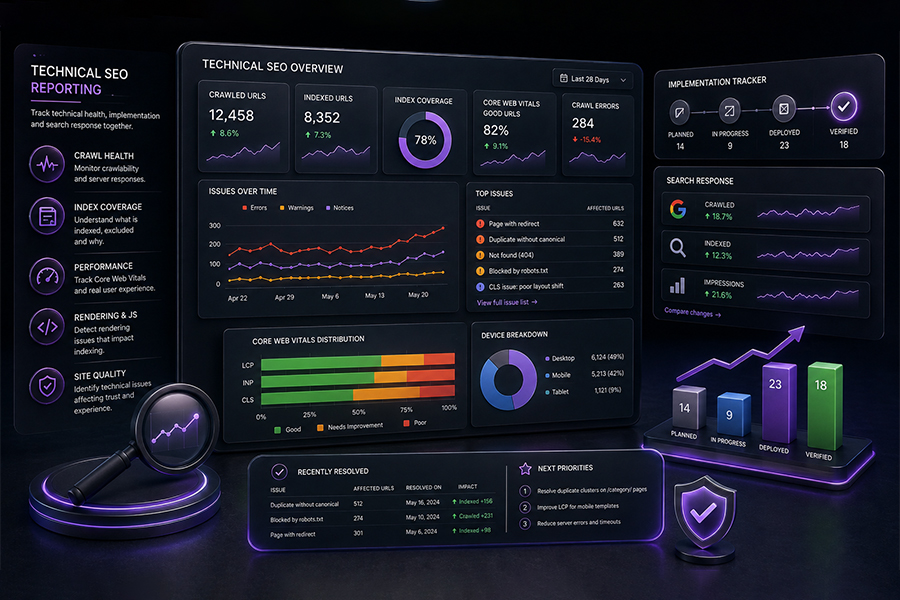
Track whether search engines can access, process and index the intended set of pages without avoidable waste or duplication.
Measure real-user performance by page type and identify templates where technical work can improve the largest share of traffic.
Monitor whether important content renders consistently and whether schema remains valid after template or platform changes.
Keep technical SEO accountable through issue ownership, release status, validation evidence and clear next actions.
Technical SEO FAQs
Understand audit scope, JavaScript SEO, Core Web Vitals, indexing, implementation support and technical reporting.
Enquire NowA Technical SEO engagement can include crawling and indexation audits, canonical and redirect analysis, JavaScript rendering checks, Core Web Vitals diagnostics, structured-data validation, XML sitemap and robots review, log-file analysis, implementation tickets, quality assurance and ongoing technical reporting. The final scope depends on the website, platform, scale and development access.
Technical SEO focuses on whether search engines can discover, render, understand and index the website efficiently. On-page SEO focuses more directly on page targeting, headings, copy, internal relevance and search intent. Both work together, but technical problems can prevent strong on-page work from being processed correctly.
Technical fixes can create meaningful gains when crawling, indexing, rendering or performance problems are limiting otherwise useful pages. However, competitive rankings also depend on content relevance, authority, user value and market conditions. We report technical impact without treating technical SEO as an isolated guarantee.
Yes. We review server-rendered, statically generated and client-rendered implementations, including Next.js applications. The analysis covers routing, metadata, rendered HTML, internal links, canonicals, hydration, lazy loading, structured data and the availability of important content to search engines.
Core Web Vitals are user-experience metrics focused on loading performance, interaction responsiveness and visual stability. The primary metrics are Largest Contentful Paint, Interaction to Next Paint and Cumulative Layout Shift. We use field and laboratory data to locate template-level causes and prioritise practical fixes.
A crawled page may remain unindexed because it appears duplicate, low value, thin, conflicting, poorly linked or inconsistent with canonical and robots signals. Indexing is also influenced by overall site quality and search demand. We examine the affected URL groups rather than assuming one universal cause.
Yes. Recommendations can be converted into development tickets with affected templates, technical requirements, examples, acceptance criteria and validation steps. We can review proposed fixes, test staging environments and confirm whether released changes produce the intended technical signals.
Log analysis is especially useful for large, frequently updated or technically complex websites. It shows which URLs verified search-engine bots request, how often they crawl, which status codes they encounter and whether crawl activity is concentrated on valuable or low-value areas.
Reporting can cover crawl errors, index coverage, submitted and indexed URLs, duplicate patterns, Core Web Vitals, rendering checks, structured-data health, implementation status and organic landing-page trends. Reports distinguish diagnosed issues, completed fixes and observed outcomes.
Get a clear roadmap for campaigns, creative, website, SEO, and performance before you scale your next project.