Capture active demand
Reach people searching for the products, services and solutions your business is ready to provide.

Capture high-intent search demand with structured campaigns, accurate conversion measurement and optimisation focused on qualified business outcomes.
Enquire NowGoogle Ads overview
Google Search Ads place your business in front of people already expressing a need. BrainADZ connects search intent, campaign structure, ad messaging, landing pages and conversion data so paid search activity remains controlled and commercially useful.
Performance is not judged by clicks alone. We review the queries, costs, conversions and downstream quality that show whether campaigns are attracting customers the business can actually serve.
Enquire Now
Reach people searching for the products, services and solutions your business is ready to provide.
Separate brand, non-brand, service, location and high-value search themes into clear campaign structures.
Connect ad clicks with qualified leads, calls, sales and downstream business results through accurate tracking.
Use query, bidding, ad, landing-page and conversion-quality data to guide the next optimisation cycle.
Search campaign strategy
A campaign is strongest when every stage continues the same commercial promise instead of forcing unrelated queries into a generic user journey.
Identify the commercial searches, questions, brand terms, service needs and location combinations relevant to the business.
What people search
Group closely related keywords by intent while using match types, negatives and search-term reviews to control reach.
Which searches trigger ads
Match responsive search ad assets with the user’s problem, offer, proof and next action.
Why the user should click
Send each search theme to a page that continues the same promise and supports a clear conversion path.
What happens after the click
Google Ads campaign management
Account structure, ads, queries, bidding and measurement must work together. Weakness in one area can distort the performance of every other area.
Keyword and market research
We research keyword themes, search intent, competition, locations and likely commercial value before deciding how campaigns should be structured.
Campaign architecture
Campaigns and ad groups are organised around business goals, geography, budgets, intent and landing pages rather than being combined into one broad account.
Responsive search ads
Headlines and descriptions are written to cover intent, differentiation, proof and action while avoiding repetitive asset variations.
Keyword and query management
Search-term reviews identify irrelevant demand, new keyword opportunities and patterns that should change account structure or landing pages.
Bidding and budget management
Bidding strategies and budgets are selected around the campaign goal, measurement maturity and available conversion signals.
Conversion measurement
We define primary and secondary conversions, validate tags and connect online campaign activity with qualified lead or sales outcomes where possible.
Search campaign models
Brand, generic, local and B2B searches have different economics, messages and conversion journeys. They should not be managed as one audience.
Protect high-intent brand searches, control messaging and direct users toward the most relevant owned experience.
Capture users actively searching for services or solutions without already knowing the business.
Structure city, area and service combinations around the locations the business can genuinely serve.
Manage lower-volume, higher-value searches with stronger qualification, proof and offline outcome feedback.

Conversion measurement
Campaign optimisation is only as useful as the conversion data it receives. We separate meaningful business actions from diagnostic activity and strengthen the feedback loop where possible.
Actions used for campaign optimisation, such as qualified forms, confirmed calls, purchases or high-value bookings.
Useful diagnostic events such as document downloads, important page views or contact-button interactions.
CRM or sales-stage information that distinguishes valid enquiries from spam, duplicates and poor-fit leads.
Revenue, order value, lead value or stage-based values used to move beyond equal treatment of every conversion.
Optimisation controls
Good account management is disciplined. Changes should respond to search quality, conversion quality, cost and business context—not the need to appear busy.
Enquire NowTags, event definitions, attribution settings and conversion status are reviewed before campaign performance is trusted.
Traffic is assessed through actual queries, intent and downstream lead quality—not only keyword-level click data.
Bids, budgets, targeting and ads are not repeatedly changed without allowing enough data to evaluate the previous decision.
The search, ad message and landing page must communicate the same service, offer and expected next action.
Google Ads process
Research, setup, measurement, launch and optimisation remain connected through one clear performance plan.
Enquire NowWe confirm the offer, customer, geography, lead or sales value, budget expectations and the actions campaigns should optimise toward.
Keyword themes, search intent, competitor messaging, result-page conditions and landing-page requirements are analysed.
Campaigns, ad groups, keywords, negatives, responsive search ads, assets, locations, schedules and budgets are configured.
Conversion actions, tags, URLs, forms, calls, mobile experience and message continuity are checked before scaling spend.
Early search terms, conversion signals, budget delivery, ad eligibility and lead quality are reviewed without overreacting to limited data.
Queries, negatives, ads, bidding, budgets, locations, schedules and landing pages are refined using conversion and business-quality evidence.
Google Ads reporting
Reporting separates traffic activity from conversion quality and explains the decisions required for the next campaign cycle.
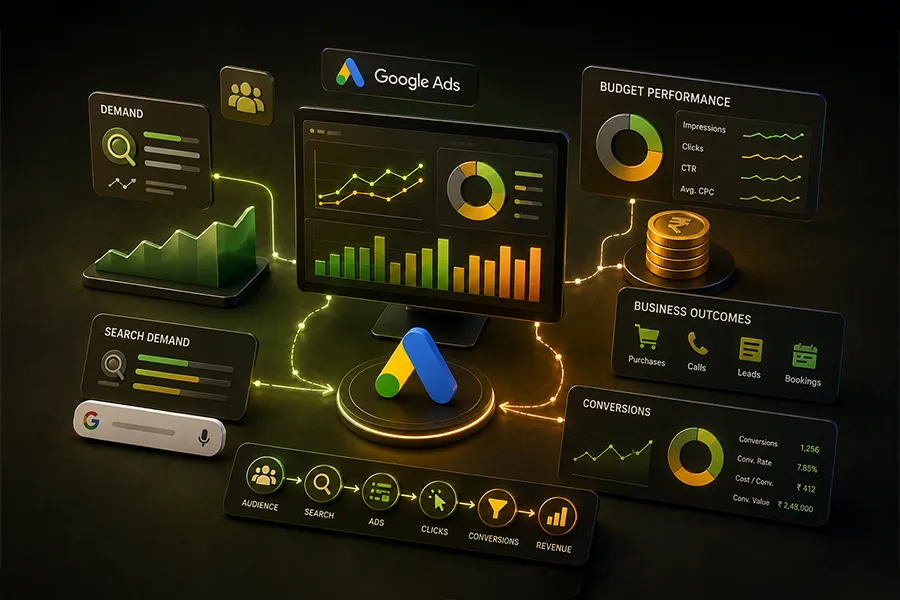
Understand which searches and campaign segments attract relevant users rather than reviewing click volume alone.
Review the actions generated by campaigns and the reliability of the measurement used for optimisation.
Connect campaign results with CRM, sales or transaction outcomes wherever data access allows.
Show where spend is efficient, constrained, wasteful or ready for controlled expansion.
Google Ads FAQs
Understand campaign scope, budgets, tracking, negative keywords, lead quality, timelines and optimisation before starting.
Enquire NowThe service can include account strategy, keyword research, campaign and ad-group structure, responsive search ads, negative keywords, bidding, budgets, conversion tracking, landing-page recommendations, ongoing optimisation and reporting. The exact scope depends on your business goals and existing account condition.
This page focuses primarily on Google Search Ads. BrainADZ provides dedicated services for Google Shopping Ads, YouTube Ads and Display Ads so each channel can use the correct strategy, creative, targeting and measurement framework.
Budget depends on search demand, competition, geography, conversion rate, customer value and the amount of data required to make reliable decisions. We recommend a starting budget after reviewing keyword costs, goals and business economics rather than using one fixed amount for every advertiser.
Campaigns can begin generating traffic soon after approval and launch, but reliable lead and cost patterns require enough conversion data and search-term evidence. Early results also depend on tracking quality, offer strength, landing pages, competition and budget.
Yes. We create responsive search ad headlines and descriptions aligned with keyword intent, offer, proof and the landing page. Messaging is reviewed and improved as performance data becomes available.
Yes. Tracking can include forms, calls, purchases and other meaningful actions using Google Ads, Google tag, Google Tag Manager or analytics integrations. Enhanced conversions and offline outcome feedback can also be planned where the required data and consent processes are available.
Negative keywords help prevent ads from showing for searches that are irrelevant or commercially unsuitable. They are developed before launch and expanded through ongoing search-term reviews.
Yes. We can audit existing campaign structure, search terms, ads, keywords, bidding, budgets, tracking and landing-page alignment, then rebuild or optimise the account according to the findings.
Where possible, we connect campaign data with CRM or sales outcomes such as valid lead, qualified lead, opportunity, booking, sale or revenue. This helps distinguish campaigns that generate cheap forms from campaigns that generate useful business results.
No responsible Google Ads service can guarantee a fixed result because performance depends on demand, competition, budget, offer, website experience, tracking and sales follow-up. We provide transparent activity, measurement and optimisation around agreed business goals.
Get a clear roadmap for campaigns, creative, website, SEO, and performance before you scale your next project.