Reach audiences beyond search
Introduce or reinforce the offer while relevant audiences browse websites, apps and eligible Google-owned properties.

Reach, re-engage and convert relevant audiences through stronger visual assets, controlled placements and measurable Google Display campaigns.
Enquire NowDisplay Ads overview
Google Display campaigns reach audiences across eligible websites, apps and Google-owned properties. BrainADZ connects campaign role, creative assets, audience signals, contextual inputs, placements, frequency and conversion measurement into one controlled programme.
Performance is reviewed beyond impressions and clicks. We evaluate whether audiences, placements and creative produce useful engagement, qualified conversions and a commercially justified level of spend.
Enquire Now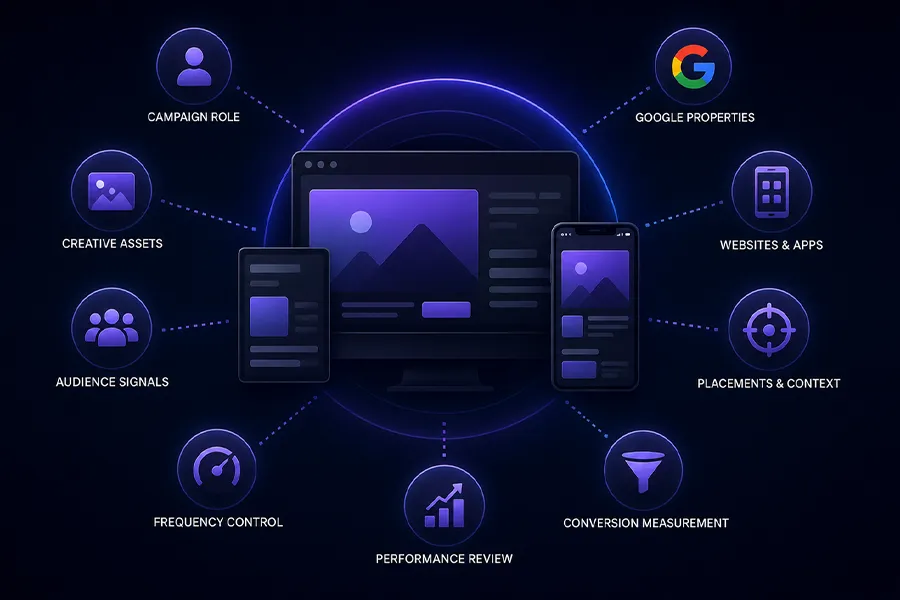
Introduce or reinforce the offer while relevant audiences browse websites, apps and eligible Google-owned properties.
Combine images, logos, headlines, descriptions and video assets that can adapt across supported display inventory.
Review audiences, content, placements, exclusions, devices and frequency to protect relevance and brand suitability.
Connect impressions and clicks with qualified conversions, revenue and downstream business results.
Display campaign roles
Prospecting, remarketing, awareness and conversion support need different audiences, creative, frequency and reporting.
Reach new audiences using audience signals, contextual inputs and conversion-led automation aligned with the campaign goal.
New customer discovery
Re-engage eligible visitors and customer segments using recency, exclusions, frequency and message progression.
Return and recovery
Build relevant reach and visual recognition when the campaign objective values exposure, recall or category education.
Reach and visibility
Use Display to support longer journeys, reinforce proof and contribute to leads or sales where tracking is reliable.
Assisted and direct action
Display creative management
Responsive Display campaigns need varied, high-quality assets, while uploaded ads need format coverage and precise production control.
Responsive display ads
We prepare multiple images, logos, headlines, descriptions and optional videos so Google can assemble eligible combinations for available inventory.
Static uploaded display ads
Uploaded image or supported HTML formats can be used when the campaign needs an approved layout, precise visual system or controlled message hierarchy.
Video-supported display creative
Short videos can strengthen responsive display campaigns when the product, process or proof benefits from movement and sound-aware storytelling.
Creative testing
Testing focuses on different reasons to respond—benefits, proof, product use, offers and objections—not only cosmetic design changes.
Placement-ready adaptation
Creative is reviewed for small-screen readability, cropping, native-style placements and different visual contexts across websites and apps.
Creative refresh system
Asset performance, repetition and audience response are monitored so new concepts can be introduced before the campaign becomes stale.
Creative response framework
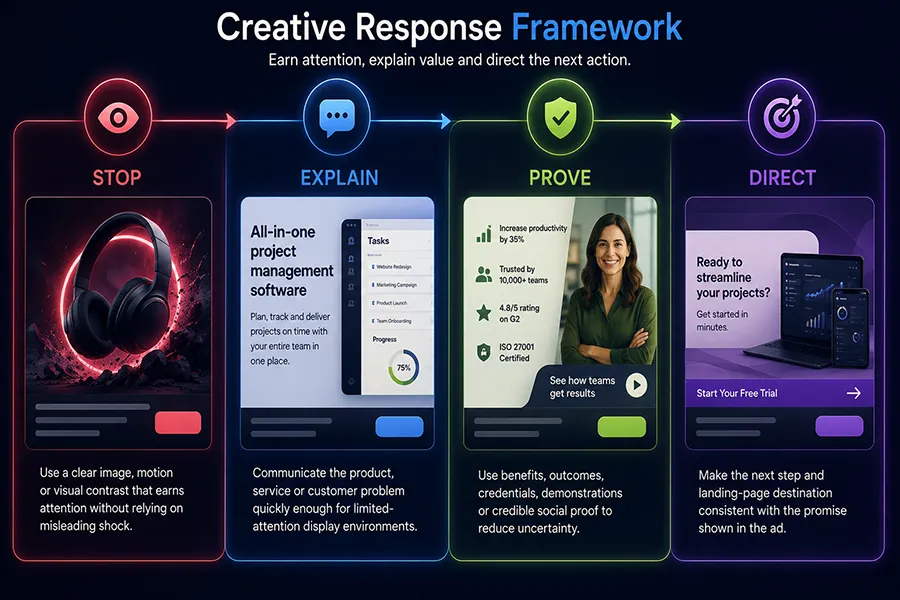
Display users are usually not actively searching. Creative must communicate context quickly and give a credible reason to continue.
Use a clear image, motion or visual contrast that earns attention without relying on misleading shock.
Communicate the product, service or customer problem quickly enough for limited-attention display environments.
Use benefits, outcomes, credentials, demonstrations or credible social proof to reduce uncertainty.
Make the next step and landing-page destination consistent with the promise shown in the ad.
Audience and contextual targeting
Targeting should reflect the campaign role. Prospecting, remarketing and awareness require different levels of automation and control.
Audience segments
In-market, affinity, demographic, custom and first-party segments can support audience planning where they match the commercial goal.
Optimized targeting
Optimized targeting can look beyond manually selected signals to find additional audiences likely to convert. We evaluate its contribution separately from the initial signals.
Contextual targeting
Topics, placements and display keywords can help guide campaigns toward relevant content contexts when contextual alignment supports the objective.
First-party data
Website visitors and customer data segments can support remarketing, exclusions and audience understanding subject to consent, policy and list-size requirements.
Location and device controls
Geographies, languages, devices and schedules are configured according to service coverage, landing-page readiness and customer behaviour.
Audience separation
New-audience acquisition, website remarketing and customer activity are separated where measurement and budget ownership require clarity.
Placement and delivery controls
Display scale requires ongoing placement review, content suitability and frequency management—not a one-time exclusion list.
Enquire NowReview websites, apps, videos and other inventory where ads served, using performance and suitability evidence.
Exclude specific websites, apps, channels, videos or categories that create weak traffic or unsuitable brand context.
Apply inventory and content exclusions according to brand, sector, audience and regulatory requirements.
Limit or monitor repeated exposure by campaign, ad group or ad when frequency no longer supports the objective.
Each audience or contextual input has a defined role, expected behaviour and measurement plan before budget is assigned.
Placements are excluded using brand-suitability or performance evidence rather than broad assumptions that unnecessarily remove reach.
Campaigns receive enough distinct assets for testing and refresh without flooding the account with near-identical variations.
Automated bidding and optimized targeting are not scaled until primary conversion events and business quality are trustworthy.
Display measurement
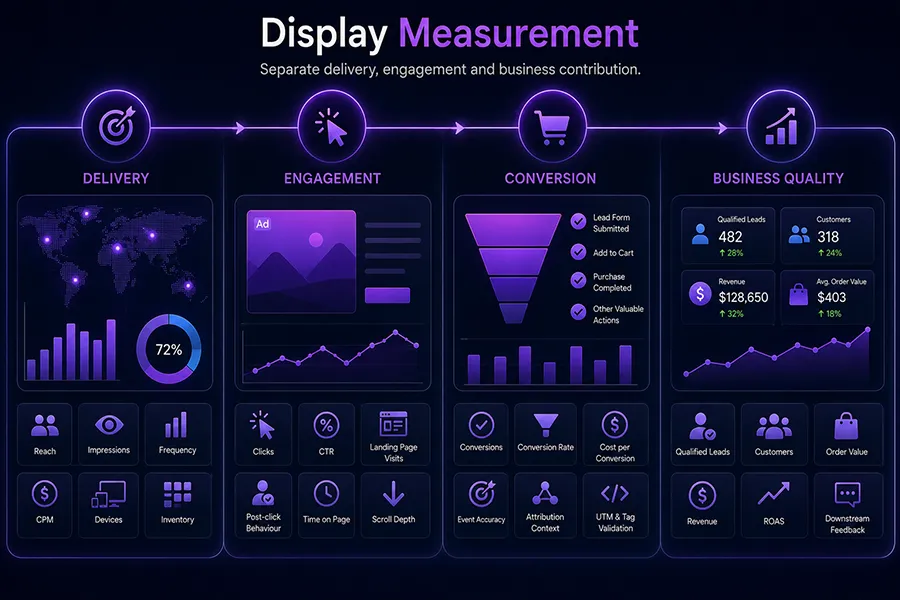
Display can influence awareness and consideration before the final conversion. Reporting should preserve attribution context without overstating every impression or view-through outcome.
Measure reach, impressions, frequency, CPM, devices and inventory distribution according to the campaign role.
Review clicks, click-through rate, landing-page visits and post-click behaviour without treating engagement as the final outcome.
Track primary leads, purchases or other valuable actions and validate whether the events fire accurately.
Connect campaign conversions with qualified leads, customers, order value, revenue and available downstream feedback.
Display Ads process
Objective, targeting, assets, placements, conversion data and budgets remain connected through one campaign roadmap.
We confirm whether Display should build awareness, acquire prospects, support consideration, remarket or generate measurable conversions.
Audience signals, contextual themes, markets, first-party segments, exclusions and brand-suitability requirements are mapped.
Images, logos, headlines, descriptions, videos and uploaded formats are planned around placements, devices and testing themes.
Campaigns, ad groups, audiences, content, optimized targeting, bids, budgets, exclusions, frequency and conversion events are configured.
Early placements, devices, audiences, frequency, clicks, landing behaviour and conversion signals are reviewed after launch.
Assets, placements, audiences, contextual signals, exclusions, bids and budgets are refined using performance and business-quality evidence.
Display Ads reporting
Reporting explains where ads appeared, who responded, which assets contributed and whether campaign spend supports the business goal.

Understand how broadly the campaign delivers and whether repeated exposure remains appropriate for the objective.
Identify which audience signals, websites, apps and content environments generate useful engagement or conversions.
Compare asset themes, formats and messages to find combinations that earn attention and support action.
Connect campaign delivery with direct, assisted and qualified outcomes so spend can be expanded or reduced responsibly.
Display Ads FAQs
Understand responsive assets, placements, optimized targeting, frequency, lead generation and campaign measurement.
Enquire NowThe service can include campaign strategy, audience and contextual planning, responsive display creative, uploaded display ads, placement and content controls, frequency management, conversion tracking, optimisation and reporting.
Display campaigns can serve across eligible websites, apps and Google-owned properties supported by the Google Display Network and campaign settings. Actual inventory depends on targeting, exclusions, assets, geography and account eligibility.
Responsive display ads use uploaded assets such as images, logos, headlines, descriptions and optional videos. Google automatically combines and adapts eligible assets to fit available ad spaces.
Yes. Uploaded display ads can be used when fixed creative control is required and the format meets Google Ads specifications. Responsive ads are usually included to expand inventory coverage.
Optimized targeting allows Google to look beyond manually selected audience signals to find additional users likely to meet the campaign goal. The original audiences and keywords act as starting signals rather than strict limits.
Yes. Managed placements can target selected websites, apps, videos or channels where supported. Campaigns can also use audience or contextual targeting that leads to automatic placements.
We use placement reporting, placement exclusions, content exclusions, inventory controls and account-level or campaign-level suitability settings according to brand and performance requirements.
Yes. Frequency caps can limit impressions for an individual user at campaign, ad-group or ad level over a daily, weekly or monthly period, subject to current Google Ads functionality.
Display can generate leads, but performance depends on the audience, offer, creative, landing page, bidding and conversion signal. It is also commonly used for awareness, consideration and remarketing support.
No responsible Display Ads provider can guarantee fixed business outcomes. Delivery and performance depend on audience size, inventory, competition, budget, creative, tracking and conversion experience. We provide transparent optimisation around agreed goals.
Get a clear roadmap for campaigns, creative, website, SEO, and performance before you scale your next project.