Clear market targeting
Help search engines and users understand which country, language and regional audience each page is intended to serve.

Expand organic visibility across countries and languages with clear market targeting, hreflang, localised content and scalable global governance.
Enquire NowInternational SEO overview
International SEO connects global website structure with local search behaviour. BrainADZ aligns countries, languages, page variants, hreflang, content and regional authority so each market receives the most relevant search experience.
The work is not limited to translation. Strong international performance depends on market selection, architecture, local terminology, proof, policies, conversion paths and the ability to manage change consistently across regions.
Enquire Now
Help search engines and users understand which country, language and regional audience each page is intended to serve.
Adapt search targeting, content, proof and conversion paths to the real needs of each priority market.
Use consistent architecture, canonical and hreflang rules to manage similar regional and language variants safely.
Compare visibility, traffic, leads and revenue by market instead of combining every region into one global total.
International site architecture
Every architecture model has different authority, operational and maintenance implications. The right choice depends on the organisation, not on one universal SEO rule.
Separate country-code domains can create strong local signals but require independent authority, technical maintenance and market operations.
Maximum market separation
Country or language folders consolidate authority under one domain while supporting clear international URL structures and governance.
Shared authority and control
Regional or language subdomains can support operational separation but often require stronger internal linking and authority coordination.
Operational independence
Complex organisations may use different models across brands, markets or platforms and need explicit rules to prevent overlap.
Portfolio-specific architecture
International SEO capabilities
International growth requires one connected system. Market research, architecture, hreflang, localisation and authority cannot be managed as isolated tasks.
Market and demand research
We compare market demand, competition, existing visibility, commercial readiness and operational capacity before recommending expansion.
International site architecture
Domains, subdomains, folders, navigation and market selectors are planned around SEO, platform constraints and long-term governance.
Hreflang implementation
We design and validate hreflang systems that reflect real alternate pages, reciprocal relationships and canonical consistency.
International content strategy
Shared topics, market-specific searches and local commercial priorities are organised without creating uncontrolled page duplication.
Localisation and adaptation
Localisation covers search terminology, examples, currencies, units, proof, policies and calls to action—not only translated paragraphs.
Regional authority building
We develop relevant local links, citations, media mentions, partnerships and brand signals instead of relying entirely on global-domain authority.
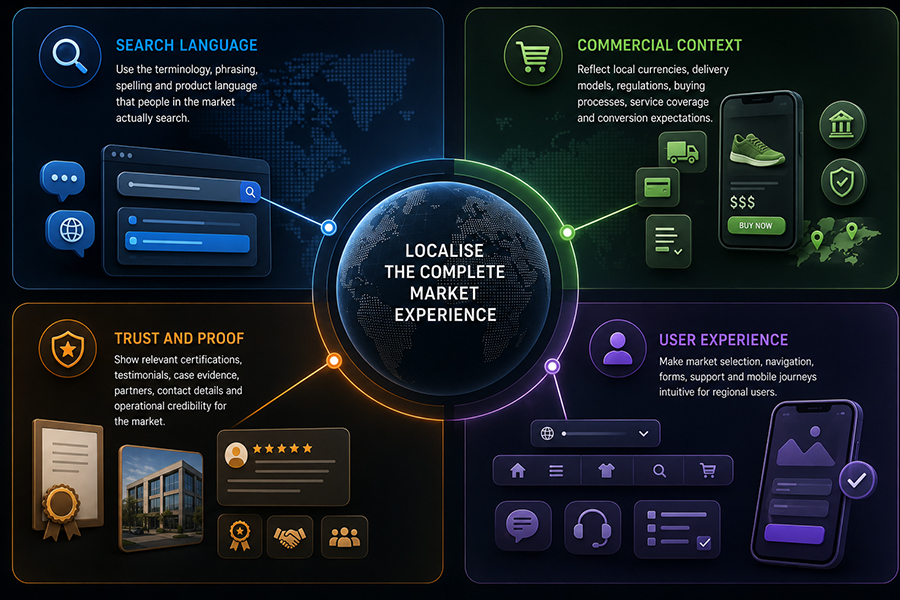
Search-led localisation
A translated page can remain commercially irrelevant. Localised pages need the search language, context, trust and user experience expected within the target market.
Use the terminology, phrasing, spelling and product language that people in the market actually search.
Reflect local currencies, delivery models, regulations, buying processes, service coverage and conversion expectations.
Show relevant certifications, testimonials, case evidence, partners, contact details and operational credibility for the market.
Make market selection, navigation, forms, support and mobile journeys intuitive for regional users.
International technical controls
Hreflang cannot compensate for incorrect canonicals, blocked pages, broken redirects or inconsistent market URLs. The complete technical system must agree.
Technical validation
Each market or language version should use a canonical strategy that supports its intended indexable status.
Alternate references should be valid, reciprocal and aligned with the correct language-country relationship.
Automatic redirects should not block users or crawlers from accessing alternative market and language versions.
International sitemaps, status codes, directives and market URLs should remain accurate as pages launch, change or retire.
International business models
Country variants, multilingual content, ecommerce catalogues and B2B lead journeys require different architecture and localisation rules.
Support country-specific offers, locations, policies and proof even when several markets share the same primary language.
Build language versions around local search behaviour rather than direct, word-for-word translation.
Manage regional catalogues, currencies, inventory, delivery, product data and international product-page indexation.
Coordinate global expertise with regional industries, distributors, offices, sales teams and longer enquiry journeys.

Global and local governance
Central teams protect architecture and standards, while regional teams supply market knowledge, proof, terminology and commercial context. Both roles need clear ownership.
Shared rules for architecture, templates, metadata, hreflang, schema, internal links, redirects and quality assurance.
Clear accountability for local keyword research, content approval, proof, offers, legal requirements and performance.
Defined processes for briefs, translation, local adaptation, review, publishing, updates and deprecation.
Technical and content checks before launch, after deployment and whenever shared templates or routing systems change.
International SEO process
Markets are prioritised, structured, localised and measured through one roadmap so expansion remains technically controlled and commercially relevant.
Enquire NowWe review markets, language versions, architecture, hreflang, rankings, traffic, conversions, authority and operational readiness.
Countries, languages, products, services and search themes are scored by opportunity, competition, business value and market readiness.
We establish URL structures, navigation, hreflang, canonicals, sitemaps, redirects and market-selector behaviour.
Priority pages receive market-specific briefs covering keywords, terminology, proof, offers, internal links and conversion requirements.
Technical and content changes are tested, released and monitored while regional links, citations and mentions are developed.
Visibility, traffic, conversions and technical health are reviewed by country and language to guide the next expansion cycle.
International SEO reporting
Global totals can hide weak markets, technical conflicts and localised pages that fail to convert. Reporting keeps country and language performance visible.
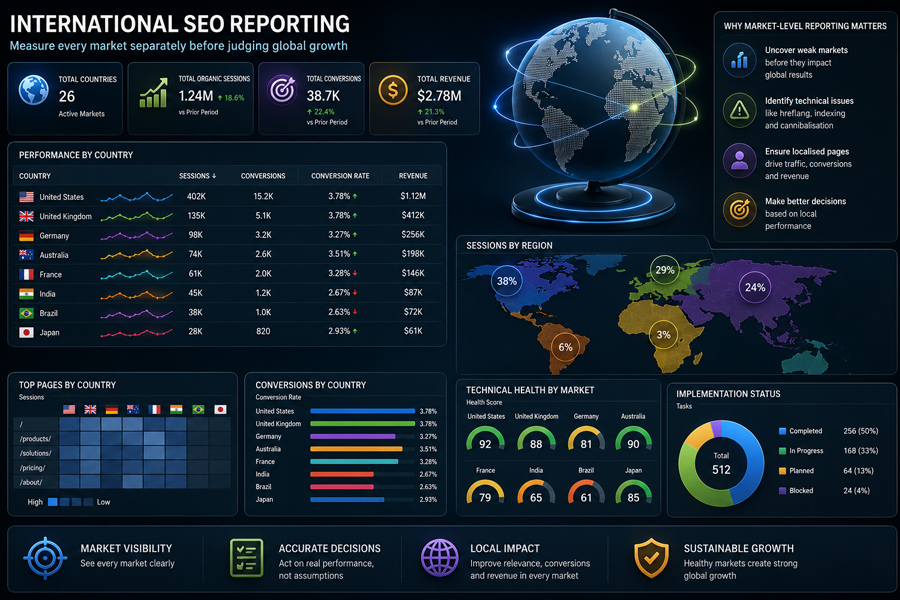
Track keyword coverage and search performance separately across priority countries, languages and regional page groups.
Monitor the technical systems that determine whether the correct regional pages are crawled, indexed and selected.
Evaluate whether adapted pages attract relevant users and satisfy market-specific search and conversion needs.
Connect organic performance with leads, transactions, revenue and assisted outcomes using market-level tracking.
International SEO FAQs
Understand architecture, hreflang, localisation, country pages, ecommerce support, timelines and market reporting before starting.
Enquire NowInternational SEO can include country and language research, international site architecture, hreflang, canonical and sitemap governance, market-specific keyword mapping, content localisation, regional authority building, launch validation and country-level reporting. The final scope depends on your markets, platform and operating model.
International SEO manages visibility across countries and languages, including architecture, hreflang, localisation and regional authority. Local SEO focuses on location-based searches, Google Business Profile, map visibility, citations, reviews and local landing pages within a defined service area or branch network.
The right structure depends on existing authority, market operations, platform capability, legal requirements, brand strategy and maintenance capacity. Subdirectories often consolidate authority efficiently, while country-code domains provide stronger separation but require more independent investment.
Hreflang helps search engines understand equivalent language or country versions of a page and select the most appropriate version for a user. It does not replace canonicals, redirects, localisation or a clear international architecture.
Translated content can rank when it is accurate, useful and aligned with local search intent. Direct translation alone is often insufficient because keywords, terminology, examples, proof, offers and conversion expectations vary by market.
Only when the markets have meaningful differences in search demand, products, services, pricing, regulations, proof or conversion journeys. Near-identical country pages created only by changing the country name can create duplication and weak user value.
Yes. International ecommerce work can include regional categories and products, currencies, availability, shipping, variants, product data, hreflang, canonical rules, faceted navigation and market-level revenue reporting.
Technical corrections can improve market selection after recrawling, while new-country visibility and authority usually require sustained work. Timing depends on competition, domain authority, localisation quality, platform limitations, market demand and implementation speed.
We report visibility, clicks, landing-page performance, technical health, conversions and revenue by country, language and market page group. This prevents strong results in one region from hiding weak performance in another.

Get a clear roadmap for campaigns, creative, website, SEO, and performance before you scale your next project.