Recover valuable interest
Reconnect with people who viewed important pages, products, videos or offers but did not complete the intended action.

Re-engage relevant visitors, viewers, cart users and customer audiences with better timing, stronger sequencing and controlled cross-channel delivery.
Enquire NowRemarketing overview
Remarketing reconnects with people who already interacted with the business. BrainADZ segments audiences by behaviour, intent, recency and conversion status so campaigns continue the journey instead of repeating the original acquisition ad.
The programme coordinates website audiences, engagement data, customer lists, dynamic product systems, exclusions, frequency and conversion measurement across relevant advertising platforms.
Enquire Now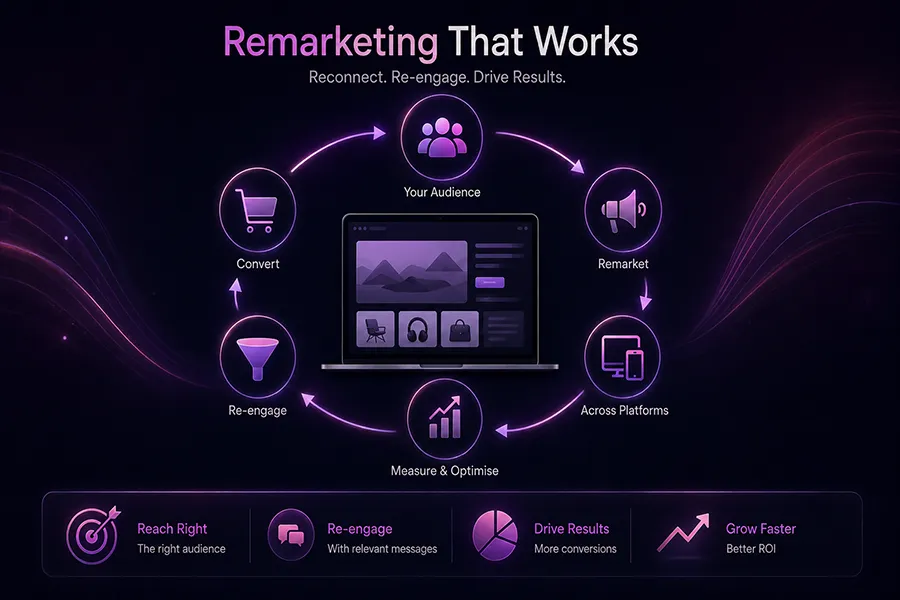
Reconnect with people who viewed important pages, products, videos or offers but did not complete the intended action.
Use different audience windows, exclusions and creative sequences for visitors at different decision stages.
Control converted users, recent purchasers, unsuitable visitors, frequency and audience overlap across campaigns.
Review assisted outcomes, qualified conversions and the incremental value of remarketing where measurement allows.
Audience journey
A video viewer, service-page visitor, cart user and recent customer need different timing, messages and exclusions.
Re-engage people who consumed useful content or watched meaningful portions of a video but have not yet visited a commercial page.
Early consideration
Reach users who viewed priority product, service or category pages with proof, comparison and next-step messaging.
Active evaluation
Use short windows and high-relevance messages for users who began a form, added to cart or reached checkout without completing.
Conversion recovery
Exclude recent buyers where appropriate, or use separate cross-sell, replenishment, renewal and loyalty journeys.
Retention and customer value
Remarketing campaign capabilities
Strong remarketing requires more than installing a pixel. Audience logic, windows, exclusions, creative and measurement must remain aligned.
Audience architecture
We organise website, app, video, social engagement and customer-list audiences around intent, recency and the action already completed.
Membership windows
Audience duration is planned around how quickly customers decide, when urgency matters and when continued advertising becomes irrelevant.
Cross-channel campaign strategy
Search, display, social and video remarketing are coordinated according to audience behaviour, creative format and campaign objective.
Audience exclusions
Exclusions protect recent customers, completed leads, employees, unsuitable visitors and overlapping audience journeys from unnecessary spend.
Creative sequencing
Creative changes by audience stage to answer objections, add proof, clarify the offer and create a stronger reason to return.
Conversion measurement
Website, platform and CRM events are reviewed so campaigns optimise toward completed and qualified actions rather than simple return visits.
Cross-channel remarketing
Search, display, social and video platforms encounter prior audiences in different contexts and should use channel-appropriate messages.
Use prior visitor or customer signals when people return to search, while keeping keyword intent and bidding strategy central.
Reach eligible prior visitors across websites and apps with responsive or dynamic creative and controlled repetition.
Use website, video, page and account engagement signals to reconnect through Facebook and Instagram campaigns.
Build consideration using viewers, channel engagement and site behaviour across short-form and in-stream video journeys.

Dynamic remarketing
Dynamic remarketing depends on accurate feeds and item-level events. When identifiers, availability or destinations do not match, the campaign cannot reliably personalise the ad experience.
Product IDs, titles, prices, images, availability and destination URLs must remain accurate and consistent.
View, cart and purchase events should pass identifiers that match the correct catalogue or business data items.
Unavailable, unsuitable, recently purchased or low-priority products should be excluded according to business rules.
Templates, branding, overlays and fallback assets should remain usable across different products and placements.
Remarketing creative sequence
The audience already knows something about the business. Creative should add clarity, proof or urgency instead of restarting the conversation.
Reconnect the audience with the exact category, service, product or content they previously explored.
Introduce testimonials, demonstrations, credentials, comparisons or outcomes that reduce uncertainty.
Answer common concerns around price, process, compatibility, timing, delivery, support or risk.
Use a valid incentive, bundle, consultation or urgency message when it supports the economics and customer journey.
Offer another product, service tier, content resource or contact method when the first route is not converting.
Switch recent converters into onboarding, replenishment, renewal, cross-sell or loyalty communication where appropriate.
Delivery and privacy controls
Remarketing uses prior interaction and customer data signals. Audience eligibility, consent, repetition and conversion status require clear controls.
Enquire NowMonitor how often audiences receive ads and refresh or reduce delivery when repetition no longer creates useful response.
Define hierarchy and exclusions so the same user is not competing across multiple remarketing campaigns unnecessarily.
Use tags, customer data and audience features according to platform rules, consent requirements and the business’s privacy obligations.
Remove completed leads and purchasers from acquisition messages unless a separate post-conversion strategy applies.
Segment rules, event activity, list size, platform eligibility and recency are checked before campaign conclusions are drawn.
Audiences receive the next useful message rather than the same acquisition creative throughout the full membership window.
Remarketing spend is controlled relative to audience size and available conversion opportunity so small lists are not oversaturated.
Reported conversions are reviewed with assisted paths, customer behaviour and holdout testing where practical to avoid overstating impact.
Remarketing Ads process
Data, windows, creative, exclusions and reporting remain connected through one controlled re-engagement roadmap.
Enquire NowWe define important visits, engagement actions, form or cart stages, purchase events, buying timelines and post-conversion journeys.
Website tags, pixels, conversion events, customer data sources, audience eligibility and exclusions are reviewed.
Audiences are segmented by behaviour, intent, recency and conversion status across the channels best suited to re-engagement.
Reminder, proof, objection, offer and product-specific assets are prepared with feed and event matching where required.
Audience population, event matching, exclusions, frequency, conversion activity and creative delivery are monitored after launch.
Windows, exclusions, creative, bids, budgets and post-conversion paths are refined using qualified and incremental outcome evidence.
Remarketing reporting
Reporting explains audience health, repetition, recovered conversions and the evidence available for incremental budget decisions.
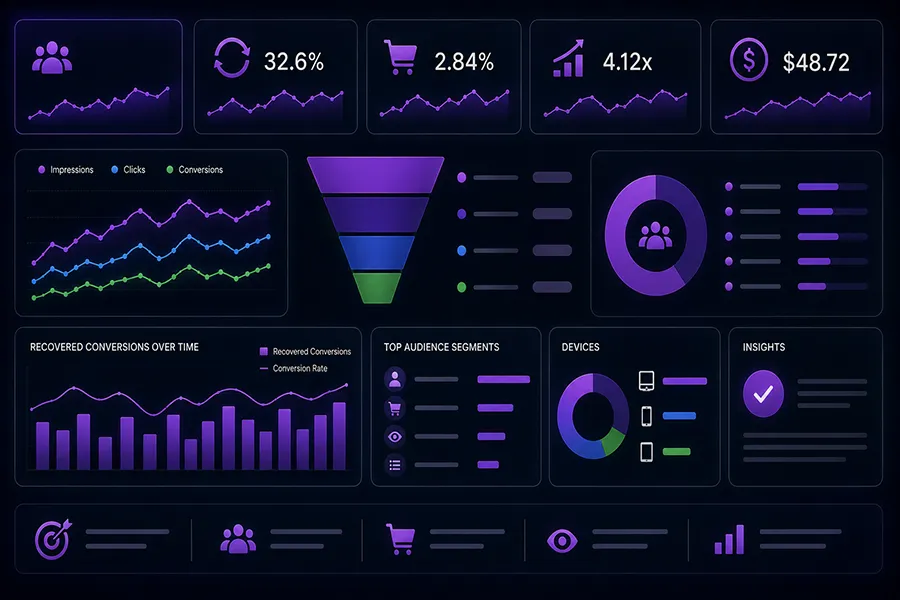
Understand whether audiences are large enough, current enough and segmented clearly enough for useful campaign delivery.
Review how often remarketing audiences see ads and where repetition, fatigue or underdelivery appears.
Measure completed actions from different remarketing stages while preserving assisted and view-through context.
Assess whether remarketing adds useful value and where spend should be reduced, expanded or redirected.
Remarketing Ads FAQs
Understand platforms, audience windows, customer lists, dynamic ads, frequency, purchaser exclusions and measurement before starting.
Enquire NowThe service can include audience strategy, website and engagement audiences, membership windows, customer-list segments, exclusions, dynamic ads, creative sequencing, frequency management, conversion tracking, optimisation and reporting across relevant advertising platforms.
Remarketing can be used across eligible Google Ads, YouTube, Facebook and Instagram campaign types. The exact features and audience requirements depend on the platform, campaign type, data source and account eligibility.
The terms are commonly used interchangeably. In practice, both refer to re-engaging people who previously interacted with a website, app, content, social account, video, customer list or business.
A membership window controls how long an eligible user remains in an audience after the qualifying interaction. Short windows can suit cart or form abandonment, while longer windows may support complex B2B or high-consideration purchases.
Dynamic remarketing uses a product or business-data feed together with website or app events to show ads containing items related to what a user previously viewed or considered. Accurate identifiers, event matching and feed data are essential.
Eligible platforms can use customer data that the business collected directly, such as email addresses or phone numbers, subject to platform policies, consent requirements and account eligibility. The business must have the appropriate rights to use and upload that data.
Recent purchasers are usually excluded from acquisition or cart-recovery messages. They may enter a separate post-purchase journey for onboarding, replenishment, renewal, loyalty or relevant cross-sell offers.
We use audience windows, exclusions, creative sequencing, budget controls and frequency monitoring. Creative is refreshed or delivery is reduced when repetition no longer generates useful response.
Reporting can include audience health, reach, frequency, conversions, cart or form recovery, qualified leads, revenue, assisted outcomes and incremental comparison where suitable testing is possible.
No. Remarketing can improve re-engagement, but results depend on audience quality, offer, timing, creative, website experience, tracking and the strength of the original demand. We provide transparent optimisation rather than guaranteed outcomes.

Get a clear roadmap for campaigns, creative, website, SEO, and performance before you scale your next project.