SEO Tools
7 Best People Also Ask Tools for SEO & Keyword Research in 2026
Finding the right keywords is important for SEO, but understanding what people actually ask on Google can be even more useful.
People Also Ask tools help you discover common questions related to your target keywords. These questions can help you create helpful blog posts, improve existing content, and understand what your audience wants to know.
In this guide, we explore the 7 best People Also Ask tools in 2026, including free and paid options, and explain how to use them for SEO, Answer Engine Optimization (AEO), and Generative Engine Optimization (GEO).
What Is People Also Ask in Google?
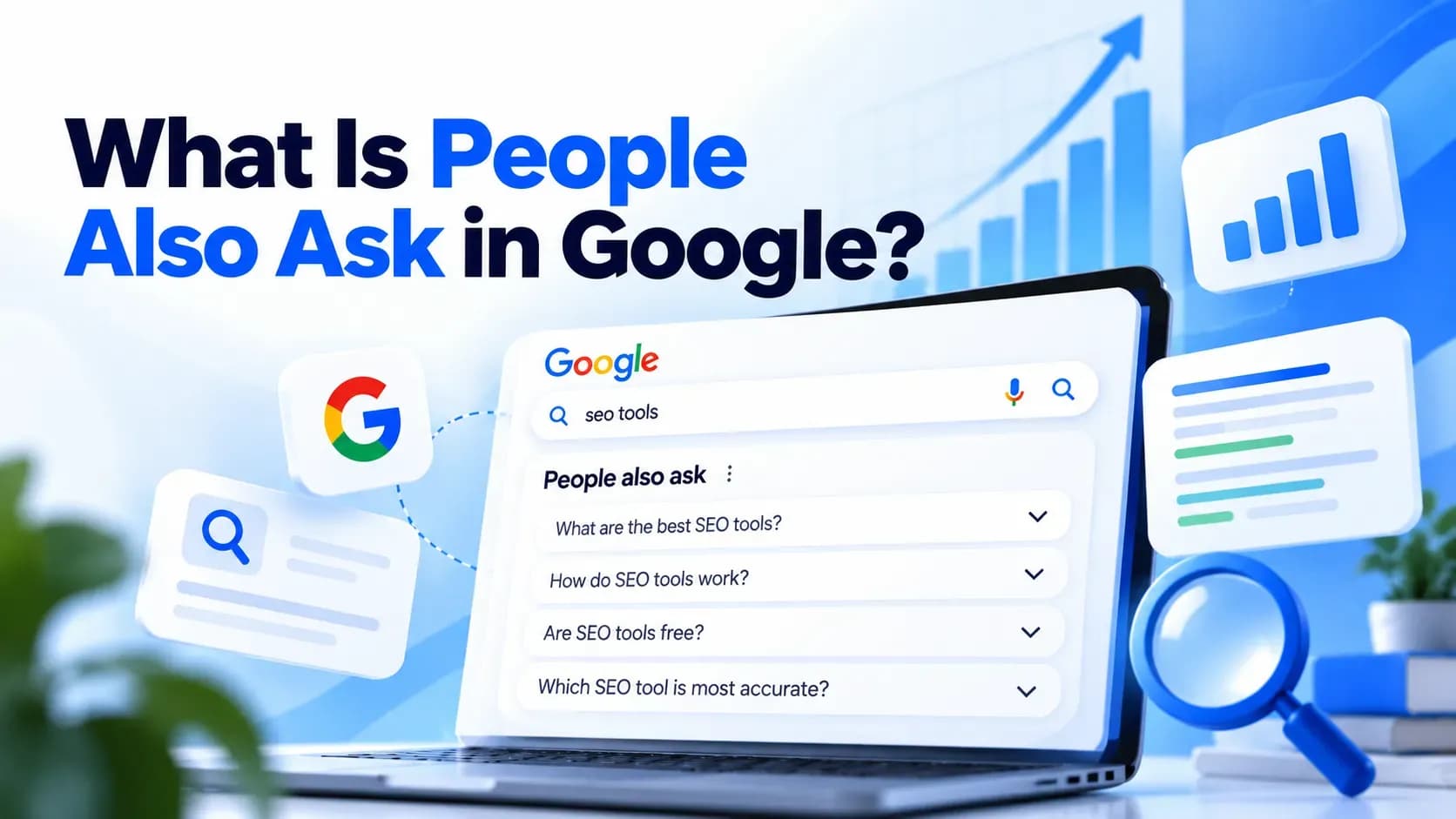
People Also Ask (PAA) is a Google Search feature that displays questions related to a user's search query. Clicking a question expands a short answer, usually with a link to its source.
For example, if someone searches for "SEO tools," Google may display questions such as:
- What are the best SEO tools for beginners?
- Are free SEO tools effective?
- Which SEO tool is best for keyword research?
- How do SEO tools improve website rankings?
These questions help users explore related topics without searching for each question separately.
For website owners, PAA questions provide useful insights into search intent, content gaps, and potential long-tail keywords.
Why Are People Also Ask Questions Important for SEO?
People Also Ask questions show what users want to understand about a particular topic.
Instead of targeting only broad keywords, businesses can use these questions to create more specific, helpful content.
For example, a blog targeting "keyword research" could also explain how to find low-competition keywords, which tools offer free research, and how to choose keywords for a new website.
This approach supports several SEO objectives:
- Discover relevant long-tail keyword opportunities.
- Understand informational search intent.
- Identify missing topics in existing content.
- Create useful headings and FAQ sections.
- Build stronger topical coverage.
- Develop content that directly answers user questions.
However, adding PAA questions does not guarantee higher rankings or placement in Google's People Also Ask results.
7 Best People Also Ask Tools for SEO in 2026
Several tools help marketers discover common search questions. Some focus directly on Google People Also Ask data, while others provide broader keyword and audience research.
Here are seven tools worth exploring.
1. AlsoAsked – Best for Visual People Also Ask Research
AlsoAsked is a dedicated People Also Ask keyword research tool that helps users discover related Google questions.
It organizes questions into visual relationships, making it easier to understand how one search query connects to additional questions.
Key features:
- Google People Also Ask question research.
- Visual question mapping.
- Location and language targeting.
- Topic and search intent exploration.
- Data exports and advanced searches on supported plans.
Best for: SEO professionals, content writers, and marketers researching topic clusters.
Free availability: Limited free search credits are available.
For example, entering "local SEO" can help you explore questions about Google Business Profiles, local rankings, and location-based search optimization.
2. AnswerThePublic – Best for Finding Search Questions
AnswerThePublic is a search-listening and keyword research tool that identifies questions, comparisons, and related search ideas.
It provides visual reports that help content creators understand how people explore different topics.
Key features:
- Question-based keyword discovery.
- Search suggestions and comparisons.
- Visual keyword reports.
- Research across multiple search and discovery platforms.
- Content planning insights.
Best for: Bloggers, content marketers, and businesses looking for new article ideas.
Free availability: A limited free version is available.
For example, searching for "digital marketing" can help uncover questions related to marketing strategies, tools, costs, and beginner guides.
These ideas can become blog topics, supporting headings, or FAQ questions.
3. Semrush – Best for Advanced Keyword Research
Semrush is an SEO platform that includes keyword research, competitor analysis, and search performance tools.
Its Keyword Magic Tool includes a Questions filter, allowing users to discover question-based keywords related to a particular topic.
Key features:
- Question-based keyword filtering.
- Keyword search volume estimates.
- Keyword difficulty analysis.
- Search intent information.
- SERP feature research.
- Competitor keyword analysis.
Best for: SEO agencies and businesses developing data-driven content strategies.
Free availability: Limited functionality is available without a paid subscription.
Unlike tools focused primarily on PAA questions, Semrush can also help evaluate whether a keyword is worth targeting.
4. Ahrefs – Best for Long-Tail Keyword Opportunities
Ahrefs provides keyword research and competitor analysis tools that can help identify search questions and related content opportunities.
Its keyword research features help marketers explore topics and assess their potential.
Key features:
- Question-based keyword research.
- Keyword difficulty estimates.
- Search volume analysis.
- SERP analysis.
- Competitor content research.
Best for: SEO teams looking for keyword opportunities backed by additional search data.
Free availability: Selected free tools are offered, while advanced research generally requires a subscription.
Ahrefs can be particularly useful when deciding which question deserves a dedicated article and which belongs in an existing page.
5. Answer Socrates – Best for Question-Based Content Ideas
Answer Socrates helps users discover questions and related keyword ideas around a topic.
It is useful when a marketer wants to move beyond a single keyword and explore what potential customers are asking.
Key features:
- Question discovery.
- Related keyword exploration.
- Topic research.
- Content idea generation.
Best for: Bloggers and smaller marketing teams researching educational content.
Free availability: Free access is offered with usage limitations.
For example, searching for "technical SEO" can help you develop content around crawling, indexing, website performance, and technical optimization.
6. Google Search – Best Free Method for Finding PAA Questions
Google Search itself is one of the simplest ways to discover People Also Ask questions.
Search for a keyword and check whether the results include a People Also Ask section.
You can expand relevant questions, review the answers, and identify useful topics for your content.
Key benefits:
- Free access to Google Search.
- Direct observation of PAA questions.
- Real search result context.
- Opportunities to discover related queries.
Best for: Beginners, small businesses, and anyone starting keyword research without a paid tool.
Cost: Free.
Keep in mind that PAA questions can vary depending on location, search context, and time.
7. Google Search Console – Best for Finding Questions Your Website Already Ranks For
Google Search Console is not a dedicated People Also Ask extraction tool.
However, it helps website owners understand which search queries generate impressions and clicks for their pages.
You can use this information to identify questions worth covering more effectively.
Key features:
- Search query performance.
- Impressions and clicks.
- Average search position.
- Page-level search performance.
- Opportunities to improve existing content.
Best for: Website owners looking to improve pages that already receive Google impressions.
Cost: Free.
For example, if an article receives impressions for "how to do keyword research," but barely addresses that question, expanding the explanation may improve its usefulness.
People Also Ask Tools Comparison: Free vs Paid
Choosing the right tool depends on your budget, research requirements, and existing SEO workflow.
Tool | Primary Use | Free Option |
AlsoAsked | PAA question mapping | Limited |
AnswerThePublic | Search questions and content ideas | Limited |
Semrush | Keyword and SERP research | Limited |
Ahrefs | Keyword and competitor research | Selected free tools |
Answer Socrates | Question and topic discovery | Limited |
Google Search | Manual PAA research | Free |
Google Search Console | Existing query performance | Free |
Which tool should you choose?
For direct PAA research, AlsoAsked is a strong starting point.
For broader search-question discovery, AnswerThePublic is useful.
For keyword metrics and competition analysis, Semrush or Ahrefs can provide more context.
If you have no budget, combine Google Search with Google Search Console.
How to Find People Also Ask Questions for Any Keyword
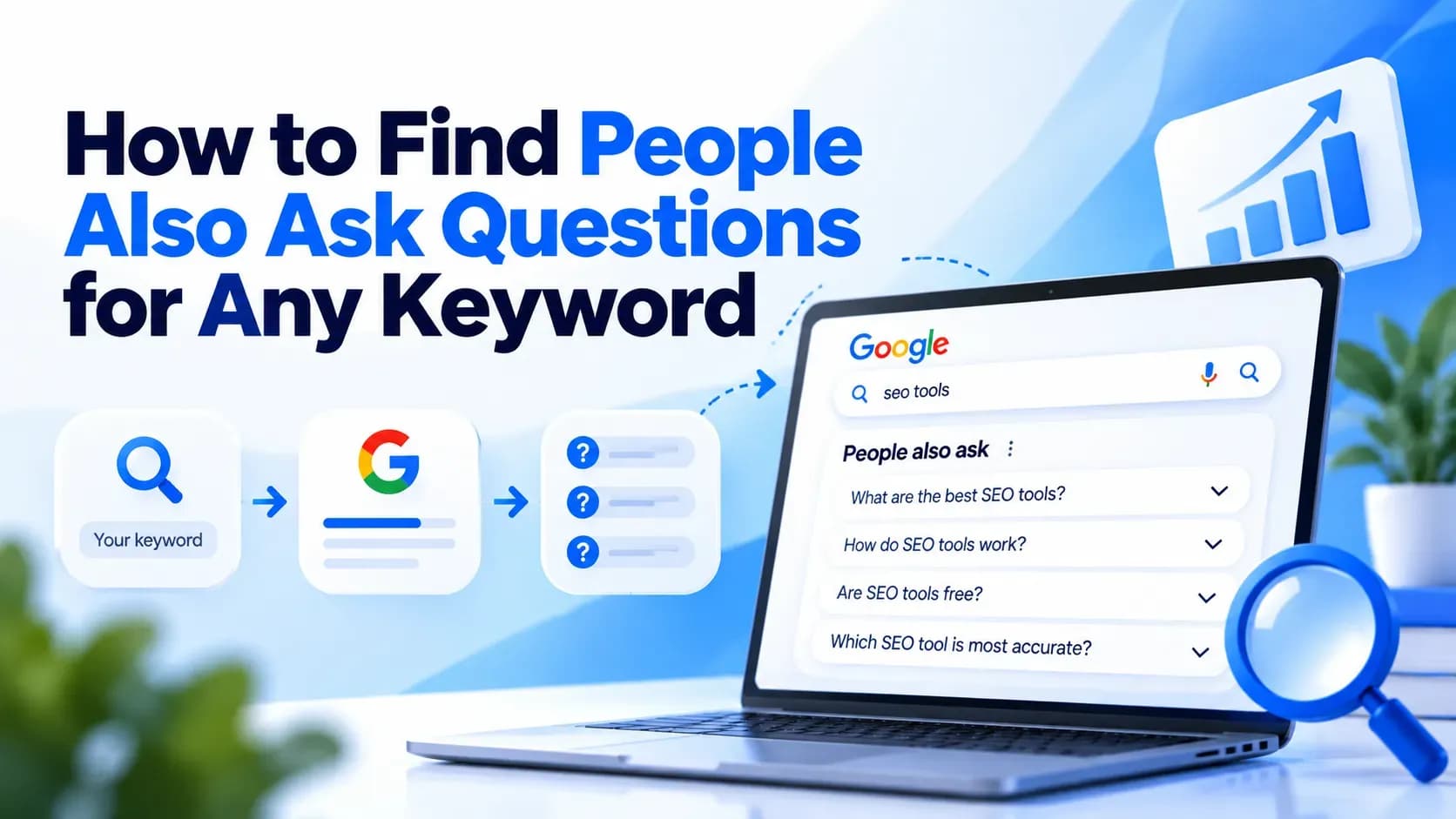
Finding useful PAA questions does not require an advanced SEO process.
Follow these simple steps.
Step 1: Choose Your Main Keyword
Start with a topic relevant to your business.
For example, a digital marketing agency might choose "SEO services."
Step 2: Search the Keyword on Google
Enter your keyword into Google Search.
Look for the People Also Ask section, if it appears, and review the related questions.
Step 3: Explore Questions Using a PAA Tool
Use AlsoAsked or another question research tool to discover additional questions.
Focus on questions relevant to your target audience rather than collecting every available suggestion.
Step 4: Group Questions by Search Intent
Organize questions into relevant categories.
For example:
- Informational: What is SEO?
- How-to: How does SEO work?
- Comparison: SEO vs PPC: Which is better?
- Commercial: How much do SEO services cost?
This helps you decide what belongs in one article and what deserves a separate page.
Step 5: Add Relevant Questions to Your Content
Use important questions as H2 or H3 headings, or answer them within the main content.
Provide clear answers supported by relevant examples.
Avoid adding unrelated questions simply because a research tool suggests them.
How to Use People Also Ask for Keyword Research
People Also Ask data is useful for discovering long-tail keywords and understanding what users expect from a search result.
Suppose your primary keyword is "SEO audit."
Related questions might include:
- What is an SEO audit?
- How do you perform an SEO audit?
- Which tools are used for SEO audits?
- How often should a website be audited?
Instead of writing separate articles for every variation, you can group closely related questions into one practical SEO audit guide.
However, a question with a different search intent may deserve its own page.
Before choosing keywords, review their relevance, search results, search volume estimates, and competition.
Remember that appearing in a PAA box does not automatically mean a question has high monthly search volume.
How People Search Online: Understanding Search Intent

Understanding how people search is essential for creating useful SEO content.
Most searches reflect one of four common intentions:
Informational intent: Users want to learn something, such as "What is technical SEO?"
Navigational intent: Users want to find a particular website, brand, or platform.
Commercial intent: Users want to compare solutions before making a decision, such as "Best SEO tools for small businesses."
Transactional intent: Users are ready to take action, such as requesting a service or buying a product.
People Also Ask research is especially helpful for understanding informational questions and the considerations behind commercial searches.
By matching content with search intent, businesses can create pages that better satisfy their audience.
How to Optimize People Also Ask Content for SEO, AEO, and GEO
People Also Ask research can support traditional search optimization and content designed for AI-powered discovery.
However, SEO, AEO, and GEO should not be treated as completely separate content strategies.
SEO: Improve Organic Search Relevance
Search Engine Optimization focuses on helping search engines discover, understand, and rank relevant website content.
To optimize PAA-based content:
- Include the primary keyword naturally in the title and main heading.
- Use descriptive H2 and H3 headings.
- Cover relevant supporting topics.
- Add internal links to related pages.
- Keep explanations original and accurate.
- Update content when information changes.
AEO: Provide Clear Answers to User Questions
Answer Engine Optimization focuses on making information easy to understand and use in answer-focused search experiences.
Start question-based sections with a direct answer.
For example:
What is a People Also Ask tool?
A People Also Ask tool helps users discover questions associated with Google searches. SEO professionals use these questions to research search intent, plan content, and identify relevant topics.
You can then expand the answer with examples or practical steps.
This structure improves readability and helps users quickly find the information they need.
GEO: Make Content Useful for AI-Powered Search
Generative Engine Optimization focuses on improving the usefulness and visibility of content in AI-assisted discovery experiences.
Helpful practices include:
- Write original explanations rather than repeating generic definitions.
- Include accurate and verifiable information.
- Add practical examples and comparisons.
- Cite reliable sources where appropriate.
- Clearly identify the author and relevant expertise.
- Keep tools, examples, and recommendations up to date.
For example, an original comparison of PAA tools with screenshots, testing notes, and clearly explained limitations offers more value than a simple list of tool names.
These practices can support AI search visibility, but they do not guarantee citations in AI-generated answers.
Common Mistakes to Avoid When Using PAA Keywords
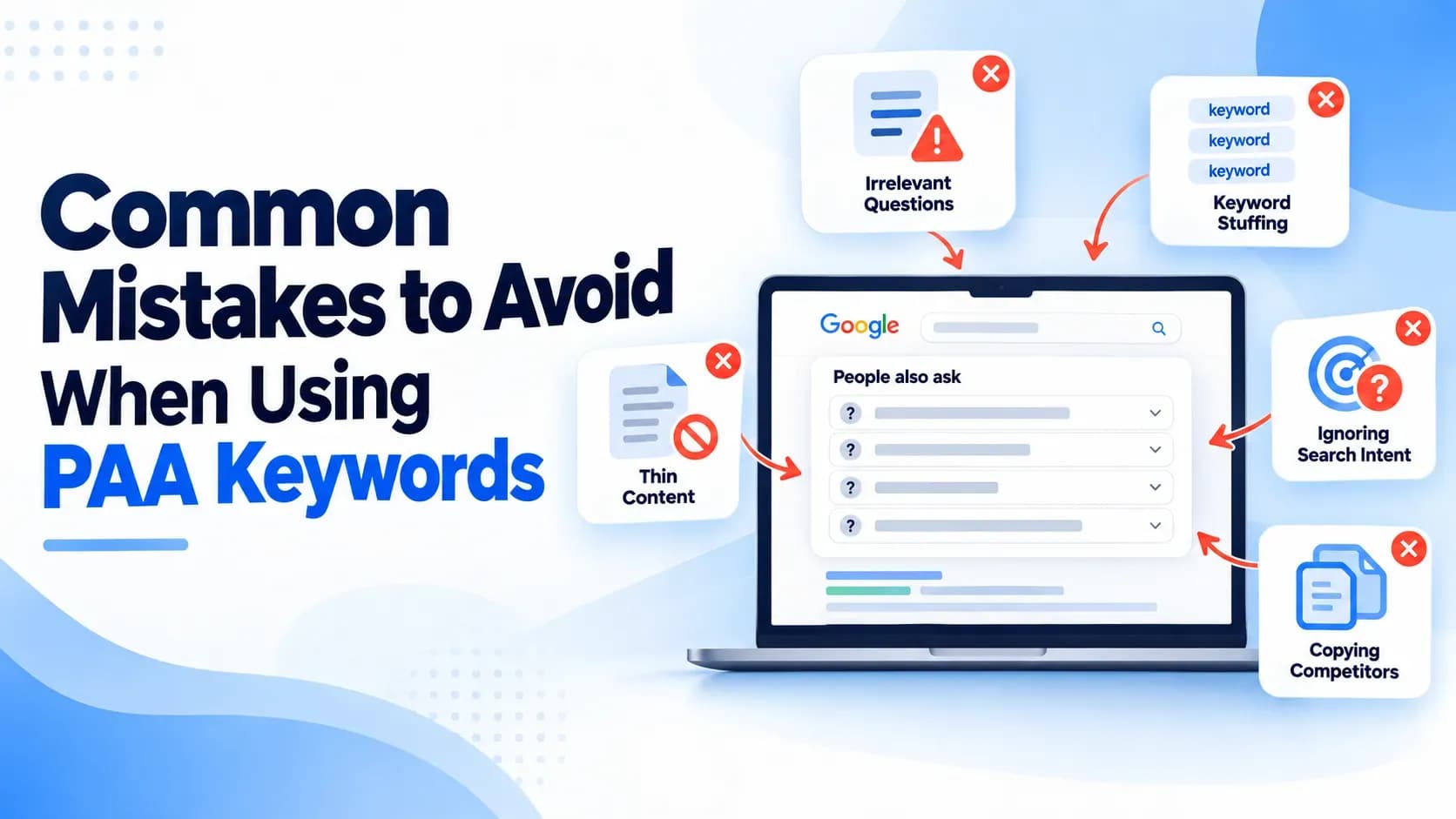
People Also Ask research is valuable, but poor implementation can make content less useful.
1. Adding irrelevant questions
A question containing the same word as your main keyword may still have completely different search intent.
2. Repeating keywords unnaturally
Keyword stuffing makes content difficult to read and does not create a better user experience.
3. Creating thin FAQ sections
One-line answers without useful context may fail to satisfy users who need a complete explanation.
4. Ignoring keyword research metrics
A popular-looking question is not always a valuable keyword opportunity.
5. Copying existing answers
Rewriting a competing website's answer without adding original value is not a strong long-term content strategy.
The goal should be to provide the clearest and most useful answer, not simply include the largest number of questions.
Final Thoughts
People Also Ask tools can help businesses understand what their audiences are searching for and create content around genuine questions.
AlsoAsked and AnswerThePublic are useful for question discovery, while Semrush and Ahrefs provide broader keyword research capabilities. Google Search and Google Search Console are practical free starting points.
The most effective approach is to combine question research with search intent analysis, relevant keyword data, and genuinely helpful content.
At BrainADZ Marketing, we focus on building SEO strategies that connect keyword research, content planning, and organic search performance.
If your business wants to improve organic visibility and reach more relevant customers, explore our digital marketing and SEO solutions.
Also, Read: 10 Best AEO Tools We’re Using to Grow AI Search Visibility in 2026
Frequently Asked Questions
What is the best People Also Ask tool for SEO?+
AlsoAsked is a useful choice for researching Google PAA questions and visualizing related search topics. Semrush and Ahrefs are better suited to workflows that also require broader keyword metrics and competitor analysis.
Is Google People Also Ask free?+
Yes. Google's People Also Ask feature is free to use whenever it appears in search results. You can manually explore related questions without purchasing an SEO tool.
How can I find People Also Ask questions for free?+
Search your target keyword on Google and review the People Also Ask box. You can also explore limited free features in tools such as AlsoAsked and AnswerThePublic.
Can People Also Ask improve SEO rankings?+
Using PAA questions can help improve content relevance and coverage of search intent. However, adding questions alone does not guarantee higher Google rankings.
What is the difference between People Also Ask and Related Searches?+
People Also Ask displays expandable questions with answers and source links. Related Searches suggests additional search queries that users can explore. Both can help identify content opportunities, but they serve different purposes.
Can People Also Ask questions help with AI search optimization?+
Yes. Relevant PAA questions can reveal user information needs and help create clear, well-structured content. Original, accurate answers may also be useful in AI-powered search experiences, although inclusion is not guaranteed.
Is People Also Ask useful for long-tail keyword research?+
Yes. Many PAA questions contain specific phrases that can support long-tail keyword research. Their actual search demand and competition should still be evaluated before targeting them.