AI SEO
How to Rank in Google AI Overviews in 2026: Complete SEO Guide
Google Search is changing. Today, users don't always need to open multiple websites to find answers. Google's AI Overviews can summarize information directly in search results and provide links to relevant sources.
For businesses, marketers, and website owners, this creates a new opportunity: getting their content discovered through AI-powered search.
But how do you rank in Google AI Overviews? Does traditional SEO still work? And what should you change on your website?
This guide explains how Google AI Overviews work and the practical SEO strategies that can improve your website's eligibility, relevance, and visibility in AI-powered search results.
What Are Google AI Overviews?
Google AI Overviews are AI-generated summaries that appear in Google Search to help users understand a topic quickly.
They combine information from Google's search systems and may include links to websites where users can explore the subject further.
For example, when someone searches for "How to improve website SEO," Google may display an AI-generated overview explaining important optimization techniques.
The response might discuss technical SEO, content optimization, internal linking, and website performance while highlighting relevant sources.
This means your content has an opportunity to gain exposure beyond traditional blue-link search listings.
However, AI Overviews do not appear for every search query, and being indexed by Google does not guarantee inclusion.
How Do Google AI Overviews Work?
Google AI Overviews use generative AI alongside Google's existing search and information retrieval systems.
When users search for a complex question, Google's systems may generate a summarized response based on information relevant to that query.
AI Overviews can also provide supporting links that allow users to explore the original sources.
For website owners, three things matter:
- Relevance: Your content should answer the user's question.
- Quality: Information should be accurate, useful, and supported by expertise.
- Accessibility: Google needs to be able to crawl, index, and understand your page.
Google may also identify supporting information relevant to different aspects of a complicated search.
This makes comprehensive, well-organized content useful for both traditional SEO and AI search optimization.
Can Your Website Rank in Google AI Overviews?
Yes. Eligible websites can appear as supporting sources in Google AI Overviews.
However, appearing in an AI Overview is not the same as holding a traditional organic ranking position.
Google automatically selects supporting links using its search systems. There is no guaranteed method to secure a citation or specific position.
According to Google Search Central, a webpage must be indexed and eligible to appear in Google Search with a snippet to qualify as a supporting link.
That means traditional SEO remains essential.
A technically healthy website with useful, relevant content has a stronger foundation for AI search visibility.
How to Rank in Google AI Overviews: 10 Practical SEO Strategies
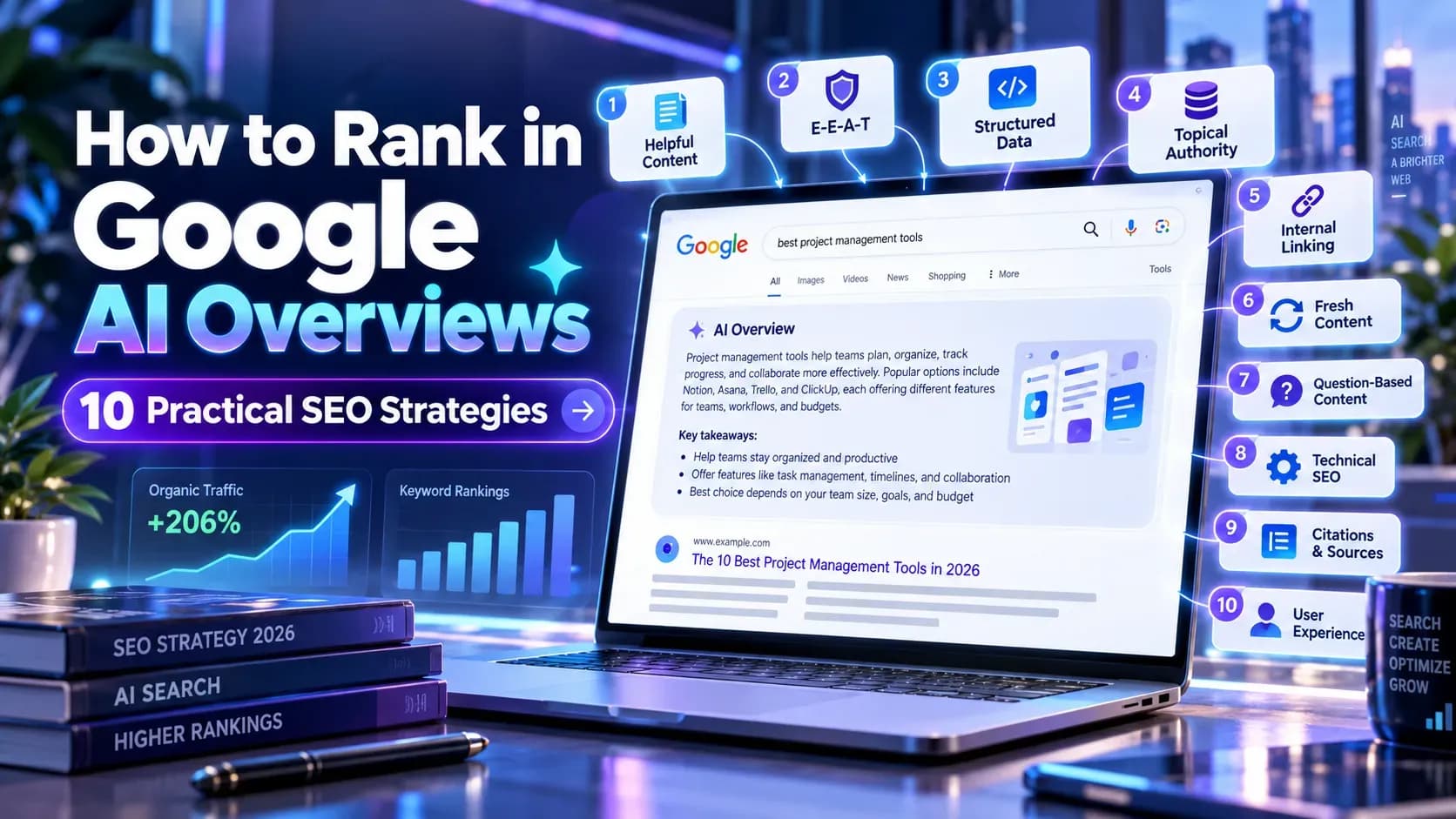
The following strategies can help improve your website's search visibility and eligibility for AI-powered search experiences.
1. Create Content That Directly Answers Search Questions
Users frequently search Google using conversational questions.
Instead of searching only for "technical SEO," someone might ask, "How can I improve technical SEO on my website?"
Your content should provide a clear answer to that question.
For example:
Question: What is technical SEO?
Technical SEO is the process of improving a website's crawlability, indexability, architecture, and technical performance so search engines can access and understand its pages.
After giving the direct answer, explain the concept with practical examples.
This approach improves readability and makes your content useful to visitors looking for quick information.
2. Focus on Search Intent Instead of Keyword Repetition
Successful Google AI Overviews SEO starts with understanding what users want to accomplish.
Search intent generally falls into four categories:
Search Intent | Example |
Informational | What is AI SEO? |
Navigational | Google Search Console login |
Commercial | Best SEO tools for agencies |
Transactional | Hire an SEO agency in Delhi |
A user searching for "How to rank in Google AI Overviews" expects practical instructions rather than a sales-focused landing page.
Build your content around that expectation.
Use relevant keywords naturally, but prioritize answering the complete question.
3. Build Topical Authority With Related Content
Publishing one article rarely establishes comprehensive expertise around a subject.
A better strategy is to create connected resources that answer related questions.
For example, a website focusing on AI search optimization could publish articles covering:
- What is Answer Engine Optimization?
- SEO vs AEO vs GEO
- How Google AI Overviews work
- How to optimize content for AI search
- Common AI SEO mistakes
- Best tools for AI search visibility
These articles should link to one another wherever the connection genuinely helps readers.
This gives visitors a clear learning path and helps search engines discover related content.
Topical coverage should focus on useful depth rather than producing many repetitive articles.
4. Demonstrate Experience, Expertise, and Trust
Google's content quality guidance discusses experience, expertise, authoritativeness, and trustworthiness, commonly known as E-E-A-T.
These are useful principles for creating credible content, not a standalone numerical ranking score.
To strengthen your content:
- Include original examples and research.
- Explain how recommended techniques work.
- Add accurate author information.
- Reference authoritative sources.
- Update information when practices change.
- Avoid unsupported ranking guarantees.
For example, a practical SEO case study showing the original problem, implemented changes, and measured results can provide more value than a generic list of tips.
Content with verifiable examples gives readers reasons to trust your recommendations.
5. Organize Content With Clear Headings and Short Paragraphs
A well-structured page helps users quickly find important information.
Use one descriptive H1 heading followed by logical H2 and H3 sections.
For example:
H2: How to Optimize Content for AI Overviews
H3: Answer Questions Clearly
H3: Improve Internal Linking
H3: Add Original Examples
Keep paragraphs short and use tables when comparisons are easier to understand visually.
Important answers should appear near their relevant headings rather than being buried in long introductions.
These improvements support usability and help search engines interpret page content.
6. Improve Technical SEO and Website Accessibility
Even excellent content may struggle to gain search visibility if Google cannot access it properly.
Before working on advanced AI Overview optimization, check your technical SEO foundation.
Pay attention to:
- Indexability: Ensure important pages are eligible for indexing.
- Crawlability: Avoid accidentally blocking Googlebot.
- Canonical URLs: Use appropriate canonical signals.
- Mobile usability: Make content accessible across devices.
- Page experience: Reduce unnecessary loading and interaction delays.
- Internal links: Connect important pages through crawlable links.
- Visible content: Make essential information available as readable text.
Use Google Search Console to identify crawling and indexing issues.
Google's official guidance confirms that normal Search technical requirements also apply to AI Overviews.
7. Use Relevant Structured Data
Structured data provides search engines with additional information about webpage content.
For a blog article, appropriate Article or BlogPosting markup can describe information such as the headline, author, publication date, and publisher.
Breadcrumb markup may also be useful when it accurately represents your website's navigation.
However, there is no special schema markup that guarantees visibility in Google AI Overviews.
Structured data should always match the content visible to readers.
Avoid adding unrelated schema types or marking up information that does not appear on the page.
8. Add Useful Images, Examples, and Original Insights
Text is important, but visual content can make complex information easier to understand.
For example, an article explaining Google AI Overviews can include:
- An annotated screenshot of an AI Overview.
- A visual comparison of traditional search and AI search.
- A diagram explaining how users discover supporting sources.
- An example of an optimized answer section.
Use descriptive filenames and meaningful image alt text.
A filename such as google-ai-overviews-seo-example.webp communicates the subject more clearly than a generic filename.
Original screenshots and examples can also make your content more useful and distinctive.
9. Strengthen Internal Linking and Website Navigation
Internal links help visitors discover additional resources and help Google find relevant pages.
For example, an article about Google AI Overviews can link to related content about AEO, GEO, keyword research, and technical SEO.
Use descriptive anchor text.
Instead of writing "click here," use descriptive wording such as "learn more about Answer Engine Optimization."
Avoid adding links simply to increase the number of links on a page.
Every internal link should improve the reader's journey.
10. Monitor Performance and Improve Content Regularly
AI search optimization is not a one-time activity.
Search behavior, competition, and Google's search experiences continue to change.
Use Google Search Console to monitor your website's performance.
Review metrics such as:
- Organic search clicks
- Search impressions
- Click-through rate
- Average position
- Queries generating visibility
- Pages receiving organic traffic
Google includes traffic from AI features in its Search Console web search performance reporting, rather than providing a universal, separate AI Overview citation report.
You can also manually examine relevant search queries to understand which websites appear as supporting sources, keeping in mind that AI results may vary.
Use these observations to improve useful content rather than making changes based on a single search result.
Traditional SEO vs Google AI Overviews SEO
Traditional SEO and AI Overview optimization share the same fundamentals.
The main difference is how users encounter and consume search information.
Factor | Traditional SEO | AI Overview Visibility |
Search experience | Organic search listings | AI-generated summaries with supporting links |
Main objective | Earn relevant organic rankings and clicks | Become discoverable through AI-powered search features |
Content approach | Match search intent and provide helpful information | Answer relevant questions clearly and comprehensively |
Technical requirements | Crawlability and indexability | Same foundational Search requirements |
Structured data | Relevant supported markup | No additional AI-specific schema |
Visibility measurement | Search Console reporting | Search Console plus supplementary observation |
A strong SEO strategy can support both experiences.
Businesses should not abandon traditional search optimization to chase AI citations.
Instead, they should create content that serves users across different search formats.
Example: Optimizing a Blog for Google AI Overviews
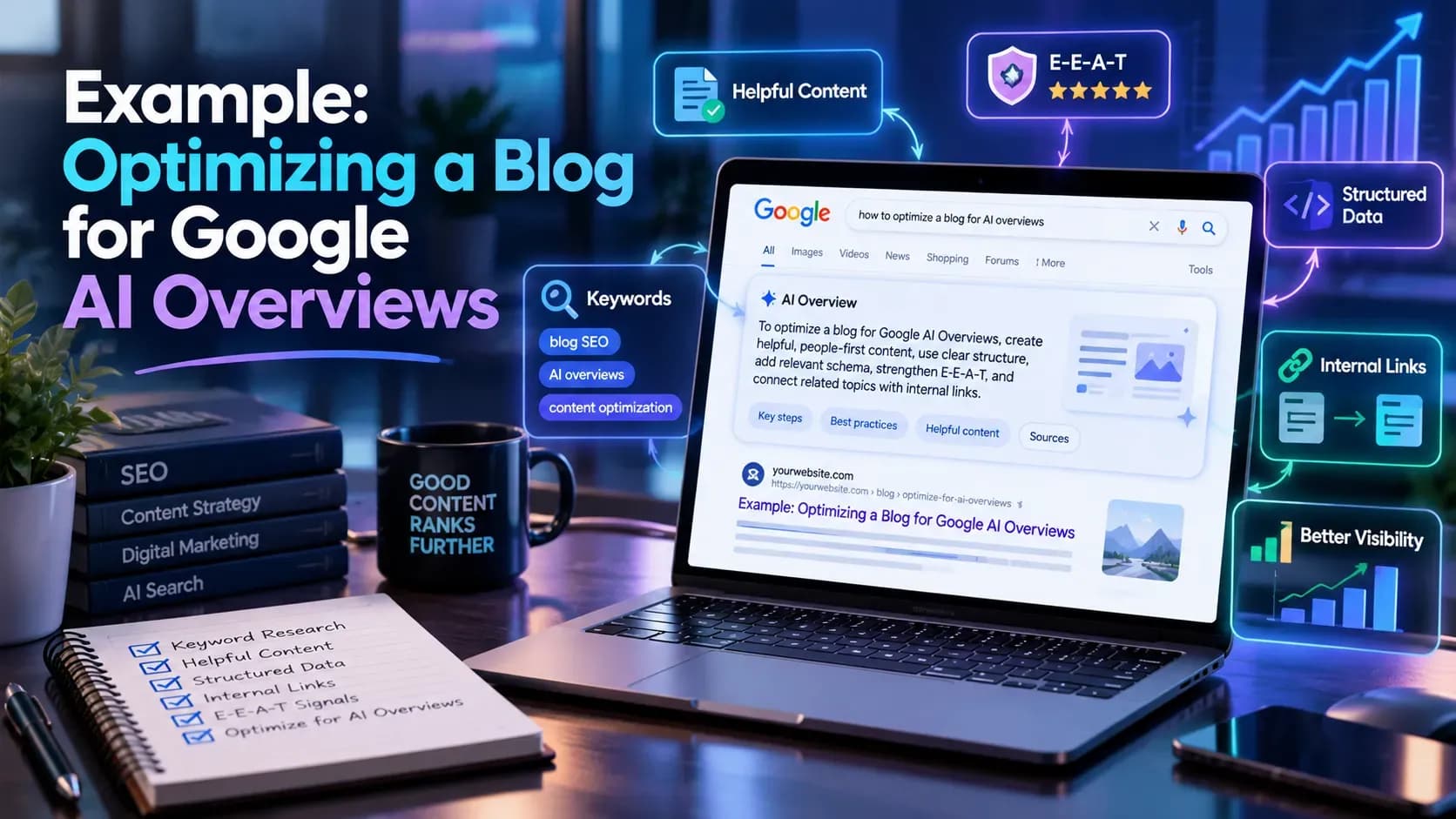
Imagine a digital marketing website publishing an article titled:
"What Is Answer Engine Optimization and How Does It Work?"
An introductory paragraph might only explain that Answer Engine Optimization is becoming popular.
That introduction does not immediately answer the user's question.
A more helpful version would begin with:
"Answer Engine Optimization (AEO) is the practice of making online content easy for answer-focused search experiences to discover, understand, and use when responding to questions."
The article could then explain the relationship between AEO and traditional SEO, provide examples, and answer related questions.
Add relevant internal links, trustworthy references, and practical implementation tips.
This structure improves the reader experience and provides clear information that search systems can understand.
It does not guarantee inclusion in any AI-generated answer.
Common Google AI Overviews SEO Mistakes to Avoid
Publishing Generic AI-Generated Content
AI tools can help with research and drafting, but publishing repetitive material without original value may limit your content's usefulness.
Review every article for accuracy and add genuine expertise.
Ignoring Technical SEO
If Google cannot index your webpage or display a snippet from it, the page cannot qualify as a supporting link in Google's AI search features.
Overusing Keywords
Repeating "how to rank in Google AI Overviews" excessively does not create better content.
Include relevant language naturally and answer the reader's actual questions.
Creating Multiple Pages With the Same Search Intent
Publishing several nearly identical articles can create unnecessary content overlap.
Give each page a distinct purpose.
Assuming Schema Guarantees AI Citations
Structured data can help Google understand eligible content, but it does not guarantee AI Overview citations.
Ignoring Existing Content
Updating a helpful article with missing information, better explanations, and original examples may be more valuable than publishing a similar new article.
Google AI Overviews SEO Checklist for 2026
Before publishing, review this checklist:
- The page answers a specific search question.
- The introduction provides a clear explanation.
- The content matches the intended search intent.
- Headings follow a logical structure.
- Important claims are accurate and supported.
- Original examples or useful visuals are included.
- Relevant internal links are added.
- The page is mobile-friendly and accessible.
- Google can crawl and index the page.
- Structured data accurately reflects visible content.
- Title and meta description are descriptive.
- Search performance will be monitored after publishing.
These steps provide a practical foundation for Google AI search optimization.
Final Thoughts: Building Visibility in Google AI Overviews
Learning how to rank in Google AI Overviews starts with understanding one important principle: useful content and strong SEO fundamentals still matter.
There is no shortcut, guaranteed citation method, or special AI markup that replaces a well-optimized website.
Focus on search intent, direct answers, technical accessibility, credible information, and practical examples.
Over time, these improvements can support both traditional organic visibility and discovery through AI-powered search.
Want to improve your website's visibility in Google Search and AI-powered results?
At BrainADZ Marketing, we help businesses strengthen their SEO foundations, improve website content, resolve technical issues, and develop search-focused digital marketing strategies.
Explore our SEO services to build a practical strategy for sustainable organic growth.
References
- Google Search Central — AI features and your website
- Google Search Central — Optimizing for generative AI features
- Google Search Central — Creating helpful, reliable, people-first content
Frequently Asked Questions About Google AI Overviews
How can I rank in Google AI Overviews?+
Focus on creating useful, accurate content that directly answers relevant search questions. Ensure your website is crawlable, indexable, and technically accessible. Google automatically selects supporting sources, so inclusion is not guaranteed.
Is SEO still important for Google AI Overviews?+
Yes. Google's official guidance confirms that traditional SEO fundamentals remain relevant to AI Overviews and AI Mode. Technical SEO, useful content, internal links, and a good page experience continue to matter.
Can a new website appear in Google AI Overviews?+
A new website can be eligible if its pages are indexed and meet Google Search requirements. However, eligibility does not guarantee visibility. Building helpful content and a technically sound website is an important starting point.
Does schema markup help with AI Overview optimization?+
Relevant structured data helps search engines understand webpage information, but Google does not require any special AI Overview schema. Markup should accurately match the visible content.
What content is suitable for AI search optimization?+
Helpful explanations, original research, practical tutorials, detailed comparisons, examples, and accurate answers to real user questions are useful formats. The best format depends on the search intent.
How long does it take to appear in Google AI Overviews?+
There is no fixed timeline. Google must discover and index your page, and its systems decide whether to display an AI Overview and which sources to feature.
Can I track AI Overview traffic in Google Search Console?+
Google includes AI feature activity within its broader Search Console web search performance data. Search Console does not provide a universal standalone report showing every AI Overview citation.
What is the difference between AI SEO and traditional SEO?+
Traditional SEO focuses on improving website visibility across organic search results. AI SEO is a broad industry term for strategies aimed at improving visibility in AI-powered search experiences. Both depend on useful content and strong technical foundations.