AI SEO
SEO vs AEO vs GEO: Key Differences, Examples & Strategies for 2026
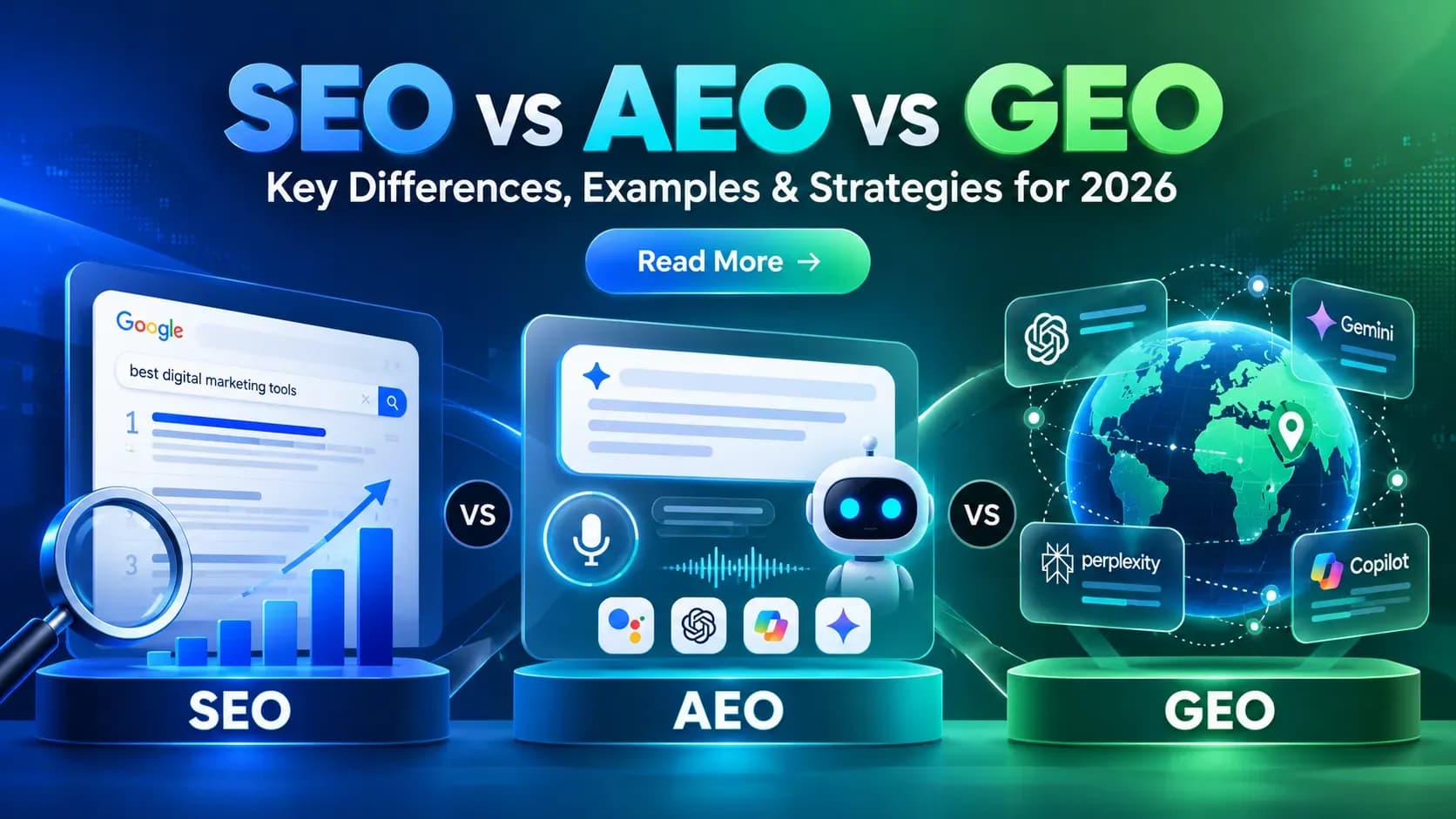
The way people search for information online is changing.
Earlier, businesses focused mainly on ranking their websites on Google. Today, users also discover information through AI-powered search results, conversational assistants, and generative AI platforms.
This shift has introduced three important terms: SEO, AEO, and GEO.
But what is the difference between SEO, AEO, and GEO? Which strategy should businesses prioritize? And can all three work together?
In this guide, we explain SEO vs AEO vs GEO with practical examples, comparison tables, and strategies to help businesses improve search visibility in 2026.
What Is the Difference Between SEO, AEO, and GEO?
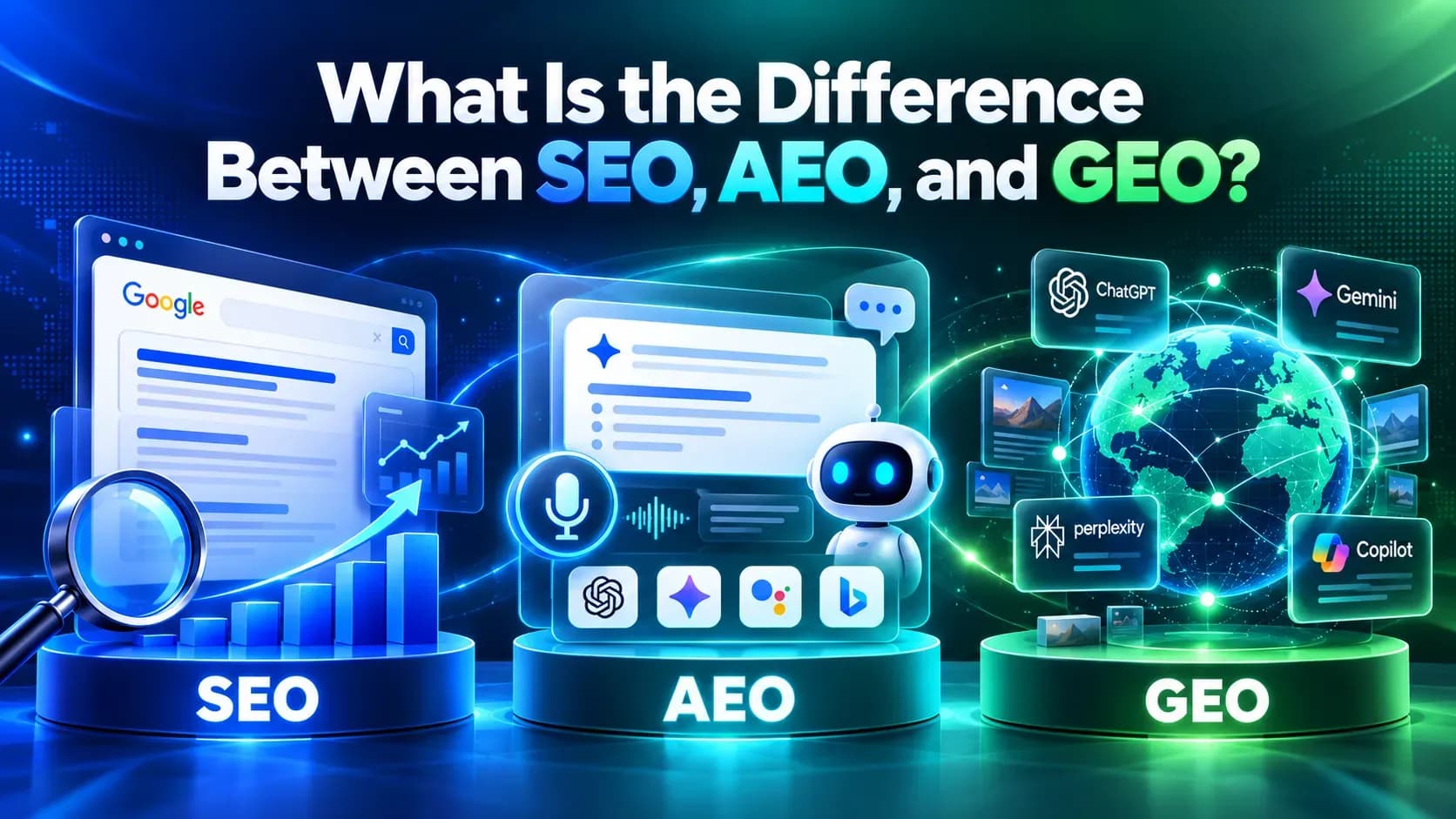
SEO (Search Engine Optimization) focuses on improving website visibility in organic search results.
AEO (Answer Engine Optimization) focuses on making content useful and accessible for systems that provide direct answers to user questions.
GEO (Generative Engine Optimization) focuses on improving content and brand visibility in AI-generated responses, summaries, and cited sources.
The simplest way to understand the difference is:
- SEO: Help people find your website through search results.
- AEO: Help people find clear answers from your content.
- GEO: Help generative AI systems discover and reference your information.
These approaches overlap significantly.
A well-optimized webpage can rank in traditional search results, provide information for a featured snippet, and potentially appear as a supporting source in AI-generated answers.
AEO and GEO are industry terms rather than three officially separated ranking systems. Their exact definitions may vary between marketing professionals.
What Is SEO (Search Engine Optimization)?
Search Engine Optimization is the process of improving a website's visibility in unpaid search engine results.
SEO helps search engines discover, understand, and present relevant webpages to users.
For example, when someone searches for "digital marketing agency in Delhi," Google may display relevant agency websites.
Businesses use SEO to improve their chances of appearing for relevant searches and attracting potential customers.
How Does SEO Work?
SEO combines multiple optimization activities.
1. Keyword Research
Identify search terms relevant to your audience, products, and services.
2. On-Page SEO
Optimize webpage titles, headings, content, internal links, and descriptions.
3. Technical SEO
Improve crawlability, indexability, mobile usability, website architecture, and technical performance.
4. Content Optimization
Create relevant articles, service pages, guides, and other resources that satisfy search intent.
5. Authority Building
Earn relevant links, mentions, and recognition through valuable content and genuine relationships.
Example of SEO
A business publishes a service page targeting "SEO services in Delhi."
The page explains its services, includes useful information, and follows technical SEO best practices.
If Google considers it relevant and useful, the page may appear in organic results for related queries.
Main Benefits of SEO
- Increase relevant organic website traffic.
- Improve search visibility.
- Reach people actively looking for services.
- Support long-term lead generation.
- Reduce exclusive dependence on paid advertising.
SEO remains the foundation of an effective organic search strategy.
What Is AEO (Answer Engine Optimization)?
Answer Engine Optimization focuses on creating content that helps search and answer systems provide useful responses to questions.
Instead of optimizing only for short keywords, AEO emphasizes answering user questions clearly and accurately.
It is commonly associated with featured snippets, question-based search results, voice answers, and some AI-powered experiences.
How Does AEO Work?
AEO involves understanding the questions your audience asks and creating useful answers.
For example, someone searches:
"What is the difference between on-page SEO and technical SEO?"
A helpful webpage might begin with:
"On-page SEO improves individual webpage content and relevance, while technical SEO improves the infrastructure that helps search engines crawl, index, and access a website."
The article can then explain both concepts in more detail.
This gives readers an immediate answer while providing additional context.
Key AEO Optimization Practices
- Identify common customer questions.
- Answer questions directly.
- Use descriptive headings.
- Explain concepts using simple language.
- Add relevant comparisons and examples.
- Keep information accurate and current.
- Use supported structured data where appropriate.
These practices improve content clarity, but there is no universal formula that guarantees answer placement.
Example of AEO
A user asks:
"How long does SEO take to show results?"
A helpful article could explain that SEO results vary based on competition, website condition, content quality, and implementation.
The article should avoid promising a fixed timeline.
An answer-focused introduction followed by useful details serves both readers and question-oriented search experiences.
Main Benefits of AEO
- Improve content usefulness for question-based searches.
- Make important information easier to understand.
- Support visibility opportunities in direct-answer features.
- Improve the user experience.
- Address conversational search queries.
AEO complements traditional SEO rather than replacing it.
What Is GEO (Generative Engine Optimization)?
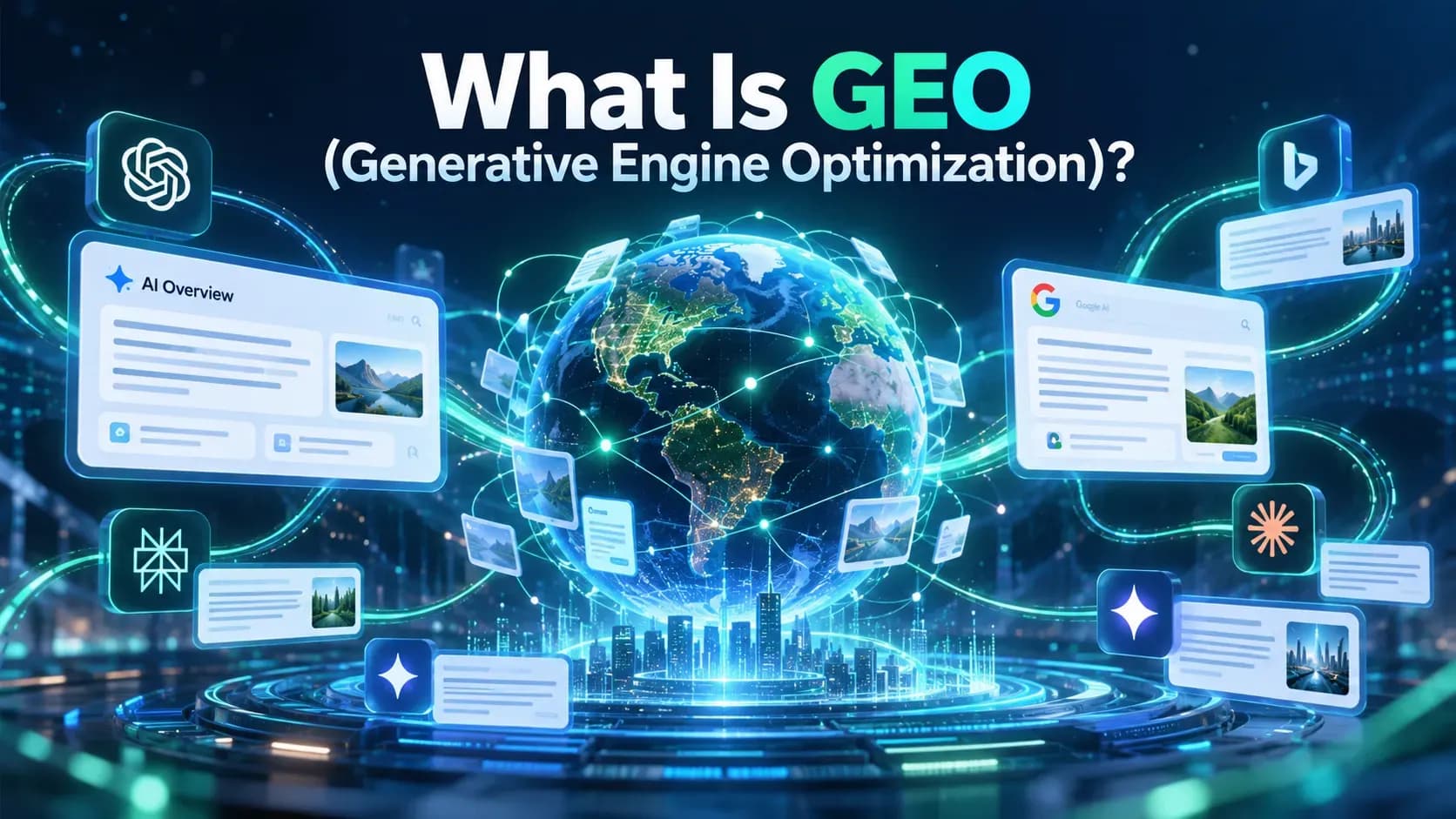
Generative Engine Optimization is an industry term for strategies intended to improve the visibility of websites, brands, and information in generative AI-powered experiences.
These experiences may include ChatGPT Search, Google AI Overviews, Google AI Mode, Microsoft Copilot, and Perplexity.
Generative systems can produce responses that synthesize information from several sources.
Some responses include supporting citations or links.
GEO focuses on making content valuable, accessible, accurate, and relevant for these experiences.
How Does GEO Work?
Imagine someone asks an AI search assistant:
"What should a small business look for when choosing an SEO agency?"
The system may search for relevant information and provide recommendations based on the available sources.
A useful article explaining agency selection criteria, common SEO services, reporting practices, and pricing considerations could potentially be referenced.
However, each AI platform uses its own systems and information sources.
No optimization method guarantees that a brand will appear in a generated response.
Important GEO Strategies
Original Research
Publish insights, examples, and data that provide unique value.
Credible Information
Support claims with reliable references and explain how conclusions were reached.
Clear Brand Identity
Maintain accurate information about your business, products, and services.
Technical Accessibility
Allow appropriate crawlers to access intended public content.
Content Relevance
Answer real questions with specific and meaningful explanations.
Authentic Industry Visibility
Build genuine recognition through relevant publications and professional contributions.
Example of GEO
A digital marketing agency publishes an original case study explaining how it improved a client's organic search performance.
The study includes the initial challenges, optimization activities, methodology, and measured outcomes.
This provides information that readers and AI-powered search systems may find relevant when researching similar SEO problems.
Main Benefits of GEO
- Expand discovery opportunities beyond traditional search listings.
- Improve potential visibility in AI-generated answers.
- Support brand recognition during research journeys.
- Reach users exploring services through conversational interfaces.
- Create additional opportunities for relevant referral traffic.
GEO should be treated as an extension of good SEO and content practices.
SEO vs AEO vs GEO: Complete Comparison Table
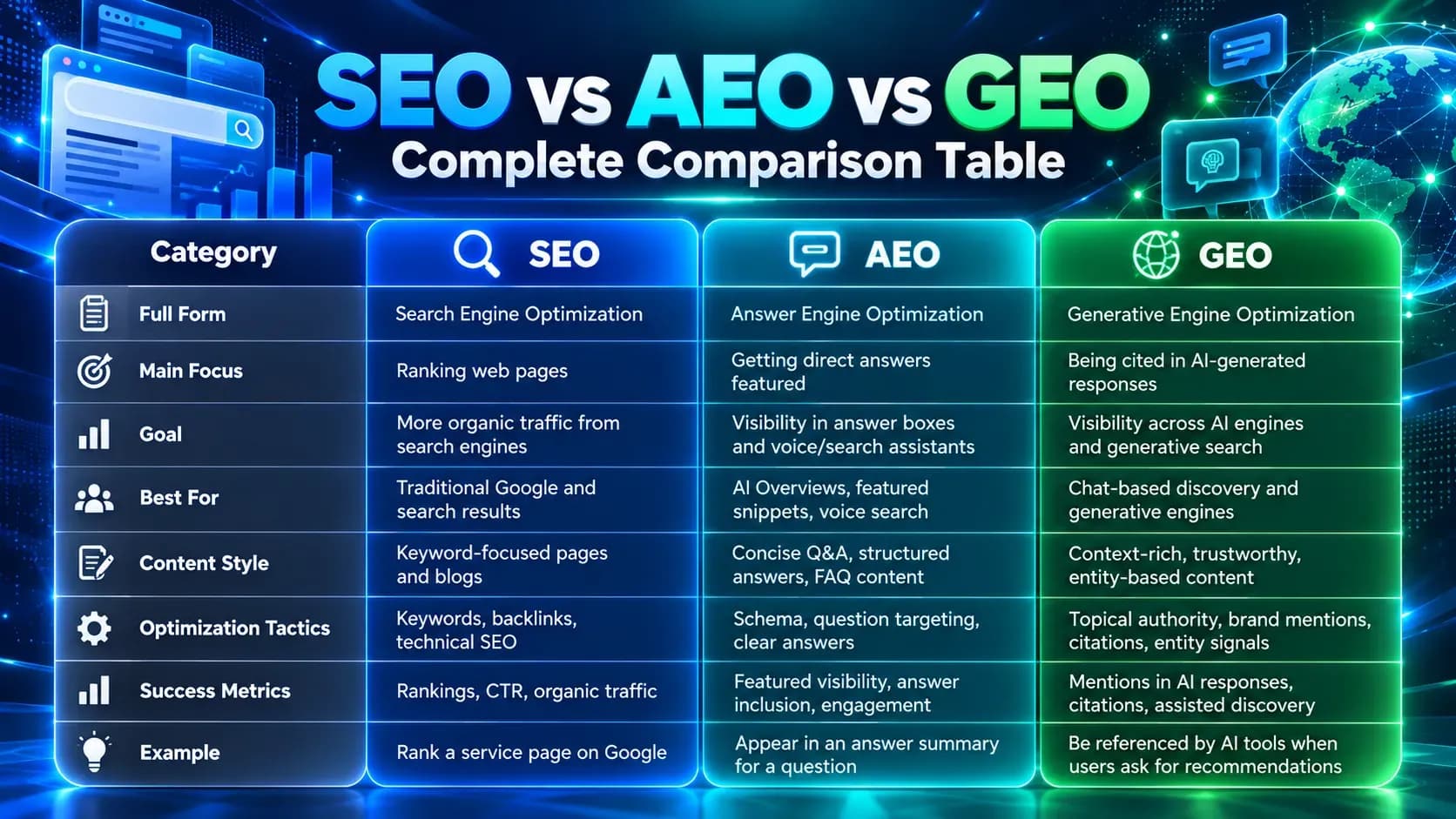
Although SEO, AEO, and GEO have different areas of emphasis, their underlying principles are closely connected.
Feature | SEO | AEO | GEO |
Full form | Search Engine Optimization | Answer Engine Optimization | Generative Engine Optimization |
Main focus | Organic search visibility | Direct-answer usefulness | Generative AI visibility |
Typical platforms | Google, Bing | Featured snippets, answer experiences, voice search | ChatGPT Search, AI Overviews, Copilot, Perplexity |
Content approach | Relevant, helpful webpages | Clear question-and-answer content | Original, credible, context-rich information |
User interaction | Search and explore results | Ask a question and receive an answer | Conversational research and generated responses |
Primary opportunity | Organic rankings and clicks | Answer visibility | AI mentions, citations, and referrals |
Measurement | Rankings, clicks, impressions, conversions | Relevant answer appearances and engagement | Citations, referrals, brand mentions, conversions |
Guaranteed results | No | No | No |
The most effective strategy is not choosing one method while ignoring the others.
It is building a website that serves users across multiple search experiences.
SEO vs AEO: What Is the Main Difference?
The main difference between SEO and AEO is their emphasis.
SEO focuses on making webpages discoverable and relevant in organic search results.
AEO focuses on presenting useful information in ways that answer specific questions effectively.
For example:
SEO-focused search: "Technical SEO services in India"
AEO-focused question: "Why is technical SEO important for my website?"
The first search may have commercial intent, while the second is informational.
Both can be addressed through a connected website strategy.
A strong service page can target commercial searches, while a detailed educational article answers common questions.
GEO vs SEO: How Are They Different?
SEO primarily measures visibility and performance in conventional search results.
GEO focuses on discoverability and potential references within generative AI experiences.
For example, a website might receive visits from Google organic search results.
The same website might also be cited in a ChatGPT Search response or a Microsoft Copilot answer.
These are different discovery experiences.
However, strong SEO fundamentals can support both.
Google's official guidance states that existing SEO best practices remain relevant to its generative AI search features.
Businesses should therefore improve foundational SEO before investing heavily in unverified AI optimization tactics.
AEO vs GEO: Are They the Same?
AEO and GEO are related, but marketers commonly use them to describe different emphases.
AEO is generally associated with making information useful for direct-answer experiences.
GEO focuses more specifically on visibility in responses generated by AI systems.
The distinction is not universally standardized.
For example, Google AI Overviews can be described as relevant to both AEO and GEO.
Rather than treating them as completely separate technical disciplines, businesses should focus on the shared fundamentals of accurate, accessible, helpful content.
SEO vs AEO vs GEO: Real-World Example
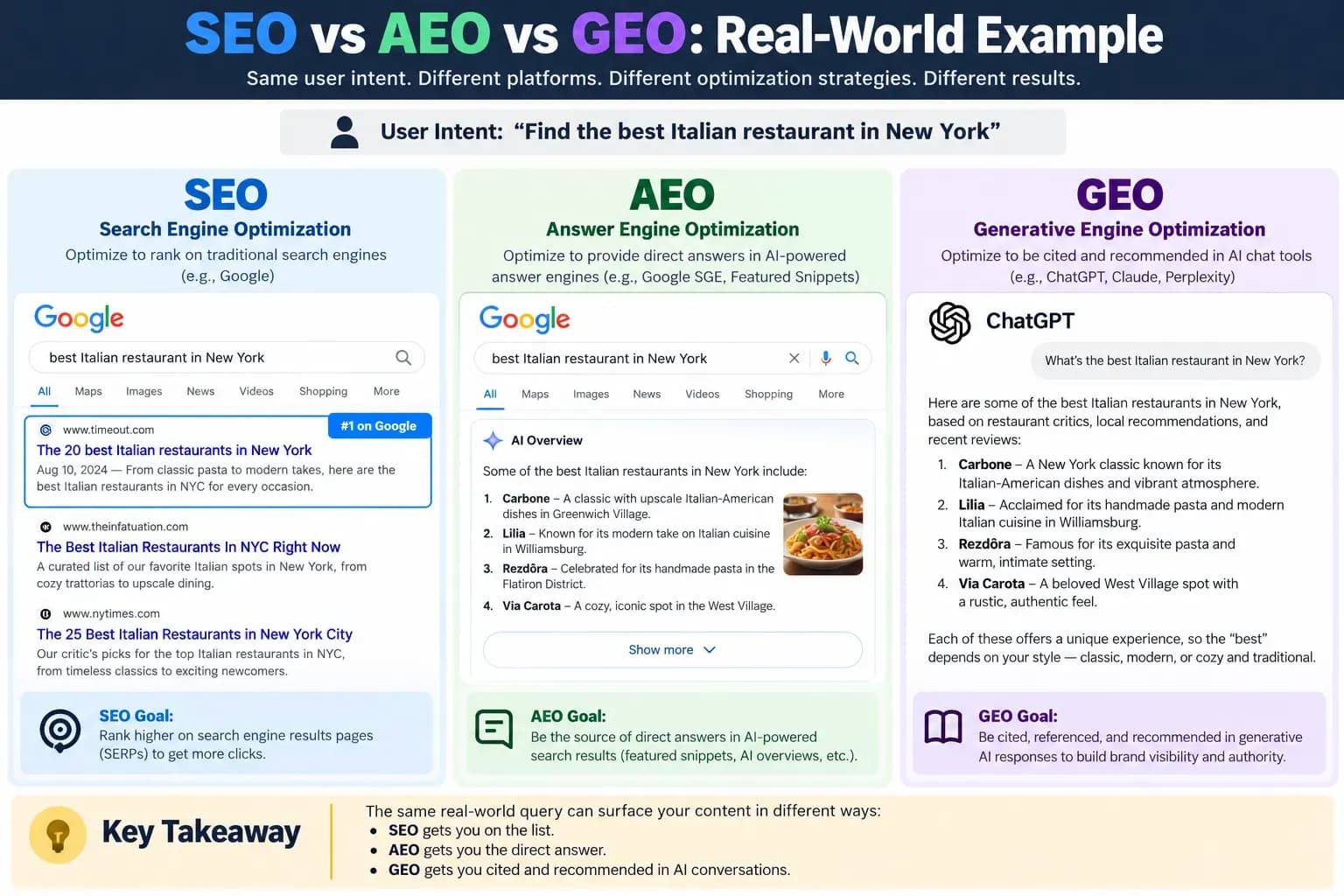
Imagine a business offering website development services in India.
It wants customers to discover its services through Google and AI-powered search tools.
Here is how the three approaches can work together.
SEO Example
The company creates a landing page targeting:
"Website Development Company in Delhi"
The page includes service descriptions, project examples, relevant headings, and clear contact information.
Its purpose is to attract users searching for website development services.
AEO Example
The company publishes an article answering:
"How much does it cost to build a business website in India?"
The article explains pricing factors such as design complexity, CMS selection, integrations, and maintenance.
It gives readers a clear explanation before discussing specific scenarios.
GEO Example
The company publishes an evidence-backed comparison:
"WordPress vs Next.js for Business Websites: Performance, Cost, and Maintenance"
The article explains both technologies, their limitations, and practical selection criteria.
It may be useful to people researching website technologies through AI-powered tools.
Together, these resources cover service discovery, direct questions, and broader AI-assisted research.
How to Combine SEO, AEO, and GEO: 8 Practical Strategies
Businesses do not necessarily need separate content teams for each approach.
A unified optimization strategy can support all three.
1. Build a Strong Technical SEO Foundation
Start with the basics.
Ensure your website has:
- Crawlable navigation.
- Indexable public webpages.
- Relevant canonical URLs.
- Mobile-friendly layouts.
- Fast and stable page experiences.
- Accessible content.
- A properly maintained XML sitemap.
Technical accessibility supports website discovery across search systems.
2. Research Keywords and Customer Questions
Traditional keyword research remains valuable.
However, also identify conversational questions.
For example:
Keyword: SEO cost in India
Question: How much should a small business spend on SEO every month?
Both searches relate to the same topic but may require different explanations.
Use Google Search Console, customer enquiries, keyword research tools, and relevant search results to identify useful content opportunities.
3. Create Helpful Content With Direct Answers
Begin important sections with clear explanations.
Follow those explanations with details, examples, and evidence.
Avoid writing excessively long introductions before answering the main question.
A useful content structure could include:
- Definition or direct answer.
- Explanation.
- Practical example.
- Comparison.
- Implementation steps.
- Common mistakes.
- Frequently asked questions.
The structure should match the topic rather than follow a rigid formula.
4. Publish Original Research and Real Examples
Original information can make your website more useful and distinctive.
Consider publishing:
- SEO case studies.
- Website performance comparisons.
- Original industry surveys.
- Tested optimization methods.
- Practical implementation experiences.
Explain the source of your data and avoid unsupported claims.
Originality matters more than simply producing a high number of articles.
5. Connect Related Topics Through Internal Links
Create logical content clusters around important subjects.
For example:
Pillar Page: AI Search Engine Optimization
Supporting Topics:
- SEO vs AEO vs GEO
- How to Rank in Google AI Overviews
- How to Rank in ChatGPT Search
- Technical SEO Checklist
- AI Search Content Optimization
- How to Measure AI Search Visibility
Internal links should guide visitors toward genuinely relevant information.
Avoid creating multiple articles that answer essentially the same question.
6. Strengthen Brand Credibility
Explain who created the content and why readers should trust the information.
Include:
- Accurate author details.
- Business information.
- Original case studies.
- Relevant experience.
- Trustworthy references.
- Clear contact details.
Keep business information consistent across the website and legitimate external profiles.
Avoid artificial brand mentions or manufactured reviews.
7. Optimize for People, Not AI Tricks
Some marketers promote shortcuts such as special AI keyword formulas, excessive keyword repetition, or guaranteed citation techniques.
These claims should be treated carefully.
Google's 2026 guidance emphasizes original, valuable content and foundational SEO instead of unnecessary AI-specific tricks.
Structured data can describe content, but it does not guarantee AI citations.
Focus on information that readers genuinely need.
8. Monitor Traditional and AI Search Performance
Use multiple measurement methods.
Google Search Console
Review clicks, impressions, queries, indexing, and search performance.
Google Analytics 4
Review organic sessions, referral visits, engagement, and conversions.
Bing Webmaster Tools
Use supported AI Performance reporting to analyze citation activity across Microsoft AI experiences.
AI Referral Analysis
Monitor visits from AI assistants when reliable referral information is available.
Remember that a citation is not the same as a website visit.
Track business outcomes alongside visibility.
Which Is Better: SEO, AEO, or GEO?
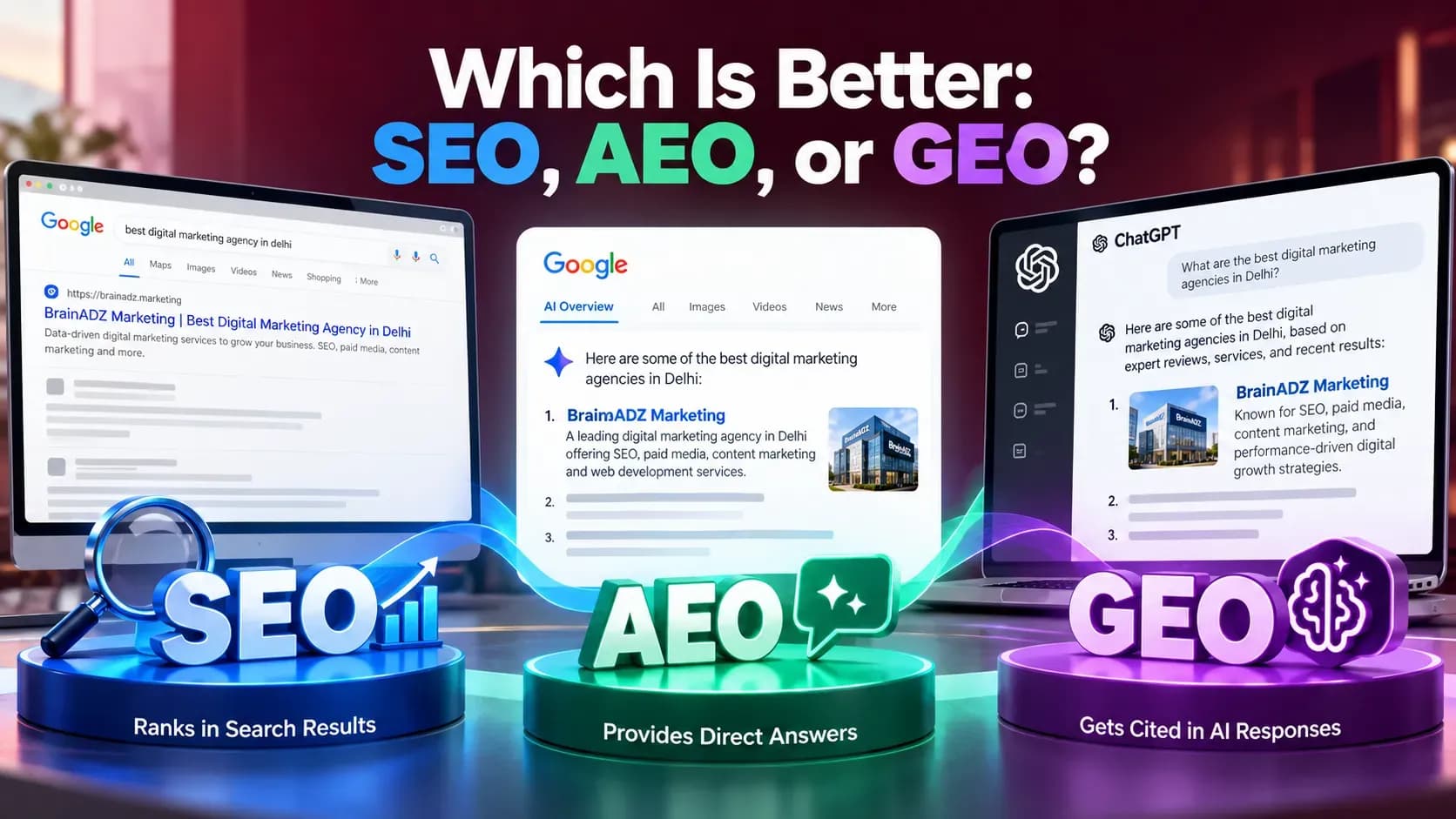
The best approach depends on your website's goals and current performance.
For New Websites
Prioritize SEO fundamentals first.
Create a clear website structure, useful pages, and technically accessible content.
Include relevant direct answers naturally.
For Established Websites
Continue improving SEO while expanding content coverage to answer audience questions.
Review existing pages before publishing similar new content.
For Service-Based Businesses
Combine commercial landing pages with educational articles, comparisons, and case studies.
This can support both organic lead generation and AI-assisted customer research.
For Ecommerce Websites
Focus on accurate product information, useful category pages, reviews, technical SEO, and detailed buying guides.
Provide specific information that helps customers make decisions.
For Content Publishers
Prioritize original expertise, factual accuracy, strong editorial standards, and useful topic coverage.
The recommendation is simple: start with SEO, incorporate AEO principles, and extend your visibility strategy toward GEO opportunities.
How to Measure SEO, AEO, and GEO Success in 2026
Different search experiences require different performance indicators.
Strategy | Useful Metrics | Tools |
SEO | Organic clicks, impressions, rankings, conversions | Google Search Console, GA4 |
AEO | Direct-answer appearances, relevant query performance, engagement | Search observation, GSC, GA4 |
GEO | AI citations, AI referrals, brand mentions, conversions | Bing AI Performance, GA4, AI visibility research |
No single tool measures every AI-generated answer across every platform.
For Google, use the relevant Search Console reporting available to your property.
For Microsoft AI experiences, Bing Webmaster Tools provides citation and grounding-query information through its AI Performance features.
Interpret these metrics carefully and avoid treating citations as equivalent to traffic.
The Future of SEO, AEO, and GEO in 2026 and Beyond
The future of SEO is not simply about replacing search engines with AI assistants.
People now discover information through multiple experiences.
Some prefer traditional search listings. Others use voice search, AI-generated summaries, or conversational tools.
This makes content relevance and trust increasingly important.
Businesses should prepare by improving technical SEO, publishing original information, and making their expertise understandable across formats.
Search platforms will continue evolving, and no single optimization method can guarantee visibility.
The most resilient strategy is one that remains useful regardless of how search results are displayed.
Common SEO, AEO, and GEO Mistakes to Avoid
1. Ignoring Traditional SEO
AI-powered search does not eliminate the need for search engine accessibility, relevant content, or a technically healthy website.
2. Targeting Too Many Keywords on One Page
Focus each page on a clear subject and search intent.
Include related terms naturally instead of forcing every keyword into the text.
3. Publishing Repetitive AI-Generated Content
Content without useful expertise, originality, or accurate information offers limited value to readers.
4. Expecting Guaranteed AI Citations
No reliable strategy guarantees that a website will be mentioned by ChatGPT, Gemini, or Google AI Overviews.
5. Creating Duplicate Search Intent
Publishing several pages with nearly identical information can create unnecessary competition between your own URLs.
6. Ignoring Conversion Tracking
Search visibility is useful, but businesses should also measure enquiries, leads, and revenue-related outcomes.
SEO, AEO, and GEO Optimization Checklist
Use this checklist when improving your website:
- Identify primary keywords and real customer questions.
- Match content to search intent.
- Resolve critical indexing and crawling problems.
- Create helpful content with clear explanations.
- Add useful examples and original insights.
- Structure headings logically.
- Implement relevant internal links.
- Maintain accurate author and business information.
- Add supported structured data where appropriate.
- Review crawler accessibility.
- Monitor organic performance.
- Track AI citations and referral traffic where available.
- Update outdated content when needed.
Conclusion: SEO, AEO, and GEO Work Better Together
SEO, AEO, and GEO are connected approaches to improving online discoverability.
SEO supports organic search visibility. AEO emphasizes clear answers to user questions. GEO focuses on opportunities to appear in generative AI-powered experiences.
Rather than choosing one and ignoring the others, businesses should build a unified strategy around technical SEO, high-quality content, search intent, original expertise, and reliable measurement.
At BrainADZ Marketing, we help businesses improve their online visibility through technical SEO, content strategy, organic search optimization, and AI search-focused marketing.
Whether you want to strengthen Google rankings, make your website more useful for answer-based searches, or explore generative AI visibility, the foundation is a clear, sustainable search strategy.
Explore BrainADZ Marketing's SEO services and start building a stronger digital presence.
References
- Google Search Central — AI Features and Your Website
- Google Search Central — Generative AI Optimization Guide
- Google Search Central — Helpful, Reliable, People-First Content
- Bing Webmaster Tools — AI Performance
- OpenAI — Overview of OpenAI Crawlers
Frequently Asked Questions About SEO vs AEO vs GEO
What is the main difference between SEO, AEO, and GEO?+
SEO improves organic search visibility, AEO focuses on direct-answer usefulness, and GEO focuses on visibility in generative AI experiences. All three overlap and benefit from accurate, helpful, accessible content.
Is AEO better than SEO?+
AEO is not a replacement for SEO. Search engine optimization provides the technical and content foundation, while answer-focused optimization helps address question-based searches.
Is GEO replacing traditional SEO?+
No. GEO expands the areas where businesses may seek visibility, but foundational SEO practices remain relevant to search and many AI-powered experiences.
Can SEO, AEO, and GEO work together?+
Yes. A website can use technical SEO, answer-focused content, original research, and trustworthy business information to serve multiple search experiences.
What is the difference between GEO and AI SEO?+
GEO generally refers to optimization for generative AI experiences. AI SEO is a broader industry term that may include both using AI in SEO workflows and improving visibility in AI-powered search.
Is structured data necessary for GEO?+
Structured data can help describe webpage information, but there is no universal GEO schema or guaranteed method for earning AI citations. Accurate content and accessibility remain essential.
Which is best for small businesses in India?+
Small businesses should generally begin with relevant SEO foundations, useful service pages, local search optimization where applicable, and content that answers customer questions. GEO can extend those efforts into AI search discovery.
How do I measure GEO performance?+
Track AI referral traffic, relevant brand mentions, citations reported by supported tools, and business conversions. Citation counts alone do not measure revenue or website visits.
Will SEO still be relevant after 2026?+
SEO remains relevant as long as search systems need to discover and evaluate content. Specific search experiences may change, but technical accessibility, useful information, and relevance continue to provide value.
Can a new website optimize for SEO, AEO, and GEO?+
Yes. A new website can build strong technical foundations, publish useful answers, and develop credible content from the beginning. However, rankings, citations, and traffic growth are not guaranteed.